
| Designation | Type | d bore | D outside | B width |
|---|---|---|---|---|
| 6204 | Deep groove ball | 20 | 47 | 14 |
| 7204 | Angular contact ball | 20 | 47 | 14 |
| 1204 | Self-aligning ball | 20 | 47 | 14 |
| 51104 | Thrust ball | 20 | 35 | 10 |
| NU204 | Cylindrical roller | 20 | 47 | 14 |
| 30204 | Tapered roller | 20 | 47 | 15.25 |
| 22205 | Spherical roller | 25 | 52 | 18 |
| HK2012 | Needle roller | 20 | 26 | 12 |
| UC204 | Pillow block insert | 20 | 47 | 31 |
Nominal ISO boundary dimensions for reference. Confirm against your drawing and the supplier datasheet.
The idea behind a rolling bearing
Sliding one surface over another creates friction that grows with load. A rolling bearing replaces sliding with rolling: hardened elements sit between two rings, so the contact moves instead of dragging. That cuts friction by a large factor, allows higher speed, and keeps the shaft located to a tight tolerance. The price is that contact stress between element and raceway is very high, concentrated in small areas. Fatigue of that thin contact zone, not simple wear, is what normally ends the life of a properly lubricated, properly mounted bearing.
Anything from a household fan to a mine hoist uses the same principle. The differences between bearing types are how the elements are shaped and how the raceways are cut, which decide the load direction each can carry.
The four parts
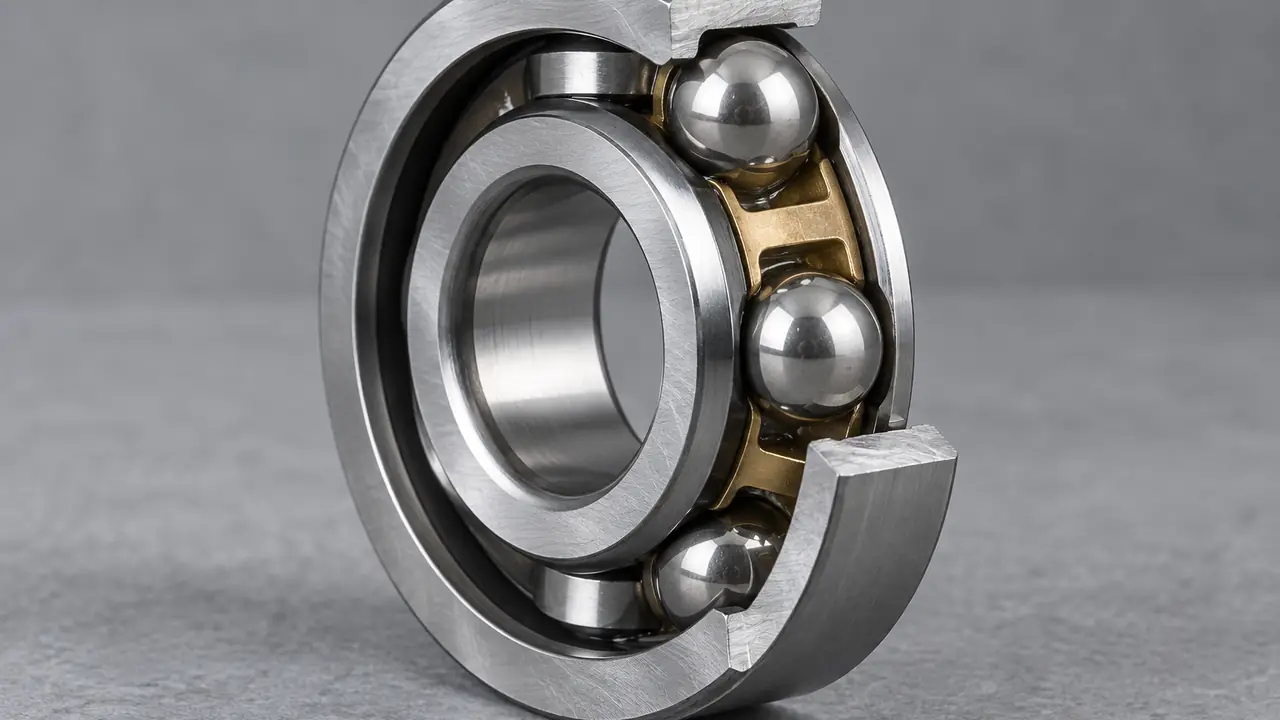
- Inner ring. Fits on the shaft, or on a sleeve. It carries the inner raceway and is usually the rotating ring.
- Outer ring. Fits in the housing, carries the outer raceway, and is usually stationary.
- Rolling elements. Balls or rollers that carry the load between the raceways. Shape and count decide capacity. Material is typically high-carbon chromium bearing steel; see bearing steel.
- Cage. Separates the elements, spaces them evenly and guides them. Options include pressed steel, machined brass and glass-fibre reinforced nylon. See bearing cages.
Many bearings also carry shields or seals, and grease filled at the plant. Those are options on the standard parts above, covered under seals and lubrication.
Families and what each is for
| Family | Element | Main load | Typical reason to choose it |
|---|---|---|---|
| Deep groove ball | Ball | Radial, moderate axial both ways | General duty, quiet, low maintenance |
| Angular contact ball | Ball | Radial plus axial one way | Combined load, rigidity, spindles |
| Self-aligning ball | Ball | Radial, tolerates tilt | Shaft deflection, hard-to-align housings |
| Thrust ball | Ball | Axial only | Axial load at low to moderate speed |
| Cylindrical roller | Cylinder | High radial | Heavy radial load, free axial movement in NU types |
| Tapered roller | Cone | Radial plus axial one way | Hubs, gearboxes, adjustable preload |
| Spherical roller | Barrel | Heavy radial, some axial, tolerates tilt | Mining, paper, vibrating screens |
| Needle roller | Long thin roller | Radial, compact section | Tight radial space |
A simple rule of thumb: balls give point contact, rollers give line contact. Line contact carries more load at the same size; point contact runs faster and with lower friction.
Load direction and arrangement
Load direction is the first selection filter. Radial load acts across the shaft; axial load acts along it; most real machines have both. A single deep groove bearing handles a bit of each. Where axial load is large and one-directional, a tapered roller or angular contact bearing is used, usually in a pair that faces opposite ways. A common layout is a locating bearing at one end of the shaft, which fixes the axial position, and a non-locating bearing at the other end, which accepts thermal growth. NU-type cylindrical roller bearings and floating deep groove bearings often serve as the non-locating end. Misalignment between shaft and housing points to self-aligning ball or spherical roller types.
Life: what ISO 281 actually says
ISO 281 defines basic rating life, L10, as the life reached or exceeded by 90 percent of a large group of identical bearings under the same conditions before fatigue appears. It is a statistical measure, not a promise for one bearing, and it assumes correct mounting, lubrication and cleanliness. Static load rating under ISO 76 covers the case where the bearing hardly turns. The numbers come from the supplier datasheet for each designation; this page does not give generic values because they differ by plant and design. In practice the most common causes of early failure are contamination, poor lubrication, wrong fit and misalignment. See C3 clearance explained for the fit and clearance side.
How to specify one for sourcing
- State load direction, magnitude range and any shock.
- State speed, temperature and the environment (dust, water, chemicals).
- Choose the family from the table, then the series from the space available.
- Write the full designation with suffixes - see the designation guide.
- Add tolerance class and clearance group from tolerance and clearance.
- State marking, packing and quantity, then send through the quote form.
Rolvane coordinates partner plants for all these families. Typical reference ranges: 100-500 pieces per standard designation, samples in 3-7 working days from stock, batch production in 25-45 days, all confirmed in writing for each program.