
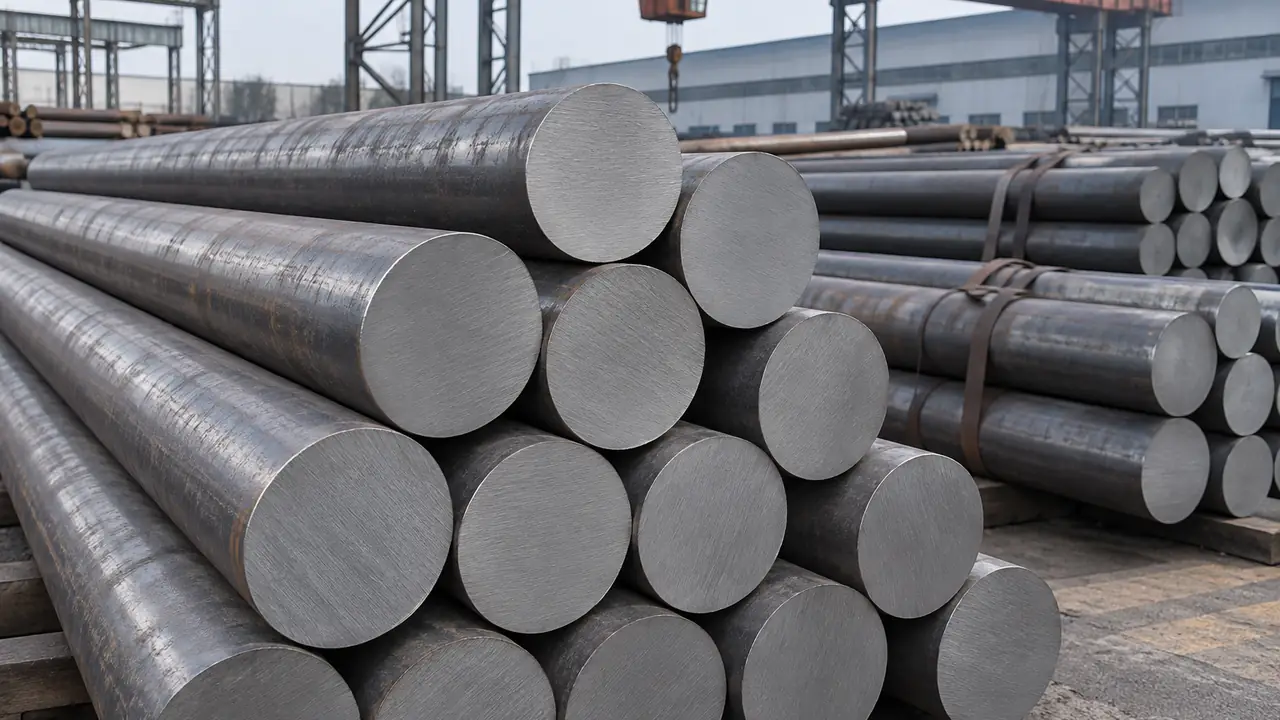
What makes a steel a bearing steel
Rolling bearing raceways carry very high contact stress in a very small area, repeated millions of times. Ordinary structural steel cannot do this; it deforms or pits early. Bearing steel is built for the job: high carbon content for hardness, chromium for hardenability, and a controlled, clean structure so that there are few weak points inside the metal.
The workhorse is high-carbon chromium steel. In Chinese standards it is called GCr15; the closest widely used equivalents are AISI 52100 in the United States and 100Cr6 in Europe. Chemical ranges differ slightly between standards, so the correct statement is comparable rather than identical, and the exact standard is stated on the order. It is used for the great majority of rings, balls and rollers in general machinery, motors and vehicles.
Steel families and where they are used
| Family | Examples | Where it fits |
|---|---|---|
| High-carbon chromium, through-hardened | GCr15, 52100, 100Cr6 | Standard rings, balls and rollers for general use |
| Larger-section chromium steel | Grades with added manganese or silicon for hardenability | Thick rings and large bearings |
| Carburizing (case-hardening) | Low-carbon alloy steels carburized after machining | Shock loads, tapered roller bearings, wear-resistant series |
| Martensitic stainless | 440C | Corrosion exposure, food and marine use |
Carburizing steels start with low carbon and a tough core. After machining, carbon is diffused into the surface and the part is hardened, giving a hard case over a tougher core. This helps in impact and heavy-load service and is common for tapered roller bearings. Stainless bearing steel 440C trades some fatigue life for corrosion resistance; see stainless steel bearings and wear-resistant bearings.
Cleanliness and inclusions
Every steel contains tiny non-metallic particles called inclusions - oxides, sulphides, silicates - left from steelmaking. Under cyclic contact stress, a hard inclusion near the raceway can start a fatigue crack. Bearing steel is therefore refined, vacuum-degassed and cast with care to keep inclusions small, few and well dispersed. This is what buyers mean by cleanliness or steel quality.
Cleanliness is checked by metallographic rating methods and oxygen content measurements at the mill. The test method and acceptance level are agreed between buyer and supplier, and the desk does not quote a figure without the mill report. In practice two bearings with the same designation and the same nominal hardness can have very different life, and steel cleanliness is one of the first things to look at when they do.
Heat treatment and hardness
Hardness is produced by heat treatment, not by the steel alone. A through-hardened chrome steel part is heated, quenched and then tempered. Hardness for through-hardened chrome steel rings and balls is typically about 58-65 HRC; the exact target and range depend on the part, the size and the bearing type and are set by the plant's drawing and standard. Tempering also stabilises the dimensions so the bearing does not change size in service at normal temperatures.
- Quenching and tempering set hardness and toughness; deviations show up as soft spots or brittle parts.
- Dimensional stabilisation matters for bearings that run warm, and for precision classes.
- Microstructure checks on a sectioned sample confirm even hardening and carbide distribution.
Hardness is checked on finished parts by sampling, as part of the plan described on testing and inspection.
Material certificates and traceability
A mill certificate lists the grade, the chemical composition and the heat number of the steel lot, often with notes on cleanliness. A heat lot number lets a finished lot of rings or balls be traced to the steel it was made from. Typical documents the desk can request per order are:
- Mill certificate for the steel, showing grade and chemistry against the stated standard.
- Heat treatment record for the finished lot.
- Hardness and dimensional inspection report from the plant.
- Material declarations such as RoHS or REACH where the project requires them.
Documents are agreed before the order and confirmed in writing; they should be matched to the delivered lot, not accepted as a general statement.
Sourcing notes
Steel is bought in the form needed for the part: bars and tubes for rings, wire rod for balls and rollers. Plants in the main bearing clusters buy from steel mills close to them; the desk matches steel source and plant to the part and the quality level required, rather than to price alone. Typical reference ranges for component volumes and lead times are on the MOQ and lead time page. To see how steel becomes a ring, read bearing rings, or return to the components hub.