
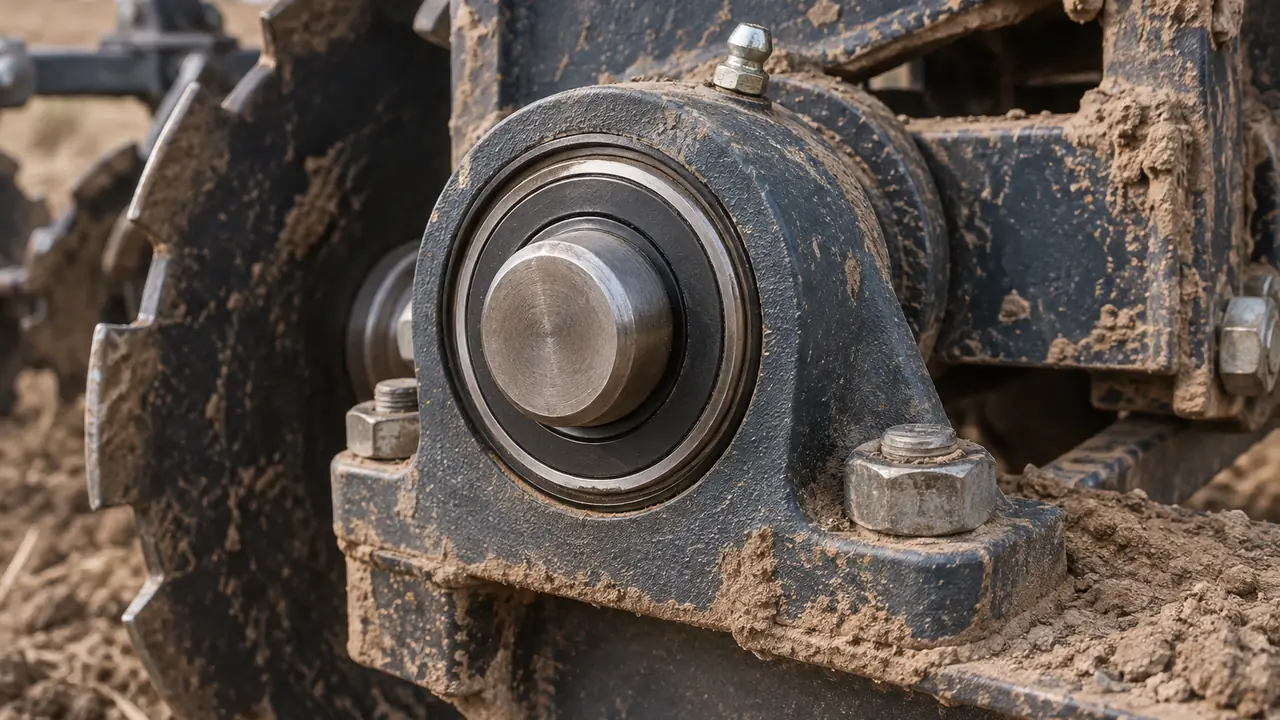
Why bearings wear out in dirty duty
A standard bearing is designed for clean, lubricated rolling. In a harvester, a mining conveyor or an excavator pivot, abrasive dust and mud get into the raceways, and a few grains of grit can start surface damage that spreads into early spalling. Water spray rusts the raceways and washes out grease. Shock loads dent the contact surfaces. In these sites the cause of failure is usually the environment, not the load rating, so the fix is in the sealing, the steel and the maintenance routine rather than in a bigger bearing.
A wear-resistant bearing is therefore not one product. It is a standard design with a package of upgrades chosen for the duty, and the desk specifies and checks them with the partner plants.
Sealing: the first line of defence
| Sealing option | How it protects | Trade-off |
|---|---|---|
| Standard 2RS contact seal | Single rubber lip against the inner ring | Adequate for light dust; limited against mud |
| Multi-lip seal | Two or more lips in series, with grease between them | Better protection; more friction and heat |
| Flinger (slinger) seal | A rotating ring throws out dirt before it reaches the lip | Works well on outdoor shafts; adds width |
| Labyrinth or cover | Non-contact path blocks particles | Needs housing design; suits larger units |
Seal material also matters. NBR is the common choice for general temperature ranges; FKM is used where heat or chemicals are present. See bearing seals for more detail. For agriculture-oriented ranges, look at pillow block bearings with triple-lip seals and at the agriculture and conveyor page.
Steel and heat treatment
Standard bearings use high-carbon chromium steel, GCr15, comparable to AISI 52100 and 100Cr6, through-hardened. For shock-loaded duty, carburized (case-hardened) steel is an alternative: a hard surface case over a tougher core, which resists denting and crack propagation. Special heat treatment can improve dimensional stability at elevated temperatures; and for rolling elements in contaminated lubricant, a cleaner steel with good raceway finish extends life under dirty running. Which option fits depends on the load pattern, the temperature and the size, so describe the duty to the desk rather than asking for a name. Material references are on the bearing steel page.
Clearance, cage and grease
- Clearance. Dirty duty often runs warm, and thermal growth uses up clearance, so C3 is common. See tolerance and clearance.
- Cage. A pressed steel or machined brass cage withstands shock and vibration better than nylon, which has a temperature ceiling.
- Grease. A heavy-duty grease with EP additives and good water resistance, filled generously so that fresh grease purges the seals. See bearing grease.
Relubrication as part of the specification
Even the best seal leaks over time. The most economical protection is regular relubrication that pushes old grease and grit out through the seal before damage starts. Specify a grease fitting on housed units, state the interval in the machine manual, and train the operator to pump slowly while the shaft turns. For a practical method see the relubrication intervals article and the lubrication guide.
Mounting and handling in the field
Good sealing can be undone at assembly. Keep new bearings in their wrapping until the moment of fitting, wipe the shaft and housing, and press only on the ring being fitted so that force does not pass through the balls. Check that the seal lips are not folded back, fill the housing cavity with the specified grease where the design calls for it, and protect the exposed seal face during cleaning, because a high-pressure jet aimed at a lip can force water past it. On equipment that stands idle between seasons, turn the shaft occasionally and regrease before restart, as static water and dust sitting in the lip can corrode the contact line.
When a bearing fails early, keep it and look at the damage: dull, scratched raceways point to abrasives, rust to water, and dents to shock. That evidence guides the next specification, and the desk can use it to adjust the seal, clearance or steel on the following lot.
Where they are used
Typical sites are combine harvesters, tillage tools, balers, mining conveyors and idlers, crushers, screens, excavator and loader pivots, concrete mixers and quarry equipment. Housed units are common on conveyors and farm machinery; for pivots that swing under shock, see spherical plain bearings. Case-style programs for these buyers are summarised in illustrative case studies.
Inspection and ordering
For wear-resistant lots the agreed checks cover dimensions against the ordered tolerance, radial clearance, seal fit and lip condition, cage type, hardness on a sample and grease type and fill. Typical quantities start around 100-500 pieces per designation, and customised sealing or steel is assessed from the drawing. Stock samples ship in 3-7 working days; batch production commonly takes 25-45 days, as typical reference ranges confirmed in writing. Send the duty, designation and quantity through the quote form. More lines on the specialty bearings hub.