
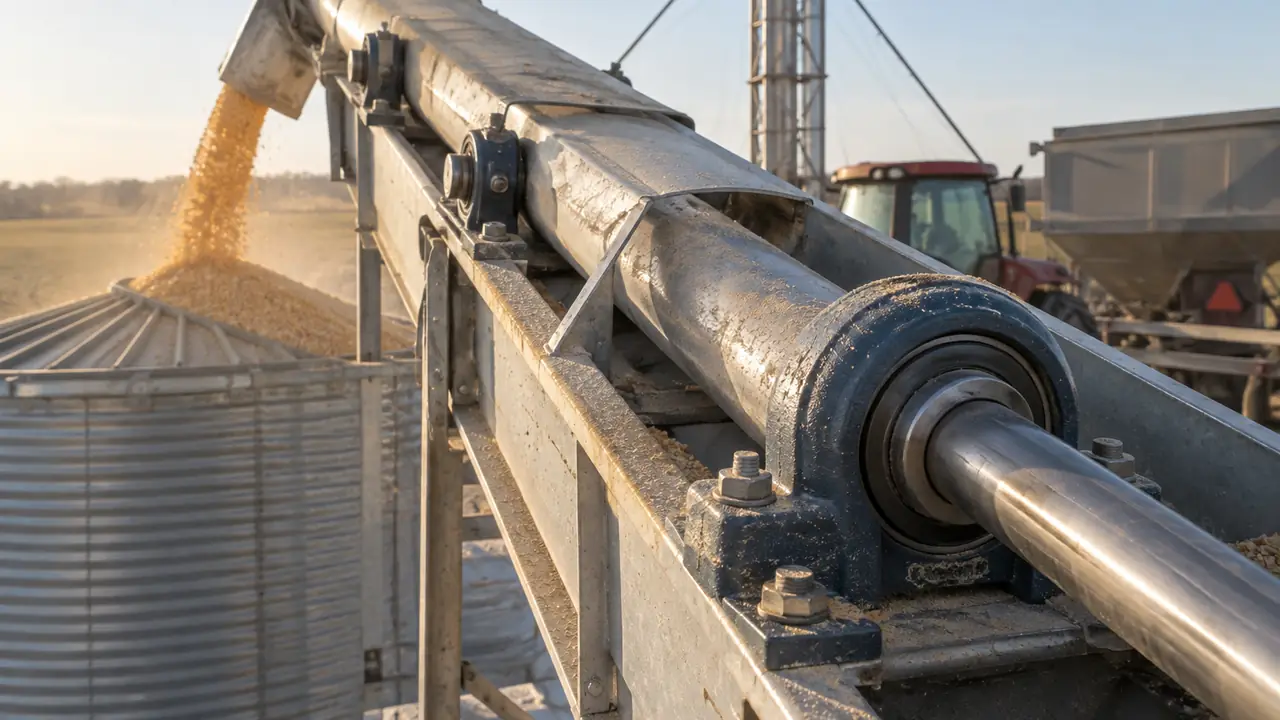
Why bearings fail in the field
A seeder, a combine header or a belt conveyor works in mud, dust, fibre and water. Bearings in those places seldom wear out from rolling fatigue. The usual cause is contamination: abrasive dust passes the seal, mixes with grease and scores the raceway, or water enters and corrodes the surface. A second cause is misalignment, because long shafts bend and frames flex under load, so a rigid bearing sees edge loading it was never designed for. The program therefore starts from the environment, not from the bearing list.
Rolvane is a sourcing desk. It does not manufacture; it shortlists partner plants and arranges inspection and shipping. For agriculture and conveyors the shortlist favours plants with experience in housed units and sealed designs rather than only plain ball bearings.
Pillow block units
The pillow block unit is the workhorse. It combines an insert bearing with a spherical outside surface and a housing whose seat is also spherical, so the bearing can tilt a little during installation and tolerate small misalignment. Housings come in several forms, and the common ones are UCP (pedestal), UCF (square flange) and UCFL (oval flange). The insert is held on the shaft by set screws or an eccentric collar. For rough duty, ductile iron housings resist impact better than basic grey cast iron, and the choice should be stated on the request.
| Unit | Typical machine | Main concern |
|---|---|---|
| UCP pedestal | Belt and screw conveyors, mixers, fans | Base alignment, set screw loosening |
| UCF and UCFL flange | Planters, feed equipment, drives | Flange flatness, bolt pattern match |
| Insert bearing only | Repair and replacement | Seal type, shaft size, locking method |
| Idler roller bearing | Belt conveyor idlers | Seal protection, low friction, long grease life |
| Harrow-type bearing | Disc harrow gangs | Heavy contamination and impact |
Wear-resistant seals and options
The seal decides how long the bearing lasts in dirt. Standard rubber contact seals are adequate in light duty. For heavy contamination the options include double lip seals, an additional outer shield or slinger, labyrinth arrangements and thicker sealing materials. NBR is the usual rubber; FKM is chosen for heat or chemical exposure. Grease also matters: a full fill with water-resistant grease is typical, and a re-greasing nipple in the housing allows fresh grease to push contaminants outward. See bearing seals and wear-resistant bearings for the surface treatments and cages available for harsh duty.
These measures add friction and heat, so they should be matched to the speed. Agricultural shafts are mostly slow, which is why heavy sealing works well there.
Conveyor idler bearings
A belt conveyor can carry hundreds or thousands of idler rolls, and each has a small deep groove ball bearing at either end. Failures are costly because of the downtime and the sheer number of parts. Idler bearings are therefore bought in large quantities with a tight definition: the bearing designation, seal arrangement, grease fill and noise level. Consistency between lots matters more than peak performance, so the desk agrees a lot inspection plan covering dimensions, clearance, seal torque and grease appearance. See deep groove ball bearings.
Disc harrow and similar bearings
Disc harrow gangs work in soil with heavy shock and abrasive contamination. Designs for this use are generally unlike the standard catalogue range: multiple seals, special housings and sometimes sleeves. Because they are application-specific, the desk works from a drawing or a sample part and asks the plant for first article samples before any lot is made. This is a concept-level description, and each design is confirmed in writing with the plant.
Inspection for rough-duty parts
Besides the usual dimension and clearance checks, the plan for housed units adds items that matter in the field: seat fit between insert and housing, free tilt of the insert, set screw or collar function, casting surface and paint, grease fill and appearance of the seals. A sample unit can be opened to check the grease and the seal lip. The report goes out with the lot, and photographs of packaging are available on request.
Ordering notes
Typical reference ranges: 100-500 pieces per standard designation, 25-45 days for batch production and 45-75 days for non-standard housings or tooling. Sea freight to the US west coast is typically 15-25 days and to Europe 30-45 days. All are confirmed in writing for each program. Housings are heavy, so the desk plans pallet loads and checks packaging for cast parts; see packaging and anti-rust. Send shaft sizes, housing type and the operating conditions through the quote form.