
| Designation | Type | d bore | D outside | B width |
|---|---|---|---|---|
| 6200 | Deep groove ball | 10 | 30 | 9 |
| 6201 | Deep groove ball | 12 | 32 | 10 |
| 6202 | Deep groove ball | 15 | 35 | 11 |
| 6203 | Deep groove ball | 17 | 40 | 12 |
| 6204 | Deep groove ball | 20 | 47 | 14 |
| 6205 | Deep groove ball | 25 | 52 | 15 |
| 6206 | Deep groove ball | 30 | 62 | 16 |
| 6207 | Deep groove ball | 35 | 72 | 17 |
| 6208 | Deep groove ball | 40 | 80 | 18 |
| 6300 | Deep groove ball | 10 | 35 | 11 |
| 6305 | Deep groove ball | 25 | 62 | 17 |
| 6000 | Deep groove ball | 10 | 26 | 8 |
| 6005 | Deep groove ball | 25 | 47 | 12 |
Nominal ISO boundary dimensions for reference. Confirm against your drawing and the supplier datasheet.
What a deep groove ball bearing does
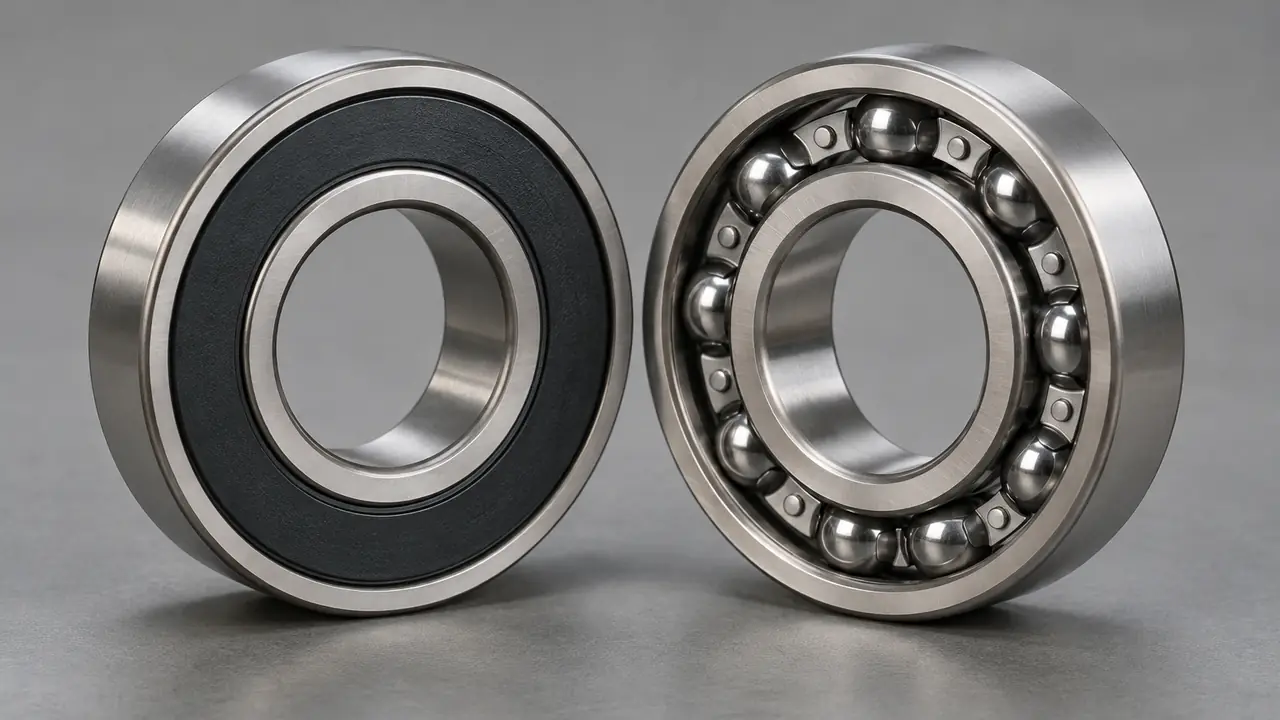
A deep groove ball bearing has an inner ring, an outer ring, a single row of steel balls and a cage that keeps the balls evenly spaced. The raceway grooves are deep relative to the ball diameter, which is what lets the bearing take axial load in both directions as well as radial load. It runs quietly at high speed, needs little maintenance when sealed, and is the default choice for electric motors, pumps, fans, gearboxes, household appliances and conveyor idlers.
Because the boundary dimensions are standardised under ISO 15, a 6204 from one qualified plant fits the same shaft and housing as a 6204 from another: bore 20 mm, outside diameter 47 mm, width 14 mm. What changes between suppliers is not the size but the details that decide service life - steel cleanliness, raceway finish, internal clearance, cage design, seal material and grease. Those details are what the desk specifies and checks.
Series and how to read them
The first digits of the designation give the type and dimension series; the last two give the bore. For bore codes 04 and above, multiply by five: 6205 has a 25 mm bore, 6310 a 50 mm bore. Codes 00 to 03 are fixed at 10, 12, 15 and 17 mm. The full logic is in the designation guide.
| Series | Section | Typical use |
|---|---|---|
| 68, 69 | Thin section, light load | Compact housings, robotics, instruments |
| 60 | Extra light | Fans, small motors, where space is tight |
| 62 | Light, the most common | Motors, pumps, gearboxes, appliances |
| 63 | Medium, larger balls | Higher radial load at the same bore |
The same bore can come in several series. A 6205, 6305 and 6905 all fit a 25 mm shaft but need different housings and carry different loads. When a replacement is needed and only the shaft size is known, measure the outside diameter and width as well - how to measure a bearing walks through it.
Options worth specifying
Most quoting mistakes come from leaving suffixes unstated. These are the options a plant will ask about:
- Seals and shields. ZZ metal shields keep out larger particles with almost no friction; 2RS contact rubber seals keep out dust and splash water but add drag and limit speed. Open bearings suit oil-lubricated gearboxes. See 2RS vs ZZ.
- Internal clearance. Normal (CN) suits most fits; C3 is common for electric motors and any shaft that runs warm or uses a tight interference fit. Read tolerance and clearance.
- Tolerance class. P0 (ISO Normal) covers general machinery; P6 and P5 are specified for quieter motors and machine tools.
- Cage. Pressed steel is standard; glass-fibre reinforced nylon runs quieter within its temperature limit; machined brass suits larger sizes and vibration.
- Grease and fill. Lithium-based grease at a standard fill is the default; high-temperature, low-noise or food-grade H1 grease can be requested.
- Material. High-carbon chromium steel GCr15 (comparable to AISI 52100 and 100Cr6) is standard; stainless and hybrid ceramic versions exist for corrosion or electrical insulation.
Where they are made
Small and medium deep groove ball bearings are a speciality of eastern Zhejiang, where clusters around Cixi and Ningbo produce in large volumes, with Jiangsu and Shandong plants covering further ranges. Steel balls, cages and seals often come from specialist makers in the Liaocheng area of Shandong. The desk shortlists plants according to the tolerance class and vibration grade you need rather than price alone - a plant tuned for P0 appliance bearings is not automatically the right choice for P6 motor bearings. More on the clusters.
Inspection before shipment
For each lot the inspection plan is agreed in advance. Typical checkpoints for deep groove ball bearings:
- Bore, outside diameter and width against the ordered tolerance class.
- Radial internal clearance against the ordered group (CN, C3 and so on).
- Vibration or noise level on a test rig against the grade agreed for the program.
- Rotation by hand for smoothness, then seal fit and grease appearance on an opened sample.
- Marking, packaging and anti-rust protection against the approved sample.
The report goes out with the lot. Details on testing and inspection.
Ordering notes
Standard catalogue sizes typically start from 100-500 pieces per designation; private-label marking and boxes usually start around 1,000-5,000 pieces per designation; non-standard sizes are assessed from the drawing. Stock samples ship in 3-7 working days and batch production commonly takes 25-45 days. All of these are typical reference ranges, confirmed in writing for each program. Send the designations and quantities through the quote form.