
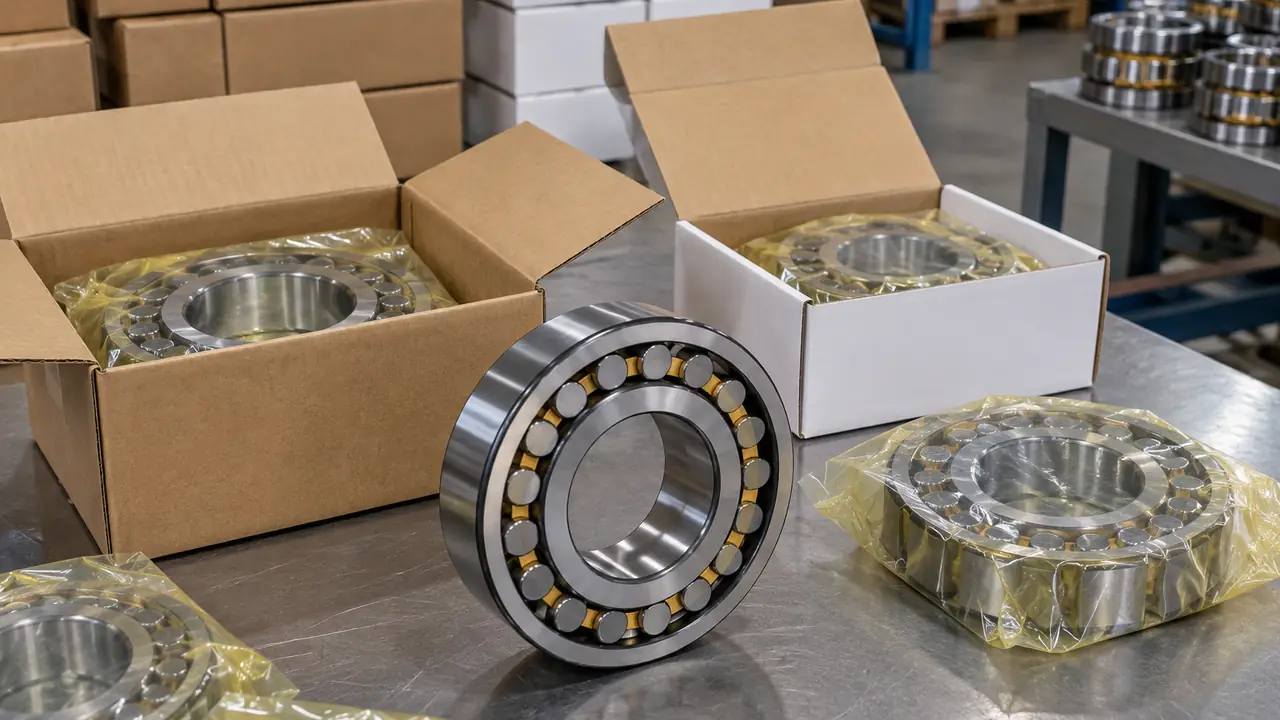
What OEM and private label mean here
Many equipment makers and distributors do not want a bearing that carries the name of the plant that made it. They want their own part number on the ring, their own logo on the box and a label that fits their warehouse system. Rolvane is a sourcing desk, so the work is coordination: the desk selects a partner bearing plant able to mark and pack to your specification, agrees the proof with you, checks the first articles and organises the shipment. The plant does the marking; you approve every detail beforehand.
Private label covers three layers that can be combined or ordered separately: the marking on the bearing itself, the inner pack that touches the bearing, and the outer packaging and labels used for storage and shipping. Each layer has its own quantity threshold and its own approval step.
Marking on the rings
Two marking methods are common. Laser marking burns a shallow, permanent mark into the ring face without pressure on the part, and it handles small characters, logos and data codes cleanly. Etched or engraved marking is used where the plant already runs that process. Both are applied to the ring face after grinding, so they do not alter raceways. Typical content on a ring:
- Your designation or customer part number, with or without the standard designation beside it.
- Your logo or brand word, within the space available on the face.
- A batch or date code, which makes traceability simple when a lot has to be located later.
- Country of origin text where the destination market requires it.
Space is the real limit. A thin-section 6800 series ring offers far less face area than a 6310, and miniature rings may take only a short code. The proof shows the actual layout on the actual size, which is why the proof step cannot be skipped. Standard suffixes such as 2RS, ZZ or C3 normally stay on the ring unless you decide to replace them with your own code; see the designation guide for what each suffix means so nothing important is lost.
Packaging and labels
Packaging choices run from simple to fully branded. The table shows the usual options and what they suit.
| Option | What it is | Suits |
|---|---|---|
| Branded individual box | Printed carton or colour box per bearing | Retail and counter sales, MRO catalogues |
| Plain box with your label | Neutral box, printed label with code and barcode | Distributors who want low set-up cost |
| Tube or sleeve pack | Plastic or paper tube holding several bearings | Small bearings, automated assembly lines |
| Industrial bulk pack | Oiled paper or VCI bag in an inner carton | OEM lines that unpack in volume |
| Master carton label | Outer label with part number, quantity, batch | All programs |
Label content is agreed in writing: designation, quantity, batch code, barcode format, origin line and any language the destination requires. Artwork is supplied by you or prepared from your brand files, then proofed. Protective materials inside the box are covered separately on the packaging and anti-rust page.
Proof and approval steps
- You send the designation list, the marking text or artwork and the packaging requirement.
- The desk returns a marking proof showing position, size and content on each ring size, plus the box and label artwork.
- You approve or correct the proof in writing. Nothing is produced before approval.
- A first-article sample is marked and packed, then photographed and, if you wish, shipped to you.
- After sign-off the batch runs, and the final inspection includes a check of marking and labels against the approved sample.
A change after approval, such as a new logo version or a different barcode, is treated as a revision and may affect timing and minimum quantity.
What cannot be marked
The desk does not apply third-party bearing brand marks, or any mark that implies a bearing was made by a company other than the one that made it. It also does not copy protected logos, and it does not use wording that suggests a brand origin the part does not have. If you own a trade mark, you will be asked to confirm that you are entitled to use it on the product and in the destination market. Certification marks are different again: a plant certificate such as ISO 9001 or IATF 16949 belongs to that plant and is verified per project, and it is not printed on a bearing as if it were a product certification.
Typical quantities and timing
As reference ranges, standard unmarked catalogue sizes commonly start at 100-500 pieces per designation. Laser marking and printed boxes usually start at around 1,000-5,000 pieces per designation, because set-up, artwork and packaging runs have a fixed cost spread over the lot. Custom samples with your marking typically take 15-30 days, and a regular batch commonly runs 25-45 days after approval. These are typical ranges only, confirmed in writing for each program. For the full picture see MOQ and lead time, and read bearing MOQ and OEM explained for the reasoning behind the thresholds.