
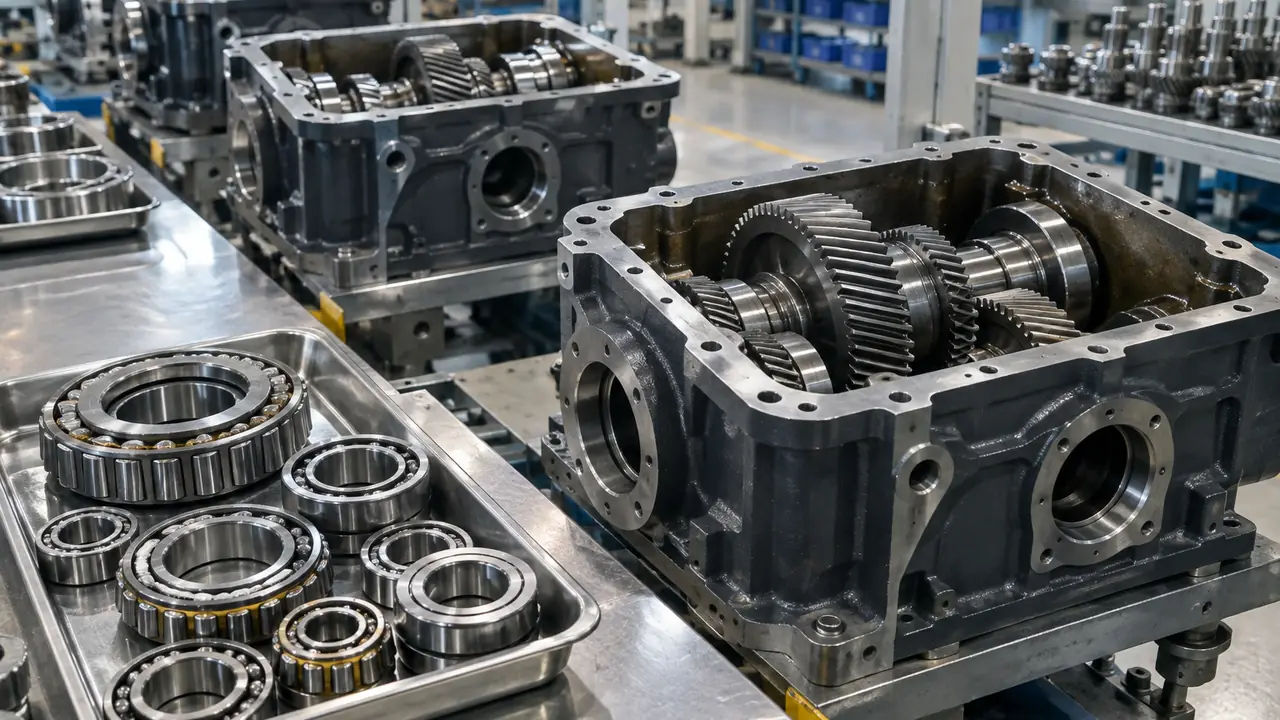
What an equipment maker needs from a bearing source
An equipment maker rarely buys a bearing once. The part is designed into a gearbox, a spindle or a drive, then ordered every quarter for years. The risks are therefore different from a one-off purchase: a change in steel supplier, heat treatment or cage design that nobody announced, a drift in clearance between lots, or a plant that cannot repeat a special fit. The program is built around those risks.
The desk does not manufacture. It shortlists partner plants whose equipment and experience match the tolerance class, material and quantity of your part, agrees the checks with you, and keeps the paperwork in order. Parts range from catalogue designations with specific suffixes to drawing-based variants with modified widths, special seals or particular materials.
From drawing to approved part
- Drawing and specification review. The desk checks the drawing for completeness: boundary dimensions to ISO 15, tolerance class under ISO 492, internal clearance group, material, heat treatment, cage, seal, grease, marking. Missing items are asked before a plant is approached.
- Plant shortlist. One to three partner plants are selected. A plant is judged on the closest comparable part it already makes, not on a general catalogue.
- Samples and first article inspection. The first sample set is measured against the drawing and compared with the agreed checkpoints. The report is sent to you with the samples.
- Approval and freeze. After you approve, the specification, marking and packing are frozen and referred to in every later order.
- Batch production and lot inspection. Each lot is checked against the same plan and the record is attached to the shipment.
What can be documented
| Document | What it contains | When |
|---|---|---|
| First article report | Measured dimensions, clearance, hardness, visual and rotation checks against the drawing | With the approved sample set |
| Lot inspection record | Sampled results for the agreed checkpoints, lot number, quantity | With every shipment |
| Material declaration | Steel grade, RoHS and REACH statements where requested | On request, before first order |
| Process and control summary | A PPAP-style package covering process flow, control points and change notification, in the scope the plant can support | Where requested by your quality system |
| Change notification | Written notice before a change in material, process or sub-supplier | Agreed in the frame agreement |
A PPAP-style package is a concept borrowed from the automotive supply chain. Whether a given plant can supply a full package depends on its quality system, and the desk states clearly what is available instead of promising a standard format. The wording of any certificate is verified per project; see certifications and quality control.
Batch consistency
Consistency is mostly about control of change. The desk records the plant, steel source, heat treatment route and sub-component makers at approval, and asks for notice before any of them changes. For rolling bearings the usual drift points are internal clearance, vibration level and seal fit. Those three are measured on every lot against the first article results, and a lot that falls outside the agreed band is held for discussion before it ships. The methods are described under testing and inspection.
Second source and requalification
Many equipment makers come to the desk to add a second source for a part that is already in production. In that case the existing part is the reference: the desk asks for the drawing, a few retained samples and the failure modes seen in the field, then plans the first article inspection so that the new source is compared with the current one on the same checkpoints. Differences are reported plainly, and the decision to release stays with your engineers.
Frame agreements and ordering
For repeat demand, a frame agreement fixes the specification, packing, inspection plan and an expected annual quantity, and releases are called off against it. This helps the partner plant plan steel and capacity, and helps you hold a stable lead time. Typical reference ranges: custom samples in 15-30 days, batch production in 25-45 days for catalogue designations and 45-75 days for non-standard parts or tooling, with non-standard lots commonly starting at several thousand pieces. These are confirmed in writing for each program. Private marking and boxes are covered under OEM and private label.
Send the drawing, annual volume and tolerance requirements through the quote form, or read how MOQ works for OEM orders first.