
Ordering
How do I start? Send the designations, quantities, tolerance class, seal type, clearance and any marking through the quote form. A parts list in a spreadsheet is fine. If you only have a worn part or a drawing, send photos and measurements and the desk will propose a designation.
What are the typical minimum quantities? Standard catalogue sizes commonly start from 100-500 pieces per designation. Private-label marking and printed boxes usually start around 1,000-5,000 pieces per designation. Non-standard sizes and materials are assessed from the drawing and often start in the thousands. Components such as steel balls and cages are counted in tens of thousands. These are reference ranges, confirmed in writing for each program; see MOQ and lead time.
Can I order samples first? Yes. Stock samples of standard designations typically take 3-7 working days; custom samples commonly take 15-30 days. Approving a sample sets the reference that the production lot is checked against.
How long does production take? Stock goods commonly ship within 7-15 working days, regular batches in 25-45 days, and non-standard or tooled items in 45-75 days. The confirmed schedule appears in the quotation.
Sizes and specs
How do I read a bearing number? The digits give the type, dimension series and bore, and the suffix gives seals, clearance and tolerance. For bore codes 04 and above, multiply the code by five to get the bore in millimetres. The designation guide covers prefixes and suffixes in full.
Where do I find dimensions? The size chart lists nominal ISO boundary dimensions for common series. They are for reference; confirm against your drawing and the supplier datasheet before ordering.
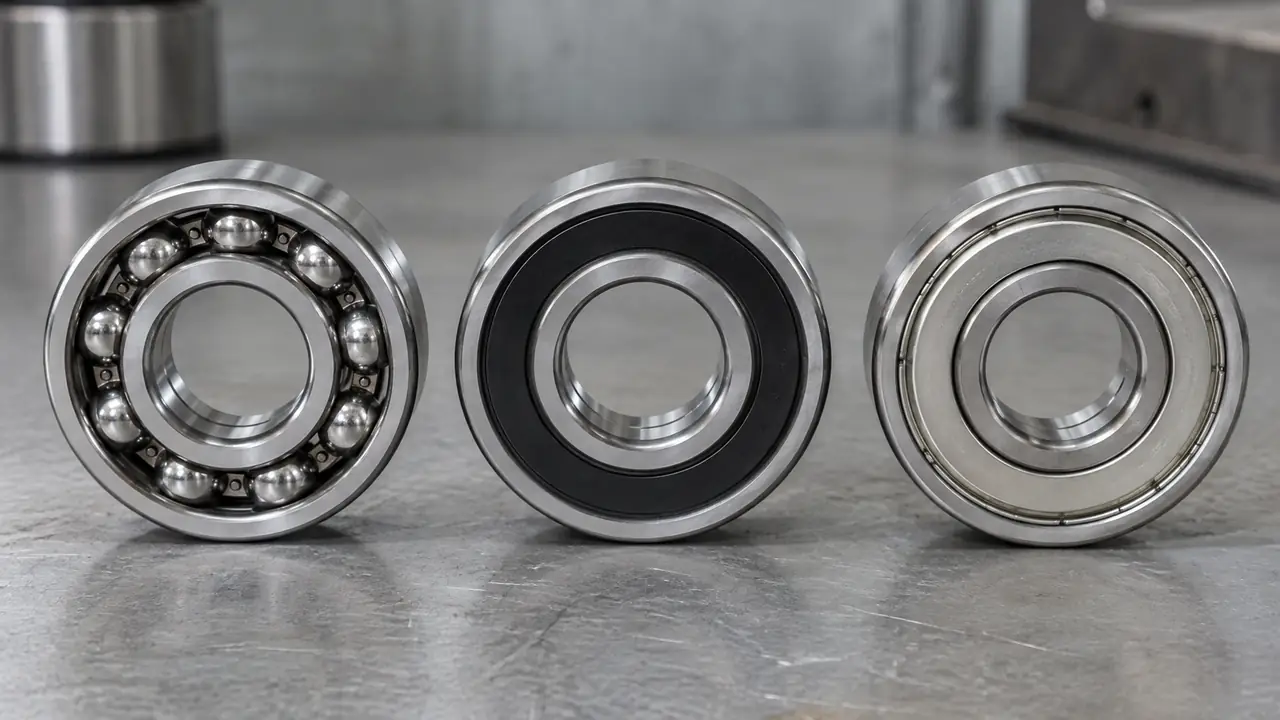
What do C3, P6 and 2RS mean? C3 is radial internal clearance larger than normal. P6 and P5 are tighter tolerance classes than P0 (ISO Normal), defined in ISO 492. 2RS means two contact rubber seals; ZZ means two metal shields. See C3 clearance explained and 2RS vs ZZ.
Quality and documents
How is quality checked? An inspection plan is agreed before production. Typical checkpoints are dimensions against the tolerance class, radial clearance, vibration or noise on a test rig, hardness, rotation smoothness, and seal and grease appearance. The report goes with the lot. See quality control.
Which certificates are available? ISO 9001 and, for automotive programs, IATF 16949 are common at partner plants and are verified per project. Rolvane itself holds no quality certificate. Material declarations such as RoHS or REACH can be requested.
Are bearings interchangeable with another brand? Boundary dimensions of standard designations follow ISO standards, so the size fits. Ratings, noise and life depend on the plant and material, so compare datasheets and test samples; no interchange is promised.
Shipping
How are bearings packed? They are protected with rust-preventive oil, VCI bags, cartons and wooden pallets, because bearings are heavy and sensitive to moisture. See packing and anti-rust.
How long does freight take? Typical transit times are 3-7 days by express for samples, 5-10 days by air, 15-25 days by sea to the US West Coast and 30-45 days to Europe. Routes and terms are confirmed per order; read logistics and shipping.
Can shipments be consolidated? Often yes. Orders from more than one partner plant can be gathered at a consolidation point and sent as one shipment, which reduces freight handling and gives you a single set of documents. Whether this suits a program depends on volumes and timing, and the desk proposes it in the quotation when it makes sense.
What happens if a lot does not match the specification? Report it with photos and measurements as soon as the goods are received. The desk compares the finding with the inspection report and the approved sample, then agrees the remedy with the plant. Remedies are set out in the written terms of each order, which is why specifications and the approved sample are recorded before production starts.
Do you ship to every country? Shipments go to most destinations by express, air or sea. Destination rules, import duties and any restrictions vary, so the quotation states the agreed terms, and the buyer or its broker remains responsible for local import requirements.
Who handles customs? Rolling bearings are generally classified under HS heading 8482. The exact code and the customs broker are confirmed with the freight forwarder for each shipment.