
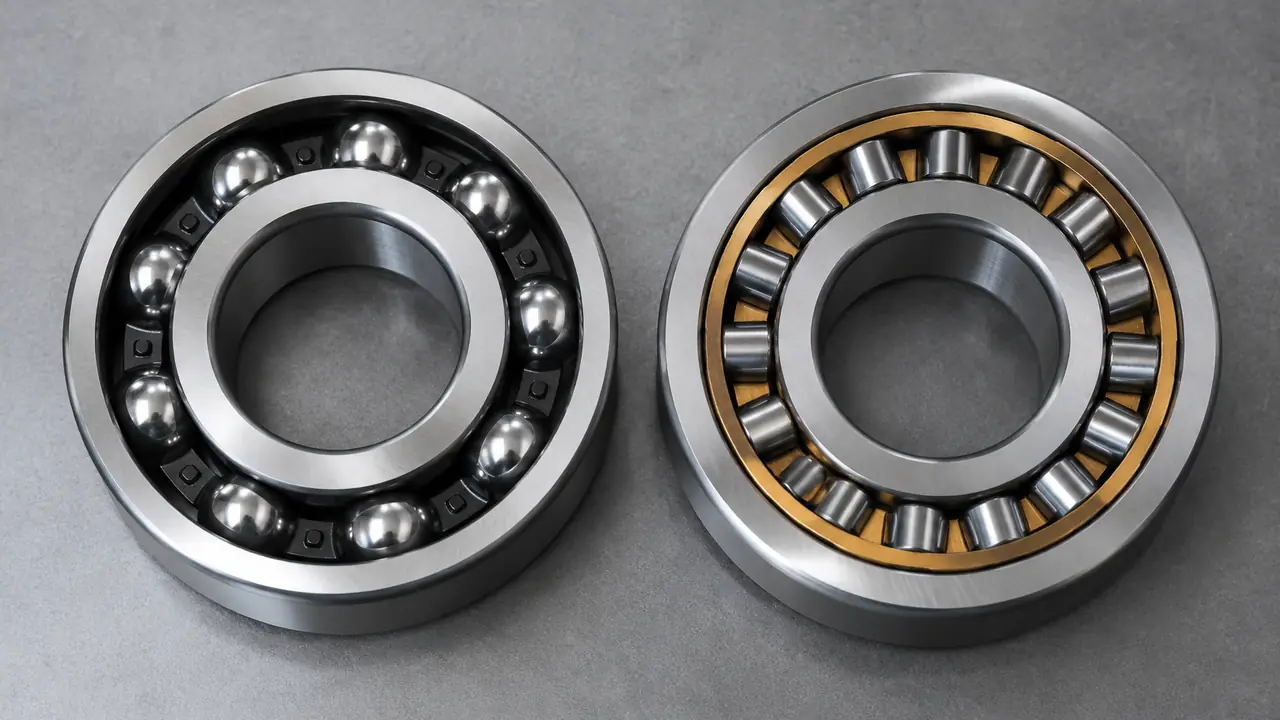
What the two suffixes mean
Both suffixes describe how the open side of a deep groove ball bearing is closed. 2RS (sometimes written 2RS1, RS or DDU depending on the plant) means a synthetic rubber lip seal, usually nitrile rubber on a steel carrier, fitted on both sides. ZZ (also 2Z) means a stamped steel shield on both sides, pressed into a groove in the outer ring and left with a very small gap to the inner ring. A single letter, RS or Z, means one side only.
The two parts do different jobs. The seal presses lightly on a shoulder of the inner ring, so it forms a real barrier against dust and splashing water. The shield never touches, so it keeps grease in and large particles out but does not stop fine dust or moisture. Everything else in this comparison follows from that single difference. The parts themselves are described on the bearing seal and bearing shield pages.
Side-by-side comparison
The table uses relative terms only. Exact limiting speeds and temperature ranges depend on size, grease and the supplier, and come from the datasheet for the designation you order.
| Criterion | 2RS rubber seal | ZZ metal shield |
|---|---|---|
| Load direction | Same as the open bearing: radial plus moderate axial | Same as the open bearing: radial plus moderate axial |
| Load capacity | Unchanged by the closure | Unchanged by the closure |
| Speed | Lower limit, because lip contact adds drag and heat | Higher limit, close to the open bearing |
| Misalignment tolerance | Low, as for any deep groove bearing | Low, as for any deep groove bearing |
| Friction and noise | Higher starting and running torque, slightly more audible hum | Lowest torque of the closed types, quiet |
| Contamination protection | Good against dust and splash | Moderate; fine dust and water can pass the gap |
| Maintenance | Lubricated for life; relubrication not possible | Lubricated for life; grease can creep out at high speed |
| Typical applications | Pumps, wheels, conveyors, agricultural and outdoor equipment | Electric motors, fans, appliances, clean indoor machinery |
| Relative cost factors | Slightly more complex part, a little more to supply | Simple stamping, usually the lower-cost closed type |
Why speed and temperature favour the shield
A contact seal turns a small amount of the shaft power into heat at the lip. At low speed that is negligible; at high speed it becomes the main heat source in the bearing. The rubber also sets the temperature limit of the whole assembly, since nitrile hardens and cracks when it runs hot for long periods. A shield has no rubbing contact and no polymer, so the bearing runs cooler and the grease lasts longer for the same speed.
That is why electric motors and fans, which spin fast and sit in a relatively clean housing, almost always use ZZ. A motor frame already keeps out most dirt, and the lower torque helps efficiency and noise. If the motor sits in a dusty or wet environment, the answer is usually a better housing seal outside the bearing, or a non-contact low-friction seal, rather than a heavy contact lip on the bearing itself.
Why protection favours the seal
Dirt is the main cause of early bearing damage in the field. Hard particles that enter the raceway indent the surface, and every ball that passes over an indent produces a pulse of high stress. Water washes out grease and causes corrosion. A rubber lip seal gives the best protection a standard bearing can have without an external housing seal. For gearbox-free wheel assemblies, garden machinery, conveyor idlers and farm equipment, 2RS is the sensible default. The contamination damage note shows what the failures look like.
The trade-off is that a lip seal is not leak-proof against pressure or high-pressure washdown, and its drag makes a small difference to starting torque in light mechanisms such as hand-turned rollers and small instruments. For fine mechanisms where both protection and low torque matter, ask the supplier for a low-friction or non-contact seal variant and compare samples.
Grease and life in closed bearings
Neither version can be relubricated in the normal way. The grease installed at the plant is all the bearing will ever have, so the grease type matters as much as the closure. A bearing with a lithium-based grease designed for general use will not suit sustained high temperature; one with a low-noise grease suits motors. When you compare quotations, confirm the grease type and fill in writing. The bearing grease page and the lubrication guide cover the options.
Grease behaviour also differs. In a ZZ bearing, grease can slowly migrate out through the gap at speed, so over a long life the bearing runs drier than the label suggests. In a 2RS bearing the grease stays inside but works harder because of the lip contact heat. Neither is bad; both are limits you design around.
Sourcing notes for both types
Seals and shields are separate components, often made by specialist partners and assembled at the bearing plant. Rubber compound, lip geometry and shield fit vary between plants, and that variation shows up as differences in torque and in how many bearings leak grease after a test run. For a first order, ask the desk to arrange samples from more than one partner plant and compare running torque, noise and grease appearance after a short run. Record the result against the reference sample so later batches can be checked against the same standard.
Packaging matters too. Sealed bearings arrive with a light coating of anti-rust oil on the outside, and the oil can attract dust if cartons are stored open. The packaging and anti-rust page explains the usual wrapping, and the reference MOQ and lead time ranges apply to both closure types, confirmed in writing for each program.
How to decide
Use this sequence to settle the question for most programs.
- Is the bearing exposed to dust, splash or washdown with no housing seal outside it? If yes, choose 2RS.
- Is the speed high relative to the size, or is low torque and low noise the priority? If yes, choose ZZ.
- Is the operating temperature high? Check the seal material and grease against the datasheet; ZZ is the safer default, or ask for a fluoroelastomer seal.
- Is the environment clean and enclosed, like a motor or appliance? Choose ZZ.
- Is it a repair stock line for mixed customers? Stock both, labelled clearly on the carton, because the suffix is easily missed on a shelf.
Mixed-up suffixes are a common cause of returns, so state the closure type, clearance group and grease in the purchase order. The bearing number guide explains the full suffix system, and the quote form is where you list the exact designation.