
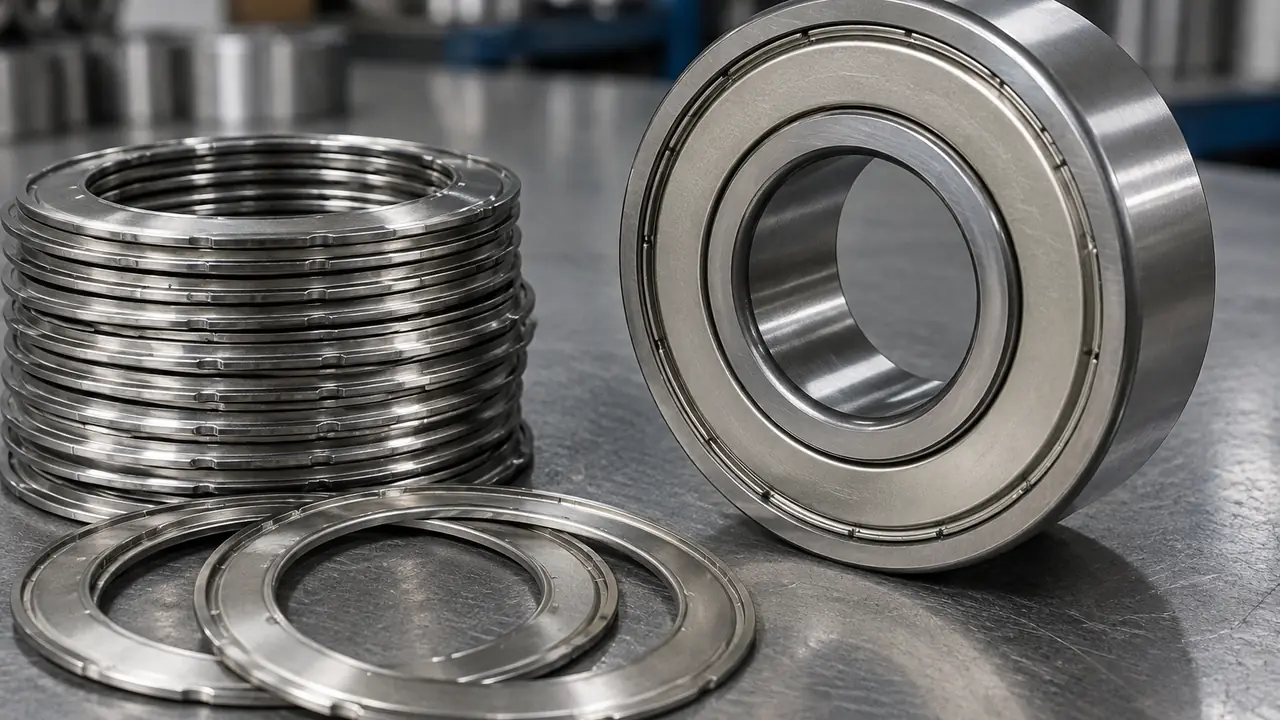
What a bearing shield is
A bearing shield is a thin pressed sheet-steel disc that fits into a groove in the outer ring of a ball bearing and extends inward toward the inner ring shoulder. It does not touch the inner ring. Between the inner edge of the shield and the inner ring there is a small running gap. Because there is no contact, there is almost no added friction, no heat from rubbing and no wear on the seal lip, which makes shielded bearings the usual choice for electric motors, fans, small pumps and similar machines running at moderate to high speed.
The common suffixes are Z for a shield on one side and ZZ (also written 2Z) for shields on both sides. A bearing marked 6204ZZ is the same 20 x 47 x 14 mm size as an open 6204, with the shields included inside the standard width. The marking system is explained in the designation guide, and the family of bearings that take shields starts with the deep groove ball bearing.
How a shielded bearing is built
The shield is stamped from cold-rolled steel, which is cheap, stiff and easy to press. Stainless shields exist for corrosive environments and pair with stainless bearings. The outer edge is pressed into a groove in the outer ring, sometimes with a small bead to improve retention. The inner edge sits close to the shoulder of the inner ring. The grease is filled before the shield is fitted, and the shield then keeps the grease near the balls through centrifugal action and the geometry of the gap.
The gap is what sets performance. A smaller gap gives better particle protection and a longer grease path, and a larger gap lowers any chance of touching under shaft deflection. Plants hold the gap within drawing tolerance, and the desk asks for the shield drawing and checks a sample for visible rub marks.
Shield, seal or open
| Version | Friction | Speed capability | Protects against | Typical duty |
|---|---|---|---|---|
| Open | Lowest | Highest | Nothing; needs external lubrication | Oil-lubricated gearboxes and clean housings |
| Shielded (Z, ZZ) | Very low | High | Larger particles; grease retention | Motors, fans, small pumps, appliances |
| Sealed (2RS) | Higher | Moderate | Dust and splash water | Conveyors, outdoor and wet equipment |
Limiting speed for each version comes from the supplier datasheet. Do not assume a specific percentage gain; the effect depends on grease, fit and size. For a longer comparison see 2RS vs ZZ.
When a shield is not enough
A shield is a particle guard, not a barrier. It will not stop water spray, washdown, fine abrasive dust, or fibre and flour that can work through a gap. Typical situations where you should move to contact seals or an extra external seal:
- Wet or washed equipment. Food processing and outdoor machines: choose 2RS or 2RZ, or stainless with food-grade grease.
- Fine, abrasive dust. Agriculture, cement, woodworking: use contact seals, labyrinth housings or a housing with built-in seals.
- Vertical shafts. Grease can migrate out through the gap; a sealed bearing holds it better.
- Long service with no regreasing. A tightly sealed bearing with matched grease is more predictable than a shield in a harsh place.
If the bearing runs hot, the cause is rarely the shield. Check clearance, fit and grease fill first; the tolerance and clearance page covers the first two and grease the third.
Handling and mounting notes
Shields are thin and can be dented by careless handling, so press the bearing on through the ring that carries the interference fit, never through the shield. Do not wash a shielded bearing in solvent: the solvent strips the grease, and it is hard to dry out from behind the shield. Store bearings flat in their wrapping, away from damp, and keep the anti-rust film on until mounting. If a shielded bearing is mounted in a housing with a lubrication hole, make sure the hole does not point at a shield face, because the grease will be pushed against the shield and not the balls.
For equipment makers, one practical point: lock the shield type into the drawing. Replacing ZZ with 2RS in service changes friction and temperature, and it can change noise as well, so treat the suffix as part of the part number.
Sourcing and checks
Shields are produced alongside bearings in the eastern Zhejiang and Shandong clusters and are also sold as loose stampings to bearing assemblers. Before shipment the desk checks shield seating and retention, the visual gap, absence of burrs and rub marks, free rotation by hand, grease appearance on an opened sample, and the marking. Quantities for components are counted in thousands, and all timing is a typical reference confirmed in writing for each program. Send your designation list through the quote form and state Z or ZZ clearly with the suffix list.