
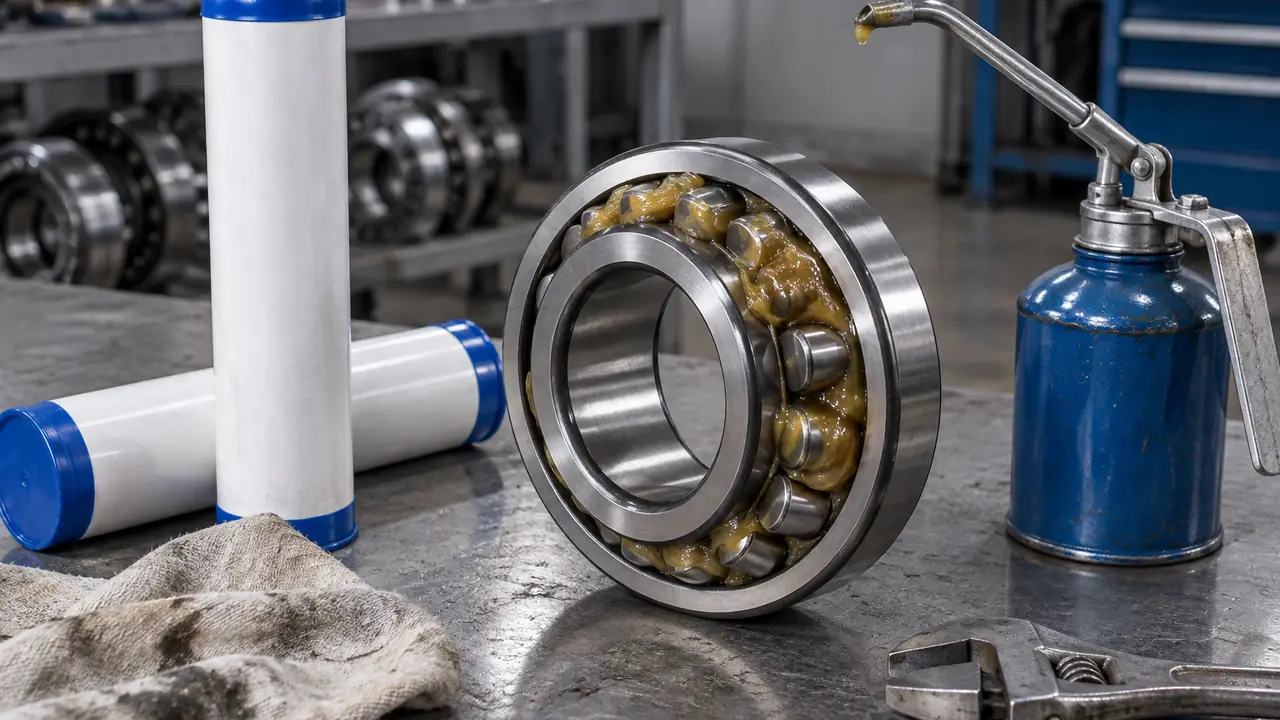
What lubricant does in a bearing
Inside a rolling bearing, the lubricant forms a thin film that keeps hardened steel surfaces from touching, even though they carry high contact stress. It also reduces friction in the cage and at the seals, carries away some heat, and protects against corrosion. When the film fails because the lubricant has aged, drained, overheated or been contaminated, wear and fatigue follow. Surveys of failed bearings regularly place lubrication and contamination among the main causes of early failure, which is why the choice deserves as much attention as the bearing itself.
Grease or oil
| Factor | Grease | Oil |
|---|---|---|
| Construction | Simple housing, stays in place, helps sealing | Needs a sump, circulation or mist system |
| Maintenance | Periodic relubrication or sealed for life | Level checks and oil changes |
| Speed | Low to high, limited by churning and heat | Highest speeds with circulation |
| Heat removal | Poor | Good when circulated |
| Typical use | Motors, fans, pumps, conveyors, pillow blocks | Gearboxes, spindles, high-load or hot machines |
Grease is the default for most bearings the desk supplies, especially sealed and shielded ones, because it is simple and self-contained. Oil is chosen when the machine already has an oil system, when speed or temperature are beyond the limits of grease, or when heat must be carried away.
Selecting by speed, temperature and load
- Speed. Faster running calls for a lower base-oil viscosity and a softer grease; a very stiff grease at high speed churns and overheats. Slow running with heavy load calls for higher viscosity so that the film holds.
- Temperature. Every grease has an operating temperature range. Lithium-based greases cover general use. Complex lithium and polyurea types extend to higher temperatures, and specialist synthetic greases cover extremes. Running above the range ages the grease quickly.
- Load. Heavy or shock load asks for a grease with extreme-pressure additives and adequate base-oil viscosity. Light, precision duty may prefer a low-noise grease.
- Environment. Wet conditions need a water-resistant grease; food and beverage plants use food-grade grease; electric motors often use low-noise polyurea grease.
Datasheets of the grease supplier give temperature range, base-oil viscosity and compatibility. The desk specifies the grease on the order and confirms it in writing; it is not left to assume. For component detail see bearing grease.
Relubrication: interval and quantity
Grease does not last forever. Over time the oil bleeds out, the thickener breaks down and contamination builds up. A relubrication interval is the running time after which fresh grease should be added, and it shortens with higher speed, higher temperature, heavier load, vertical shafts and dirty conditions. Typical practice is to take the interval from the bearing and grease suppliers, then adjust it with condition monitoring such as temperature and noise trends. The quantity added at each interval is small compared to the initial fill: enough to renew the film and push old grease toward the relief point, not enough to pack the housing.
How much grease to fill
A bearing should not be packed full. Too much grease raises churning losses and temperature, and can burst seals. A common rule is to fill the bearing and then fill roughly a third to a half of the free space in the housing; fast running uses less, slow running with contamination uses more. Sealed bearings are filled at the plant to a defined fraction of free volume, which is part of the order specification. Ask the desk for the fill level to be stated in writing for private-label programs.
Contamination and storage
Dirt and water are the main enemies of lubricant film. Keep grease guns, nipples and containers clean, wipe the nipple before greasing, and do not mix greases with incompatible thickeners without checking. Seals and shields help; see 2RS vs ZZ and seals. In storage, keep bearings in their original packing, in a cool, dry place away from vibration, with the rust-preventive coating intact; the methods are described in packaging and anti-rust. Shelf life of pre-greased bearings depends on the grease and storage conditions.
When a bearing needs a grease fitting, a grease nipple can be fitted to the housing - see bearing accessories. State grease type, fill and any special requirement on your request through the quote form; typical reference ranges for MOQ and lead time are on MOQ and lead time and are confirmed in writing.