
| Designation | Type | d bore | D outside | B width |
|---|---|---|---|---|
| UC201 | Pillow block insert | 12 | 47 | 31 |
| UC204 | Pillow block insert | 20 | 47 | 31 |
| UC205 | Pillow block insert | 25 | 52 | 34.1 |
| UC206 | Pillow block insert | 30 | 62 | 38.1 |
| UC207 | Pillow block insert | 35 | 72 | 42.9 |
| UC208 | Pillow block insert | 40 | 80 | 49.2 |
| UC209 | Pillow block insert | 45 | 85 | 49.2 |
| UC210 | Pillow block insert | 50 | 90 | 51.6 |
| UC212 | Pillow block insert | 60 | 110 | 65.1 |
Nominal ISO boundary dimensions for reference. Confirm against your drawing and the supplier datasheet.
What a pillow block unit is
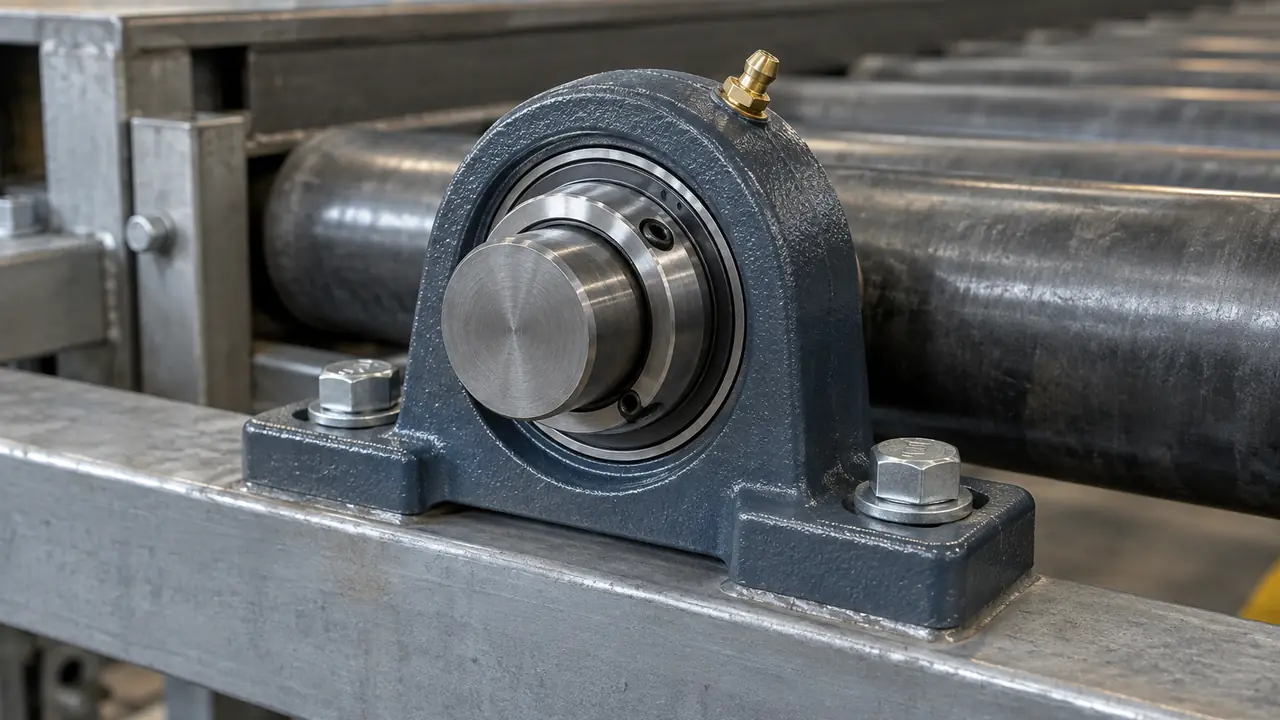
A pillow block unit pairs an insert bearing with a housing. The insert is a deep groove-type ball bearing with a spherical outside surface and a wide inner ring that extends past the outer ring, so it can be fixed to the shaft. The housing has a matching spherical seat, which lets the bearing swivel slightly during mounting and absorb small shaft misalignment. The result is a support that bolts to a frame and takes a shaft without any machining of a bore, which is why housed units are everywhere on conveyors, fans, blowers, agricultural machinery, packaging lines and food-processing equipment.
The same insert can sit in several housing shapes, and the same housing takes several inserts. That modularity makes housed units easy to stock and easy to replace in the field.
Unit types: UCP, UCF, UCFL, UCT
The prefix names the housing shape. UC names the insert: the bearing with a spherical outside and inner ring extended on both sides, fixed by set screws.
| Unit | Housing | Mounting | Typical use |
|---|---|---|---|
| UCP | Pillow block (plummer block) | Bolts on a flat base parallel to the shaft | Conveyor frames, fans, line shafts |
| UCF | Four-bolt square flange | Bolts on a face perpendicular to the shaft | Machine side plates, agricultural machines |
| UCFL | Two-bolt oval flange | Same as UCF, with two holes | Compact, lighter loads |
| UCT | Take-up housing | Slides in a slot to tension a belt or chain | Conveyor tail shafts, drive tensioners |
The number after the prefix gives the shaft size through the insert series. A UCP205 holds a UC205 insert, nominally 25 mm bore, 52 mm outside diameter and 34.1 mm inner ring width. Common nominal values for other inserts, UC204 (20 mm bore) through UC212 (60 mm bore), are on the size chart. Confirm against the drawing and datasheet, since the housing dimensions - hole spacing and centre height - differ by series.
Locking: set screw or eccentric collar
- Set screw. Two grub screws in the extended inner ring clamp the bearing to the shaft. Easy to fit and remove, and well suited to shafts that rotate in one direction with steady load. In heavy vibration or reversing duty, screws can loosen, so use thread locking or select another method.
- Eccentric collar. A collar with an eccentric bore locks onto a matching step on the inner ring and is tightened by rotating it against the shaft direction. It resists loosening better under unidirectional duty but is not intended for reversing shafts.
- Adapter sleeve. A tapered sleeve grips the shaft evenly and suits larger sizes or shafts that cannot be marked by a screw.
Shaft tolerance is usually looser than for standard rolling bearings. Check the datasheet for the recommended shaft tolerance zone and avoid shafts with burrs under the inner ring.
Housing materials and seals
Cast iron, usually grey cast iron of the HT200 type or ductile iron for heavier duty, is the standard choice for strength and cost. Pressed steel housings are lighter and cheaper and suit light machinery. Stainless housings pair with stainless inserts for food and washdown lines, see stainless steel bearings. Thermoplastic housings resist corrosion and are used in light-duty wet environments, within their load and temperature limits. The bearing housing page covers housing parts supplied alone.
Standard seals are a rubber contact lip plus a slinger; for dusty or wet sites choose a multi-lip seal and a housing with a cover. Inserts arrive pre-greased with lithium grease, and a grease fitting allows relubrication. Food-grade H1 grease can be requested.
Relubrication and maintenance
A housed unit is only as reliable as its relubrication routine. A small amount of grease added at intervals suited to speed, load and temperature keeps the seal flushing out dust. Over-greasing overheats the bearing, so add slowly while the shaft turns and stop when a little purge appears at the seal. For intervals and base oil considerations, see the lubrication guide and the relubrication intervals article.
Applications
Conveyors use UCP and UCT units for head and tail shafts. Farm machinery uses UCF and UCFL units on drive shafts and gauge wheels, often with a heavier seal. Fans, blowers, mixers and packaging lines choose the shape that fits the frame. For wet or dirty duties, see agriculture and conveyor solutions.
Ordering notes
Provide the shaft diameter, the unit prefix, the housing material, the locking method and the seal. Standard units commonly start from 100-500 pieces per designation, and private-label marking starts around 1,000-5,000 pieces. Stock samples ship in 3-7 working days; batch production commonly takes 25-45 days, as typical reference ranges confirmed in writing. Send your list through the quote form and see specialty bearings for related lines.