
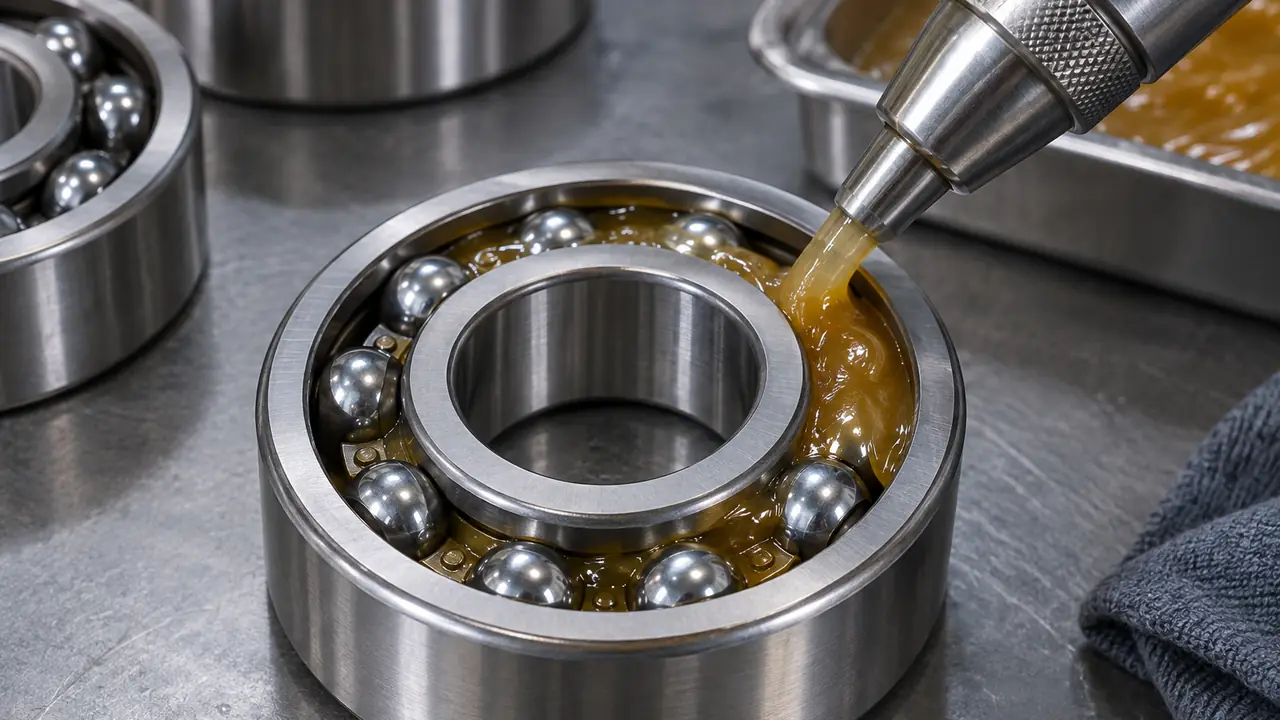
What bearing grease is made of
Grease is a mix of three parts: a base oil that does the lubricating, a thickener that holds the oil in place like a sponge, and additives that improve resistance to wear, rust and oxidation. In a rolling bearing the oil film separates balls from raceways while the thickener keeps the oil near the contact. Over time the oil bleeds out, oxidises and the grease stiffens, and this ageing sets the grease life. In sealed and shielded bearings the grease is intended to last the service life of the bearing, so choosing the right one up front matters; once the bearing is sealed it cannot be changed.
The desk sources bearings filled with a grease specified by you or recommended by the partner plant for the duty. For loose grease supply, cartridges and tubes can be coordinated for relubrication, but the grease should always be matched to the original type; see the mixing section below.
Thickener types compared
| Thickener | Strengths | Limits | Typical use |
|---|---|---|---|
| Lithium | Good all-round performance, water resistance, widely available | Moderate temperature ceiling | General motors, pumps, appliances |
| Lithium complex | Higher temperature range, better mechanical stability | Slightly higher cost | Automotive, industrial, hotter shafts |
| Polyurea | Long life, quiet, good at high temperature | May be incompatible with some other thickeners | Sealed-for-life motor bearings, low-noise duty |
| Calcium sulfonate | Strong water and corrosion resistance, high load | Not for every speed range | Wet, dirty, heavy-duty equipment |
The temperature ceiling of each thickener depends on the base oil and additive package, so exact limits come from the grease data sheet and not from this page.
Base oil, viscosity and NLGI grade
Three terms appear on every grease specification and are often confused.
- Base oil viscosity. This describes how thick the oil is at operating temperature. Higher viscosity builds a thicker film for heavier load and slower speed; lower viscosity runs cooler at high speed and suits low-torque starts. The usual approach is to pick the base oil viscosity from speed and bearing size, following ISO 281 life reasoning and the supplier guidance.
- NLGI grade. This is the consistency of the finished grease, from softer to harder. Most rolling bearings use grade 2 or a slightly softer or firmer grade according to housing position and speed. A softer grease flows more easily to the contact; a harder one stays put in vertical shafts.
- Base oil type. Mineral oil is the standard; synthetic oils such as PAO or ester extend temperature range and life in more demanding duty.
Fill percentage and why more is not better
Bearings are not filled solid. A typical sealed ball bearing carries grease in a fraction of the free internal space, enough to lubricate for the life of the bearing without causing churning. Over-filling creates heat, since the balls have to push through the grease, and raises torque; under-filling shortens life. The right amount depends on speed, size and the seal type, and plants set it as a percentage of free volume in the process sheet. Ask for the fill to be stated when a program is quoted. For high-speed duty, a lower fill is normal.
Special greases
- Food-grade H1. Registered as suitable for incidental food contact, for bakery, bottling and packaging machinery, usually in stainless or sealed bearings. See stainless bearings.
- High-temperature grease. Synthetic base oil with complex or polyurea thickener, for ovens, kiln cars and hot motors. Match the cage and seal to the same temperature, because the weakest component sets the limit; see seals.
- Low-noise grease. Cleanliness-controlled grease for appliance and motor bearings with a Z2 or Z3 vibration grade requirement, as discussed in tolerance and clearance.
- Low-temperature grease. Light base oil for cold starts in outdoor and refrigeration equipment.
Mixing greases
Mixing two greases is a common cause of early failure. If the thickeners are incompatible, the mixture can soften and run out, or harden and starve the bearing. As a rule, lithium and lithium complex are generally compatible, and polyurea is the type that most often causes problems when mixed with a non-urea grease. Calcium sulfonate also needs checking. The safest practice is to keep one grease per bearing position, record it on the maintenance card, and flush thoroughly when changing type. When in doubt, ask the grease supplier for a compatibility statement for the exact products.
Ordering notes
State the grease type and any approvals on the request: thickener, base oil type, NLGI grade, temperature range and any food-grade or low-noise requirement. The desk confirms the grease with the partner plant, asks for a data sheet and an RoHS or REACH statement where needed, and checks grease appearance on an opened sample of each lot. Send your list through the quote form; quantities and timing are typical reference ranges, confirmed in writing for each program.