
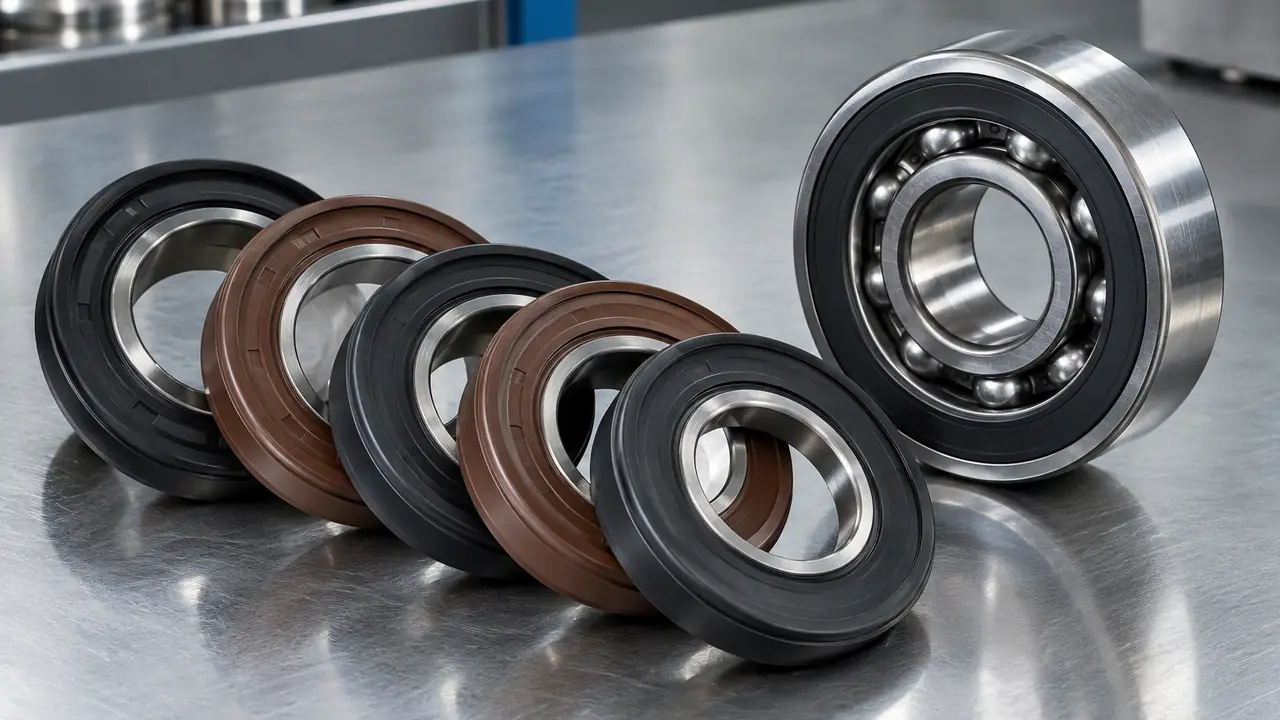
What a bearing seal does
A bearing seal is a ring of elastomer bonded to a pressed steel insert. It sits in a groove in the outer ring and either touches or closely approaches the inner ring shoulder. Its job is twofold: keep the grease inside the bearing where it lubricates the balls and raceways, and keep dust, water and process debris outside where they would otherwise wear the surfaces. For a sealed-for-life bearing, the seal is effectively the life limiter, because once the grease escapes or contamination gets in, wear accelerates quickly.
Seals are a distinct component line because they are bought two ways. Most are fitted at the plant onto ball bearings, such as the sealed variants of the deep groove ball bearing. Others are bought loose, as replacement seals for bearing housings, hubs and gearbox shafts, where the bearing itself is not the part being changed. The desk coordinates both with specialist seal makers; in China, seal production is concentrated in clusters including the area around Guanxian in Shandong, which supports the nearby bearing trading centre.
Contact seals versus low-friction seals
The main design choice is how closely the seal lip meets the inner ring. The common suffixes are explained in the designation guide.
| Type | Suffix | Lip contact | Strength | Trade-off |
|---|---|---|---|---|
| Contact seal | 2RS, 2RSH | Lip rubs the inner ring shoulder | Best barrier against dust and splash | More friction, heat and torque; lower speed limit |
| Low-friction seal | 2RZ | Tiny gap or very light touch | Lower drag, suits higher speed | Weaker protection against fine dust and water |
| Metal shield | Z, ZZ | None, small gap | Almost no friction | Keeps out particles, not liquids; see shields |
The RS and RSH labels both describe contact seals; RSH usually denotes a particular lip profile in a plant's range. Because suffix meaning varies a little between makers, the desk asks the partner plant for the seal drawing and confirms the lip type in writing. For a direct comparison with metal covers, read 2RS vs ZZ.
NBR, FKM and other compounds
The elastomer is chosen by operating temperature and the fluids around the bearing. The comparison below is qualitative: exact temperature limits depend on the compound formulation and come from the supplier datasheet.
- NBR (nitrile rubber). The standard choice. Good resistance to mineral oils and greases, good abrasion resistance and low cost. Suited to general machinery, motors, pumps and conveyors. It ages faster at sustained high temperature and does not tolerate some solvents and ozone well.
- FKM (fluoroelastomer). Chosen for higher temperatures and aggressive chemicals, including many synthetic oils and fuels. It costs more than NBR and is often less flexible at very low temperature.
- Other compounds. Hydrogenated nitrile (HNBR), silicone and PTFE-based lips are used for specific duties such as wider temperature ranges or low friction. They are quoted per application rather than stocked as standard.
When a bearing runs hot, check the grease limit as well as the seal. A high-temperature seal in a bearing filled with standard grease does not extend the service temperature; see the grease page and the lubrication guide.
Lip design, fit and replacement seals
Single-lip seals are common on standard sealed ball bearings. Double-lip and labyrinth profiles add a second barrier for dusty or wet duty such as agriculture and conveyors. The steel insert keeps the seal round and gives it stiffness to stay in the groove; it is usually pressed carbon steel, with stainless inserts available for washdown applications. Seals are snapped into a groove in the outer ring, and the inner ring side is either a clear shoulder for the lip or a recess.
For replacement seals in housings and shafts, the dimensions are the shaft diameter, the bore diameter and the seal width, and the lip profile has to match the direction of the fluid. Send the sizes, the medium being sealed and the operating temperature through the quote form; if you have an old seal, a photo with a ruler or caliper reading helps. Related parts are the bearing housing seals and the accessories range.
Checks before shipment
- Seal material and hardness against the approved sample or drawing.
- Outside diameter, inside diameter and width of loose seals against the drawing.
- For fitted bearings, seal seating in the groove, lip condition and absence of rubber flash.
- Rotation torque feel on a sample, and grease level when a bearing is opened.
- Marking, packaging and anti-rust protection; see packaging and anti-rust.
Reference ranges for components: seals commonly ship in lots counted in thousands, stock samples in 3-7 working days. All timing and quantities are confirmed in writing for each program.