
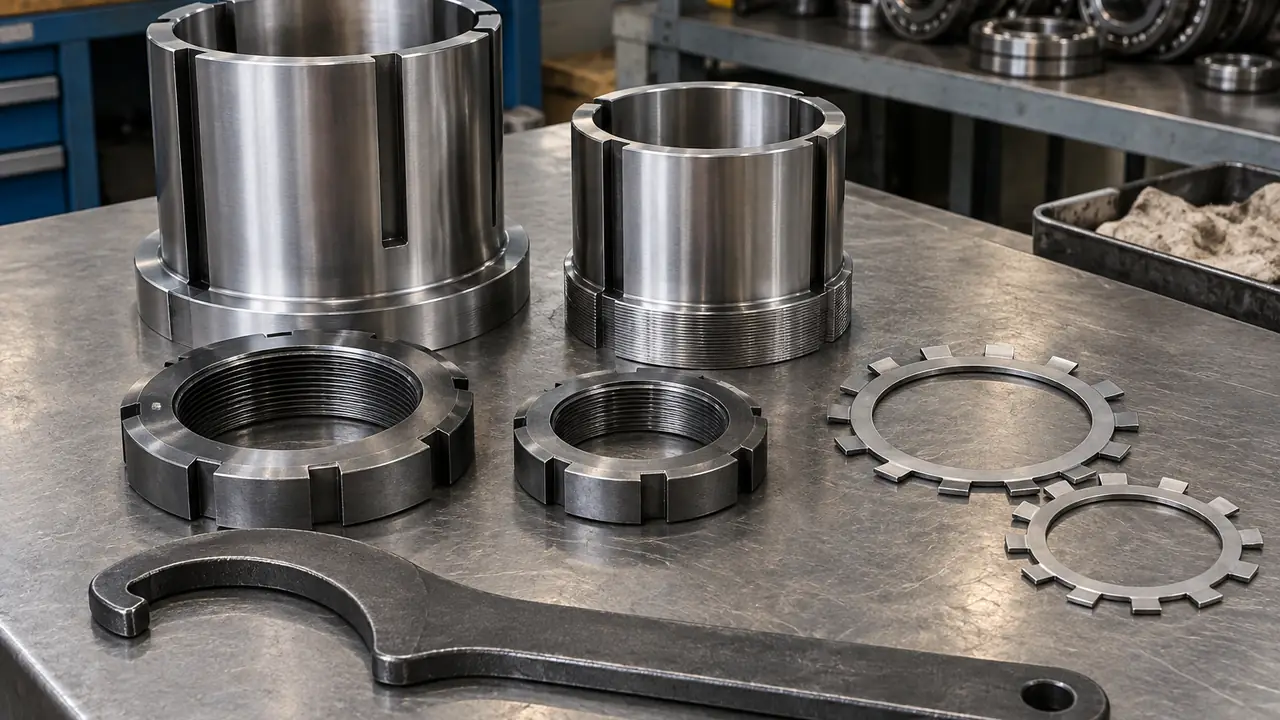
What bearing accessories do
Bearing accessories are the small parts that position, lock, release or lubricate a bearing. Most of them are inexpensive compared with the bearing itself, yet a missing or mismatched one stops an installation. They fall into a few families, and the one that causes the most confusion is the set used with tapered-bore bearings: the adapter sleeve, the lock nut and the lock washer. Spherical roller bearings and self-aligning ball bearings with a tapered bore, for example, are often mounted on shafts that are plain and unstepped, using exactly this set.
Rolvane sources these parts through partner plants and matches them to the bearing designation before quoting, so the set arrives as a set.
The parts and where they belong
| Part | Series | Role | Pairs with |
|---|---|---|---|
| Adapter sleeve | H | Slotted tapered sleeve that locates a tapered-bore bearing on a plain shaft | Tapered-bore bearing (K suffix), lock nut, lock washer |
| Withdrawal sleeve | AH | Sleeve pressed into the bore to release a bearing from a stepped shaft | Tapered-bore bearing, KM or HM nut |
| Lock nut | KM | Round nut with locking grooves, tightened against the sleeve or bearing | MB washer, adapter sleeve thread |
| Lock washer | MB | Tab washer that bends into a nut slot to prevent loosening | KM nut of the same size |
| Circlip | Internal / external | Retaining ring in a housing or shaft groove to limit axial movement | Ring groove of the housing or shaft |
| Grease nipple | Thread form per drawing | Fitting for relubrication of a housing or bearing | Housing port thread |
Matching a set to a tapered-bore bearing
A tapered-bore bearing has a bore with a standard taper, commonly 1:12 on most series and 1:30 on a few wider ones, marked with a K suffix in the designation. The bearing is not slid onto a shaft directly. It is pushed up a tapered sleeve, which in turn grips a plain shaft, so the inner ring expands slightly and the internal clearance is reduced by a controlled amount. That reduction is the whole point of the arrangement and why the matching must be right.
- Read the bearing designation and confirm the K suffix. See the designation guide.
- Measure the shaft diameter where the sleeve will sit.
- Select the H sleeve whose bore fits that shaft and whose taper fits the bearing bore series.
- Pair the sleeve thread with the KM nut and the MB washer of the same size.
- Check the housing side: the sleeve and nut protrude, so shoulder and seal arrangement must clear them.
The exact sleeve designation for each bearing comes from the supplier datasheet or catalogue table. This page does not list pairings, and the desk confirms the full set in writing before any order. Related bearing lines are the spherical roller bearing and the self-aligning ball bearing.
Withdrawal sleeves, circlips and grease nipples
- Withdrawal sleeves (AH). Used where the bearing sits on a stepped shaft. The sleeve is fitted into the bore and the nut is tightened to draw the bearing on; later the nut is used to push the bearing off. They make dismounting of large bearings far easier.
- Circlips. Internal rings fit a bore groove; external rings fit a shaft groove. Material and thickness must suit the groove drawing. Snap-ring grooves on a bearing outer ring, with the NR suffix, take a matching ring.
- Grease nipples. Thread form and angle are specified from the housing drawing. Relubrication planning is covered in the lubrication guide.
Material, finish and inspection
Sleeves, nuts and washers are normally made from carbon steel with a rust-preventive finish. Thread form, tolerance and finish are stated on the order. Typical checks before shipment are dimensions and thread fit against the drawing, slot and tab condition on washers, surface finish and rust protection, and a count against the packing list. For lots where fit is critical the desk can arrange a trial assembly of a sample set with the matching bearing. See testing and inspection.
Ordering notes
Standard accessories typically start from 100-500 pieces per designation; private-label packing starts around 1,000-5,000 pieces. Stock samples ship in 3-7 working days and batch production commonly takes 25-45 days. These are typical reference ranges, confirmed in writing for each program. Accessories are often ordered together with bearings or inside a bearing kit; send the full list through the quote form.