
What a bearing kit is
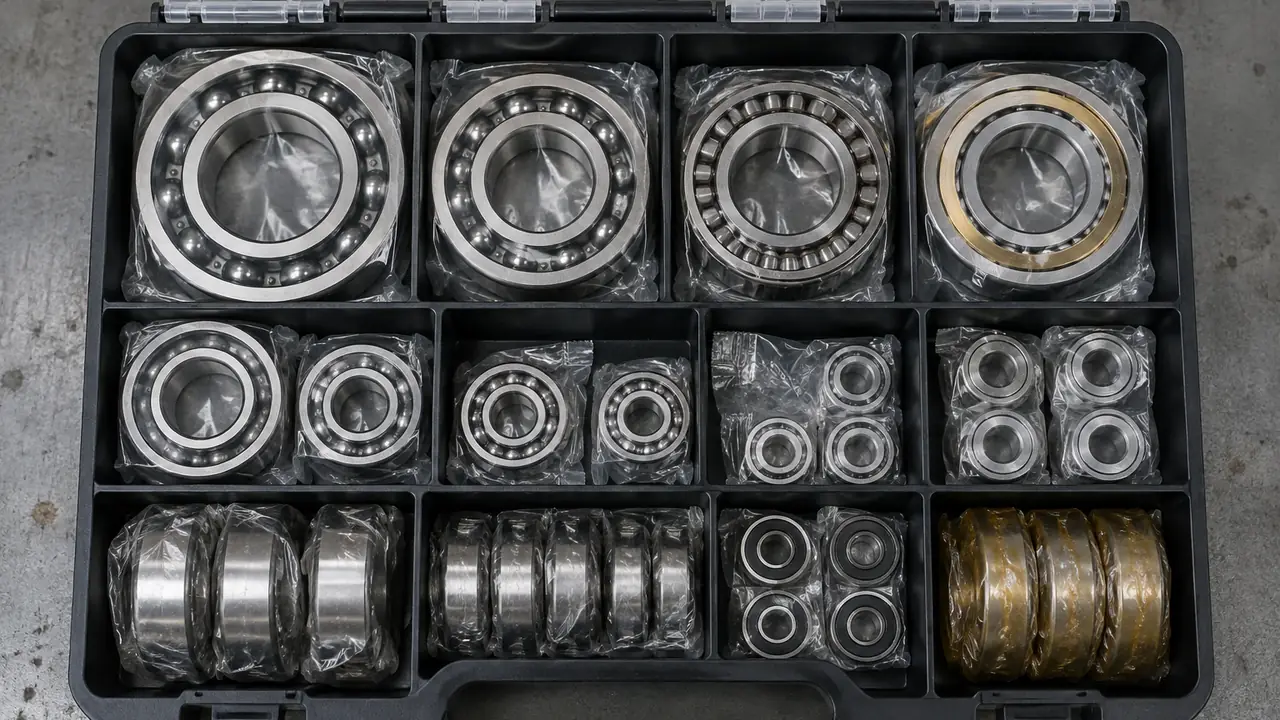
A bearing kit is a defined set of parts supplied together in one box so that a repair, a service or a stockroom can be covered without hunting for individual numbers. There is no single industry-wide kit format. Every kit is a list: which designations, how many of each, what else goes in the box, and how it is labelled. The desk composes that list with you and sources the parts from partner plants, so a kit is a sourcing program with a packing specification on top.
The three kinds below cover most requests from MRO distributors, automotive aftermarket sellers and OEM service departments.
Kit types compared
| Kit type | Typical contents | Used for | Main spec decision |
|---|---|---|---|
| Maintenance assortment | A spread of common deep groove sizes, sometimes with needle bearings, in a compartment tray | Workshop shelf, plant stores, resale to small workshops | Which sizes and how many per size |
| Wheel and hub kit | One or two tapered roller or ball bearings, a seal, sometimes a circlip or nut | Vehicle, trailer and agricultural wheel hubs | Exact fit to the hub, metric or inch |
| Repair kit for named equipment | The bearings, seals and retaining parts for one machine model or gearbox | Field service, dealer spares | Parts list from the equipment drawing |
Building a kit around your list
The composition is the part that decides whether a kit sells or sits. A few rules help.
- Start from consumption, not variety. A workshop uses the same ten sizes repeatedly. Fill the box with those, in quantities that match real usage, instead of padding it with rare sizes.
- Keep the bearing pair together. For wheel hubs, inner and outer bearings are replaced as a pair with their seal. State the pair and the seal in one line of the contents list.
- State the variant of each part. A 6204 can be open, ZZ or 2RS; seals have different materials. See the designation guide for the suffixes to write on the list.
- Confirm the fit. For equipment-specific repair kits, send the bearing numbers from the old parts or the drawing. If only the old part exists, measure bore, outside diameter and width; the size chart and how to measure a bearing help.
- Do not promise brand cross-references. Kits are built to dimensions and specification. Performance is compared on datasheets and samples, not assumed from a part number.
Custom kit composition and private label
Custom kits can use your own part number, box artwork, insert card and bar code. The packing format is chosen with the sales channel in mind: a retail box with a window for shelf sale, a plain carton with a contents sticker for industrial resale, or a compartment tray for a service van. Typical starting quantity for a custom version is around 1,000-5,000 boxes, because the box tooling, print and parts counting are set up per version. Standard assortments without custom print can start lower. Read more on OEM and private label.
Packaging and rust protection
Kits sit in storage longer than single bearings, so protection matters. Each bearing is coated with rust-preventive oil and wrapped in VCI paper or sealed in a VCI bag; seals and circlips are kept clean and separate from oiled parts so that oil does not contaminate rubber. Cartons are counted and sealed, then palletised for shipping. The method and the expected storage period are agreed up front, as described in packaging and anti-rust.
Typical mistakes to avoid
Three problems recur in kit programs. First, the contents list names a base designation without suffixes, so one plant ships open bearings and another ships sealed ones. Second, a wheel kit is ordered by vehicle model alone, without a bearing number or hub drawing, and the first batch does not fit. Third, the box is designed for a retail shelf but the product is sold through industrial channels, which adds cost and no value. A short review of the list with the desk before the first order avoids all three.
Inspection and ordering
For kits, the lot inspection checks the contents of sample boxes against the list, then the standard bearing checks on the parts themselves: dimensions, clearance, smooth rotation and marking, as set out in testing and inspection. Typical reference ranges: samples of stock assortments in 3-7 working days, custom sample kits in 15-30 days, batch production in 25-45 days, all confirmed in writing for each program. Send the contents list and quantity through the quote form; the desk replies with a sourcing plan and written terms.