
| Designation | Type | d bore | D outside | B width |
|---|---|---|---|---|
| 30203 | Tapered roller | 17 | 40 | 13.25 |
| 30204 | Tapered roller | 20 | 47 | 15.25 |
| 30205 | Tapered roller | 25 | 52 | 16.25 |
| 30206 | Tapered roller | 30 | 62 | 17.25 |
| 30208 | Tapered roller | 40 | 80 | 19.75 |
| 30210 | Tapered roller | 50 | 90 | 21.75 |
| 30304 | Tapered roller | 20 | 52 | 16.25 |
| 30306 | Tapered roller | 30 | 72 | 20.75 |
| 32005 | Tapered roller | 25 | 47 | 15 |
| 32008 | Tapered roller | 40 | 68 | 19 |
| 32206 | Tapered roller | 30 | 62 | 21.25 |
| 32210 | Tapered roller | 50 | 90 | 24.75 |
Nominal ISO boundary dimensions for reference. Confirm against your drawing and the supplier datasheet.
How a tapered roller bearing works
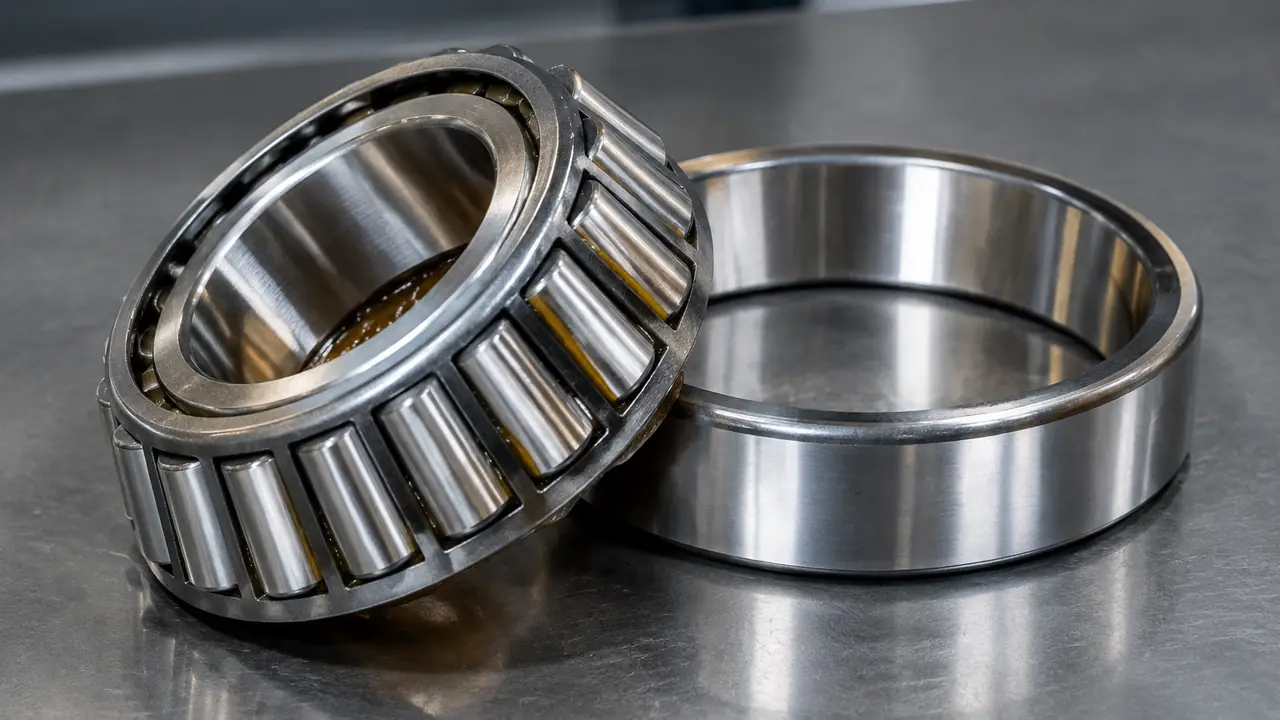
A tapered roller bearing has conical rollers running between a conical inner raceway and a conical outer raceway. The cone is the inner ring with its rollers and cage; the cup is the outer ring. The lines of the raceways and the roller axis meet at a common point on the shaft axis, which lets the rollers roll without skidding. The angle of the cup raceway sets how much axial load the bearing can take: a steeper angle carries more axial load and less radial.
The key feature is that a radial load generates an axial reaction inside the bearing. A single tapered bearing therefore only works if something pushes back, which is why they are mounted as an opposed pair on one shaft, either face to face or back to back. The pair then carries radial load plus axial load in both directions, and the setting between the two can be adjusted.
Setting: end play and preload
Unlike a ball bearing, the clearance of a tapered pair is set during assembly, by moving one cone or cup with a nut, shim pack or spacer. The result is either a small controlled end play or a light preload.
- End play. Common in hubs and general machinery where thermal growth must not seize the bearings.
- Preload. Used where stiffness and shaft positioning matter, such as pinion shafts. Too much preload raises temperature and shortens life.
The target figure comes from the machine design, not from the bearing, and the working setting changes as the shaft warms. Parts are supplied as matched cone and cup sets for this reason; mixing parts from different makers or batches can shift the setting and is not recommended. See the tapered roller bearing guide.
Metric series and inch sets
Metric tapered roller bearings follow ISO 355, which standardises bore, outside diameter and overall width. The first digits of the designation give the type and the dimension series: 302 and 303 are the light and medium series (written 302xx and 303xx, as in 30204 and 30305), while 320 and 322 are wider series with extra capacity (as in 32008 and 32208). Dimension examples, all nominal: 30204 is 20 x 47 x 15.25 mm, 30305 is 25 x 62 x 18.25 mm and 32008 is 40 x 68 x 19 mm. Confirm against the drawing.
| Series | Section | Typical use |
|---|---|---|
| 302 | Light, narrow | Pinions, small gearboxes, agricultural axles |
| 303 | Medium, larger outside diameter | Higher radial load at same bore, truck hubs |
| 320 | Light, wider (thin wall) | Machine spindles, compact reducers |
| 322 | Medium width | Reducers, wheel hubs, construction machinery |
| Inch cone-cup sets | Inch bore, outside diameter and width | Automotive aftermarket, trailers, farm implements |
Inch sets are numbered by cone and cup separately and must be matched; order both numbers together. The inch vs metric note explains how to read them, and the automotive aftermarket page shows how the desk packs hub sets.
Where they are used
- Wheel hubs for cars, trailers and light trucks, where combined load is permanent.
- Gear reducers and differentials, where helical and bevel gears generate axial thrust.
- Agricultural and construction machinery: axles, final drives and implement spindles.
- Rolling-mill and machine tool spindles that need stiffness from controlled preload.
Industry sources describe Wafangdian in Liaoning as strong in large tapered bearings for heavy equipment, while other clusters cover standard automotive and general-purpose sizes, and customs data cited by trade sources lists tapered roller bearings among China's main roller exports. IATF 16949 is a quality standard held by some partner plants; it is verified per project and Rolvane holds no certification itself.
Fits and lubrication
The cone is usually fitted with an interference fit on a rotating shaft, and the cup with a looser fit in the housing so that the setting can be adjusted without removing it. Grease or oil must reach the large end of the rollers, where the rib guides them; a lubricant that is too stiff or a seal that is too tight raises running temperature quickly. For hubs, state the grease type and whether the bearing is packed at assembly. See the lubrication guide for the basics.
Inspection and ordering
Typical checkpoints: bore, outside diameter and overall width against the class; cone and cup matched by marking; raceway and roller surface finish; cage condition; and rust protection. Torque to rotate and axial play of the assembled set can be checked on request. Standard designations commonly start from 100-500 pieces; private label and non-standard builds start higher; stock samples take 3-7 working days and production 25-45 days, all typical ranges confirmed in writing. List your cone and cup numbers in the quote form.