
| Designation | Type | d bore | D outside | B width |
|---|---|---|---|---|
| NU204 | Cylindrical roller | 20 | 47 | 14 |
| NU205 | Cylindrical roller | 25 | 52 | 15 |
| NU206 | Cylindrical roller | 30 | 62 | 16 |
| NU207 | Cylindrical roller | 35 | 72 | 17 |
| NU208 | Cylindrical roller | 40 | 80 | 18 |
| NU210 | Cylindrical roller | 50 | 90 | 20 |
| NU212 | Cylindrical roller | 60 | 110 | 22 |
| NU304 | Cylindrical roller | 20 | 52 | 15 |
| NU306 | Cylindrical roller | 30 | 72 | 19 |
| NU308 | Cylindrical roller | 40 | 90 | 23 |
| NU310 | Cylindrical roller | 50 | 110 | 27 |
Nominal ISO boundary dimensions for reference. Confirm against your drawing and the supplier datasheet.
What a cylindrical roller bearing does
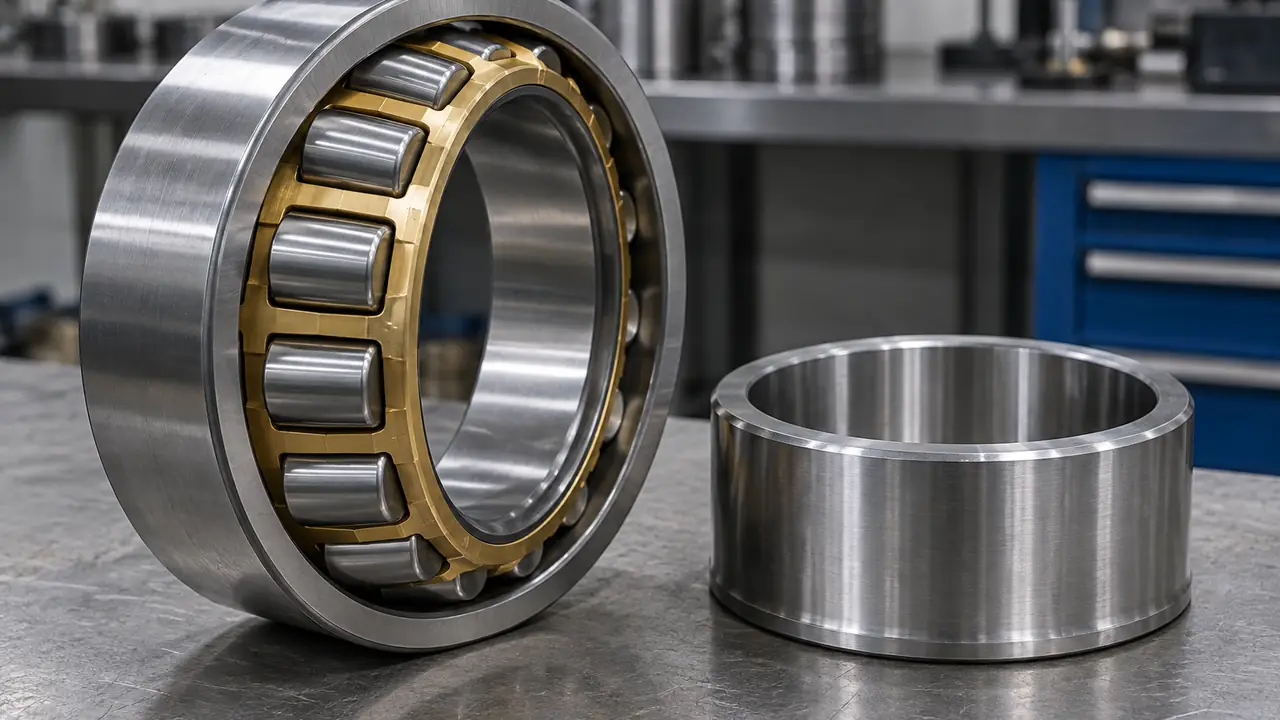
In a cylindrical roller bearing the rollers are straight cylinders running between ribbed ring raceways. Contact is along a line, so radial capacity and stiffness are high for the section, and the rollers roll rather than slide, so friction stays modest. Most designs have ribs on one ring only, which lets the other ring come apart from the roller and cage assembly. Separable rings make fitting easier because both rings can take an interference fit, which matters on rotating shafts and rotating housings alike.
The bearing is built for radial load. Axial load capacity is zero or small depending on the design, so cylindrical roller bearings are often paired with a ball bearing or tapered pair that locates the shaft, or used where the shaft is meant to float axially.
NU, NJ, NUP, N and NN: axial location
The letters describe where the ribs are. Choosing the right one is the main decision on this line.
| Design | Ribs | Axial behaviour | Typical position |
|---|---|---|---|
| NU | Two on outer ring, none on inner | Floats axially in both directions | Floating end of a shaft |
| N | Two on inner ring, none on outer | Floats axially in both directions | Floating end; mirror of NU |
| NJ | Two on outer ring, one on inner | Locates the shaft in one direction | Semi-fixed end |
| NUP | Two on outer ring, one rib plus loose rib ring on inner | Locates in both directions, light load | Fixed end |
| NN / NNU | Double row, tight tolerance | Radial stiffness for spindles | Machine tool spindles |
Axial capacity at the rib is limited and depends on lubrication, so treat NJ and NUP as location devices rather than thrust bearings. For significant axial load, add a bearing designed for it - see angular contact or tapered.
Series: NU2, NU3, NU22
The number after the letters follows the same dimension-series logic as ball bearings. NU2 is the light series, NU3 the medium series with a larger outside diameter for the same bore, and NU22 a wider variant of NU2 with higher capacity. Boundary dimensions follow ISO 15; for example NU204 is nominally 20 x 47 x 14 mm and NU306 nominally 30 x 72 x 19 mm. Always confirm against the drawing. The bore code works as for ball bearings: multiply by five from code 04 upward. See the designation guide.
Cages: brass, steel or polyamide
- Pressed steel. The economical standard for small and medium sizes with moderate speed and vibration.
- Machined brass. Stronger, tolerant of vibration and shock and common on larger sizes and heavy gearbox duty. Usually the choice where the bearing sees reversing loads.
- Glass-fibre reinforced polyamide. Quiet, light and low friction, suited to moderate temperature and electric motor duty. Check the temperature limit with the grease or oil used.
More on materials is on the bearing cage page, and on steel and nylon trade-offs in nylon vs steel cage.
Where they are used
Typical applications are industrial gearboxes, large electric motors, pumps, compressors, rolling mill auxiliaries, machine tool spindles and construction machinery transmissions. In a motor, an NU bearing at the drive end with a deep groove ball bearing at the other end is a classic arrangement: the ball bearing fixes the rotor axially while the roller bearing carries the heavier radial belt or coupling load and absorbs thermal growth. In gearboxes, NJ or NUP bearings often locate helical gear shafts that see small axial components.
Cylindrical roller bearings are among the main roller categories in China's bearing exports according to customs data cited by trade sources. The desk shortlists plants by tolerance class, cage type and clearance needed. Radial clearance matters a great deal here because the interference fit on the inner ring closes it; C3 is common for warm-running motors. See C3 clearance explained.
Inspection and ordering
Typical checkpoints are bore and outside diameter against the tolerance class, radial internal clearance of the assembled set, roller and raceway surface finish, cage fit, rib condition and marking. Roller diameter grouping inside one bearing is also checked on request. Standard designations commonly start from 100-500 pieces; private-label marking starts higher; non-standard dimensions are assessed from the drawing. Stock samples ship in 3-7 working days and production takes 25-45 days, all as typical reference ranges confirmed in writing. Send your designation list through the quote form.