
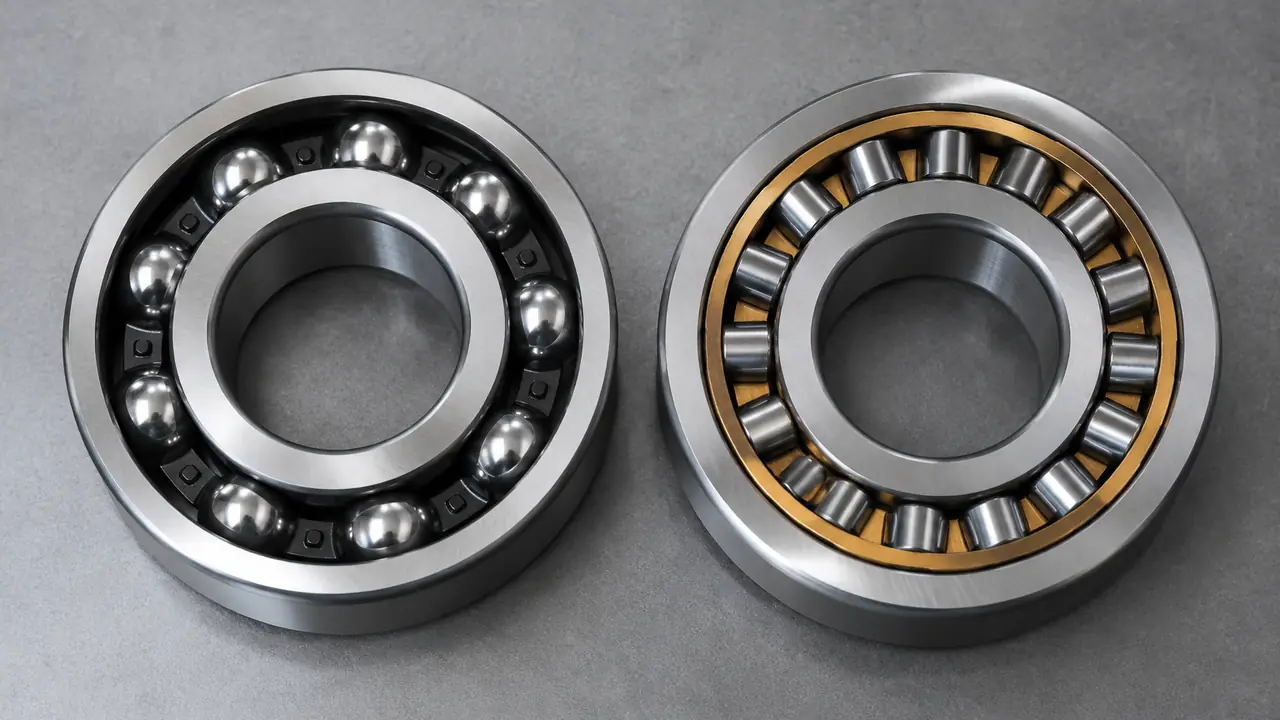
What the cage does and why material matters
The cage, also called a retainer, spaces the balls or rollers evenly, stops them rubbing on each other and carries them through the unloaded zone of the bearing. It carries little load itself, but it experiences constant friction, centrifugal force, vibration and heat. A poor cage causes noise first, then heat, then seizure, even when the rings and rolling elements are sound. This is why cage material and design are called out in a good bearing specification and are on the checklist in the bearing cage materials note.
The three common materials are pressed steel (stamped from strip and riveted or snapped together), glass-fibre reinforced polyamide 66 (PA66-GF, injection moulded and snapped over the rolling elements) and machined brass (turned or milled from solid, in a single piece or two halves). Others, such as phenolic resin, appear in precision bearings. The Chinese cage industry is concentrated near Linqing in Shandong, as described on the industry clusters page.
Side-by-side comparison
The comparison covers nylon (PA66-GF) and pressed steel, with brass noted where useful. Exact temperature and speed limits depend on the polymer grade, the lubricant and the bearing size, and come from the datasheet.
| Criterion | Nylon PA66-GF cage | Pressed steel cage |
|---|---|---|
| Load direction | Not load-carrying; positions balls or rollers in any load direction | Not load-carrying; same |
| Load capacity | Low strength; fails under shock or high temperature | Strong and tolerant of shock; brass is stronger still |
| Speed | High; light and smooth, low inertia | High to moderate; mass limits very high speed |
| Misalignment tolerance | Flexible; snaps back, adapts to small distortions | Stiff; rivets can wear if distorted |
| Friction and noise | Quiet, low friction, soft contact with balls | Slightly louder; metal-to-metal contact |
| Maintenance | Needs compatible grease; limited by temperature | Tolerates a wide range of greases and oils |
| Typical applications | Motors, appliances, pumps, light and medium duty machines | General industry, hot and dirty sites, vibrating equipment |
| Relative cost factors | Low at volume; tool cost recovered over large runs | Lowest in most cases; simple stamping, mature supply |
Speed and noise: where nylon helps
Nylon is light and slightly resilient. The balls sit in pockets that give a little, so contact is soft and noise is low. In deep groove ball bearings for motors, fans and household appliances, a polyamide cage is often chosen to reduce noise and to allow high speed with low friction. In angular contact bearings for pump shafts, it also helps. Because the polymer is self-lubricating to a degree, it handles brief marginal lubrication better than a metal cage.
Pressed steel is heavier, and at the highest speeds the inertia of a heavy cage shows as heat and wear. For ultra-high speed, precision bearings use machined phenolic or polymer cages designed for the speed, which are outside the range of simple stamped cages. The comparison of the bearings themselves is in deep groove vs angular contact.
Heat, chemicals and shock: where steel wins
Nylon has a temperature ceiling. At sustained high temperature it softens, becomes brittle with age, and loses strength; some synthetic oils and greases and additive packages attack it over time. A bearing running hot in a gearbox with aggressive oil, or in an engine bay, is a poor place for PA66-GF unless the grade is specified for it. Pressed steel does not care about temperature within the bearing steel limits and is chemically robust.
Steel also takes shock and vibration better. A polymer cage may crack under heavy impact or sustained vibration, particularly in large bearings with heavy balls; this is why vibrating screens, crushers and construction machines commonly use steel or brass cages. For these cases brass is the traditional upgrade over pressed steel, with higher strength and good wear properties, at higher cost. Check the grade and the operating temperature in the supplier datasheet.
Grease compatibility and ageing
Cage material interacts with grease. Nylon ages with heat and exposure to certain base oils and additives, so the combination must be compatible; most general-purpose lithium greases are fine, while some high-temperature or synthetic products need checking. Steel cages carry no such restriction, though the grease must still suit the speed and temperature of the application. Ask for the cage material and the grease name together on the specification. The bearing grease page lists common options.
Cage design matters as much as material
Material is only half of the answer. Pressed steel cages come as ribbon-type or crown-type designs; the crown type is common in deep groove bearings and is held by rivets or snaps, while the ribbon type is lighter. Nylon cages are usually crown-type, snapped over the balls in one piece. How the pockets guide the balls, whether the cage is guided by the balls or by a ring land, and how much clearance it has in the pocket all affect noise, heat and life. Two bearings with the same cage material from different plants can therefore feel quite different in hand. Compare samples under the same load and grease rather than trusting the material name alone, and keep the sample as the reference for later batches.
Sourcing and checking
A cage is hard to see in a finished bearing, which is why it is a favoured place for quiet substitution. To check, ask the partner plant to state the cage material in writing, request photographs of the open sample, and compare weight and noise with an agreed reference. Spot checks by opening a sample on arrival are a simple safeguard. Reference MOQ and lead time ranges are on the MOQ and lead time page and are confirmed in writing for each program.
How to decide
- What is the operating temperature? If it is high or goes through large swings, choose steel or brass.
- Is there shock or heavy vibration? Choose pressed steel or brass.
- Is quiet running and low friction the priority, as in a motor or appliance? Choose nylon PA66-GF.
- Is the grease or oil aggressive towards polymers? Check compatibility, or choose steel.
- Is the speed very high? Ask for precision cage designs, not a stock stamped steel cage.
- Write the cage material into the purchase order next to the designation.
Include the cage in the specification on the quote form; the desk will confirm availability from partner plants.