
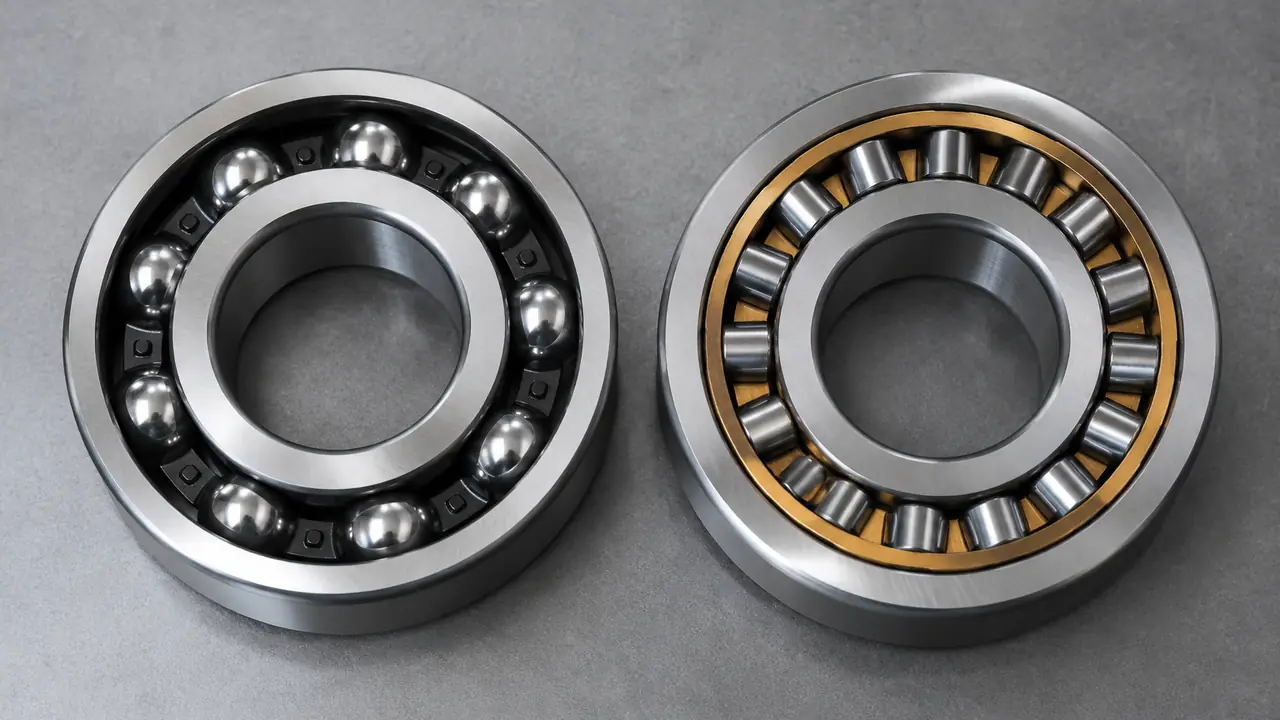
Same family, different geometry
A deep groove ball bearing has a symmetrical raceway groove on both rings, so the balls sit in the middle and the contact is nearly straight across the bearing. It carries radial load and a moderate axial load in either direction. An angular contact ball bearing has one raceway shoulder removed on each ring, so the balls touch the rings along a tilted line. The angle of that line, called the contact angle, is commonly 15 degrees, 25 degrees or 40 degrees, indicated by the suffix C, AC or B. A larger angle carries more axial load and less speed; a smaller angle favours speed and stiffness.
Because the contact is tilted, a single angular contact bearing carries axial load in one direction only. That is why they are normally fitted in pairs or sets. Deep groove bearings are used singly, and can often be the only bearing at each end of a shaft.
Side-by-side comparison
Relative terms only; exact ratings and speeds come from the datasheet. Typical series are 60, 62, 63 for deep groove and 70, 72, 73 for angular contact, as listed in the size chart.
| Criterion | Deep groove | Angular contact |
|---|---|---|
| Load direction | Radial plus modest axial in both directions | Radial plus higher axial in one direction; pairs cover both |
| Load capacity | Medium; axial share is limited | Higher axial share, rising with contact angle |
| Speed | High, especially in open and shielded forms | High to very high in precision classes |
| Misalignment tolerance | Low | Very low; needs accurate seats |
| Friction and noise | Low and quiet | Low; noise depends on preload and set accuracy |
| Maintenance | Often sealed and lubricated for life | Open, shielded or sealed; precision sets often oil-lubricated |
| Typical applications | Motors, fans, appliances, pumps, light gearboxes | Pump shafts, machine-tool spindles, screw supports, worm gears |
| Relative cost factors | Lowest unit cost, widest stock | Higher unit cost, matched sets and tighter classes |
Axial load is the deciding question
If the axial load is small compared with the radial load, a deep groove bearing is almost always enough, and its simplicity is an advantage. A common guide is to look at the ratio of axial to radial load and check the supplier datasheet limit for the designation: when the axial share is moderate or the load direction is constant, the deep groove bearing starts to lose life quickly and an angular contact type is the better answer. The exact threshold depends on bearing size and series, so ask the supplier to confirm it in writing rather than relying on a rule of thumb.
Typical cases that call for angular contact bearings are a pump shaft with a steady thrust from the impeller, a worm gear shaft, a ball screw end support and a spindle that is pushed by the cutting force. In each case the axial load always acts in the same sense, so the bearing can be set to carry it.
Pairing and preload
Angular contact bearings come in single-row form for one-direction thrust, and in matched pairs for two-direction loads. Three common arrangements are used.
- Back to back (DB): the load lines diverge, giving high moment stiffness and good resistance to tilting.
- Face to face (DF): the load lines converge, which is more tolerant of small misalignment but less stiff in tilt.
- Tandem (DT): both bearings point the same way and share a heavy axial load in one direction.
Precision pairs are ground so that a defined preload is built in when the two are clamped together. That preload removes play and raises stiffness, but it also adds friction and heat, so it must match the speed and lubricant. For general-purpose pumps and gearboxes, universal-pair bearings (suitable for any arrangement) are often used. For machine tools, the supplier supplies sets with matched tolerances. See the high-speed bearing line for the precision end of the range.
Precision, speed and handling
Both bearings reach P6 and P5 tolerance classes (ISO 492 Normal, 6, 5, 4), but the angular contact type is the one mostly specified at P5 and P4 for spindles. High-precision work calls for matched sets, clean assembly and controlled grease or oil, none of which is needed for a sealed deep groove bearing in a small motor. That difference in handling is a real cost factor: the bearing itself is only part of the price of a precision set.
Cage choice also differs. Polyamide cages are common in angular contact bearings for pumps and general machinery because they run quietly; machined brass or phenolic cages appear in spindles. Check the temperature rating and grease compatibility of the cage in the datasheet.
Where this fits in sourcing
Deep groove bearings are the easiest line to source: many sizes, many closures, and short lead times on standard types. Angular contact bearings require more specification at the enquiry stage: contact angle, arrangement, preload class, tolerance class and cage. Missing one of these is the most common reason a quotation is slow. Reference MOQ and lead time ranges are on the MOQ and lead time page and are confirmed in writing for each program. The wider comparison with rollers is in ball vs roller bearings.
How to decide
- Estimate how much of the total load is axial and in which direction. Check the direction is constant.
- If axial load is small or alternating and speed is high, choose a deep groove ball bearing.
- If axial load is significant and acts in one direction, choose angular contact; use a pair if it acts both ways.
- Pick the contact angle by priority: 15 degrees for speed and stiffness, 25 degrees as a general compromise, 40 degrees for heavy thrust.
- For stiffness against tilting, choose back-to-back; for tolerance of small misalignment, face-to-face.
- Specify seat accuracy and preload class in the enquiry, then confirm in the datasheet.
Include the shaft layout when you send an enquiry through the quote form; it saves a round of questions.