
Why this bearing dominates catalogues
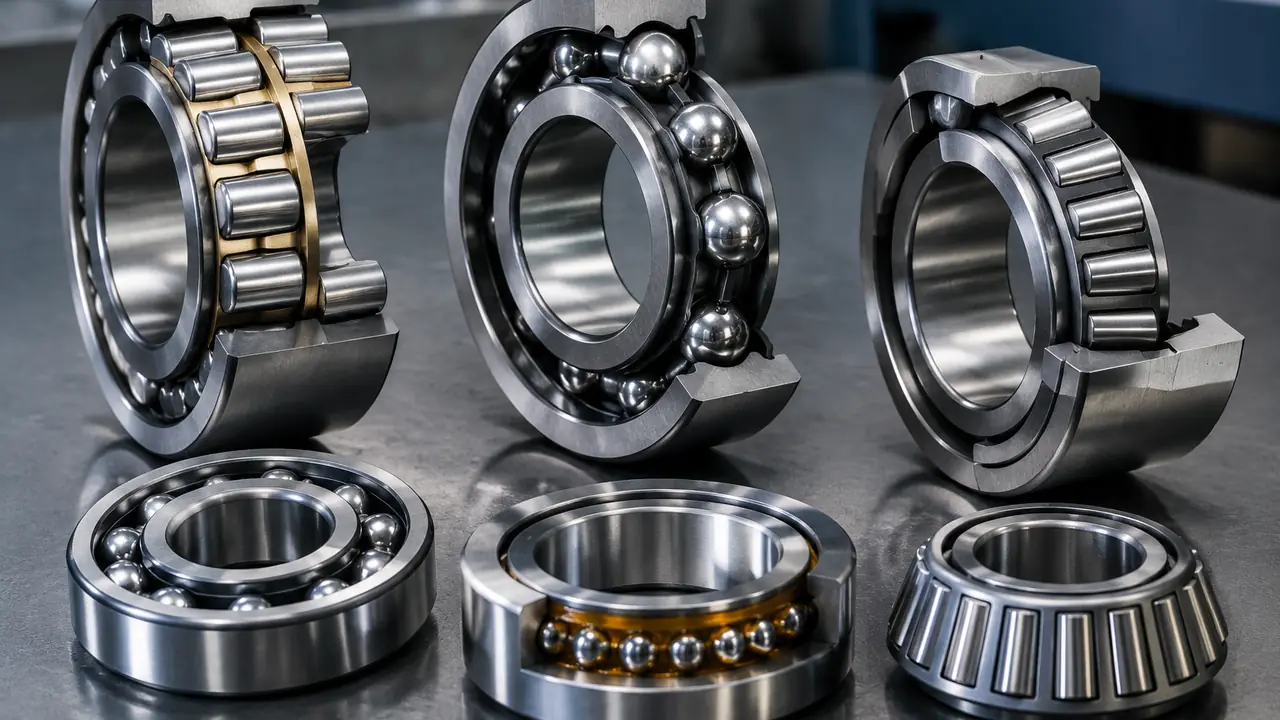
A deep groove ball bearing has a single row of balls running in deep, continuous raceway grooves in the inner and outer rings. That simple geometry gives it a rare combination: it carries radial load, it carries a moderate axial load in either direction, it runs fast and quietly, and it is cheap to make in volume. Customs data summarised by Bearing News ranks deep groove ball bearings among the main product categories in China's 2024 rolling-bearing exports, which tells you how much of the world's catalogue business sits in this one type.
For a buyer the consequence is practical. The type is made by many plants, in many grades, and the same designation can be quoted at very different quality levels. A good specification therefore matters more here than for almost any other bearing. The basic ideas behind the type are in how ball bearings work; this note is about ordering.
Reading the series
Deep groove bearings are grouped into dimension series. The bore is the same within a column of the table below; the outside diameter and width grow as the series gets heavier. Values are nominal ISO 15 boundary dimensions in mm for a 25 mm bore; confirm against the drawing and supplier datasheet.
| Designation | Series | Bore d | OD D | Width B |
|---|---|---|---|---|
| 6805 | 68, ultra-thin | 25 | 37 | 7 |
| 6005 | 60, extra light | 25 | 47 | 12 |
| 6205 | 62, light | 25 | 52 | 15 |
| 6305 | 63, medium | 25 | 62 | 17 |
Heavier series have larger balls and rings, so they carry more load in the same bore, at the cost of space and weight. The 62 and 63 series are the workhorses; the 68 and 69 series suit tight radial space. Small bores below 10 mm belong to the miniature range, such as the 608 (8 x 22 x 7 mm nominal). To check a designation quickly use the size chart, and for the code logic see the designation guide.
Open, ZZ or 2RS
The same bearing is offered in three sealing arrangements, and the choice is often the first cost and reliability decision on the drawing.
| Version | What it is | Best for | Watch out for |
|---|---|---|---|
| Open | No cover; oil or grease supplied by the machine | Oil-bath gearboxes, high speed, clean sites | Needs an external seal and a lubrication plan |
| ZZ / 2Z | Pressed metal shields, no rubbing contact | Motors, fans, moderate dust at speed | Does not stop fine dust or water |
| 2RS | Contact rubber seals, usually nitrile | Wet or dusty sites, lower speed | Seal drag adds friction and heat at high speed |
The trade-offs are covered in depth in 2RS vs ZZ bearings and open vs sealed bearings. As a rule, the faster the shaft, the more you lean toward shields or open; the dirtier the site, the more you lean toward contact seals.
Clearance, tolerance and noise
Three suffixes decide most of the real-world behaviour of a deep groove bearing.
- Internal clearance. Normal (CN) is the default. C3 is larger and is common for electric motors and any application where the inner ring runs warmer than the housing or the fit is tight. See C3 clearance explained.
- Tolerance class. Normal (P0) is standard; P6 and P5 under ISO 492 tighten running accuracy for spindles and precise equipment. Do not pay for P5 on a belt conveyor idler.
- Vibration grade. Z1, Z2, Z3 or V1 to V3 groups express noise and vibration limits and are agreed per order. Motor and appliance buyers should state it, because noise is where plants differ most. See the vibration grade note.
Cage material also matters. Pressed steel is the standard and handles heat well; glass-fibre nylon runs quietly and suits many motor bearings; machined brass is used for heavy duty or high shock. A designation like 6205-2RS C3 therefore leaves several things open, and a careful buyer states the cage and grease as well.
Where deep groove bearings stop
The type has limits that are worth knowing before a failure teaches them. It tolerates only a small angular misalignment between shaft and housing; where the shaft deflects, a self-aligning ball bearing is safer. The axial load it can take is modest, and a pure or large axial load calls for an angular contact bearing; the comparison is set out in deep groove vs angular contact. For heavy radial load in a given bore, a cylindrical roller bearing has more capacity, though it gives up speed and axial guidance.
Load ratings and limiting speeds differ by series, size, seal and plant. Take them from the supplier datasheet for the exact designation rather than from a general table, and check the speed limit for the sealed version, which is usually lower than for the open one.
Checks at incoming inspection
Because the type is so common, a few simple checks at receiving catch most problems before bearings reach the line. Measure bore and outside diameter against the drawing with calibrated gauges, since a bearing that is slightly out of tolerance may still look perfect. Spin a sample by hand: it should turn smoothly and evenly, without catches, roughness or rattle. Look at the seals for even seating and at the grease for the colour and amount you approved. Check that the marking, designation and batch code match the packing list, and that the rust-preventive film is intact and the wrapping is not damaged.
For motor or appliance programs, add a noise listening test on a small sample against an approved reference bearing. A written first-article report from the partner plant, followed by batch records for each shipment, keeps results comparable from one order to the next. The checks that can be agreed with a plant are listed on the testing and inspection page.
What to put in the RFQ
- Full designation including series, seal, clearance and tolerance class, for example 6205-2RS C3.
- Cage type and grease type if noise, temperature or food contact matter.
- Vibration grade for motors and appliances.
- Application, speed, load and temperature in two lines.
- Quantity per designation, marking and packing requirements, and delivery date.
Standard stock designations typically start at about 100 to 500 pieces per designation, and branded boxes or laser marking at roughly 1,000 to 5,000, all confirmed in writing for each program. Details are on the MOQ and lead time page. When the specification is ready, send it through the quote form and the desk will shortlist partner plants against your grade and noise requirements.