
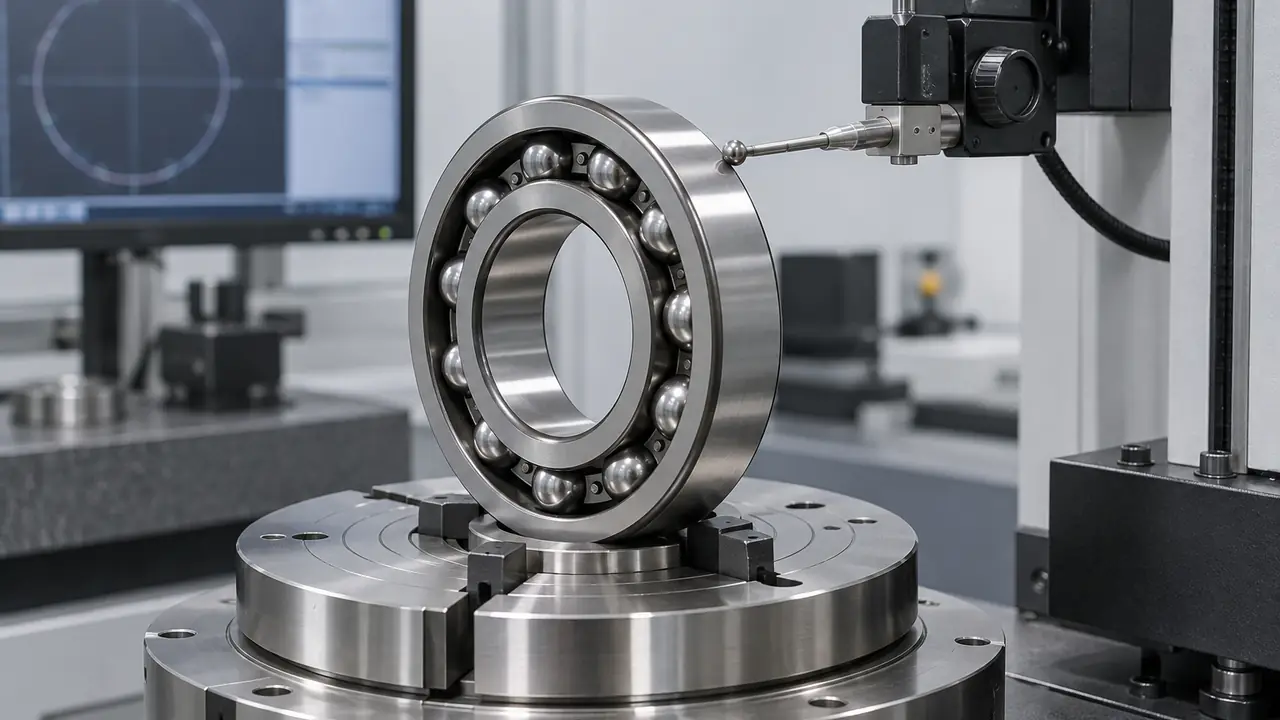
Why a separate vibration grade exists
Tolerance classes such as P0 or P5 describe size and runout. They do not describe how much noise or vibration a bearing makes when it turns. Two bearings of the same class can sound very different, because noise depends on raceway waviness, surface finish, ball roundness, cage fit, lubricant cleanliness and contamination. For electric motors, fans, air conditioners and household appliances, noise is a product feature, so the buyer needs a way to ask for a quieter bearing and have the answer checked. Vibration grades fill that gap.
The grades are applied on top of the normal specification. A bearing ordered as 6203-2RS P6 Z2 asks for a tolerance class and a vibration group at the same time, and the supplier tests for both.
Where the labels come from
The Z grades (Z1, Z2, Z3) are the labels most commonly used in Chinese bearing practice and datasheets. They sit within the GB/T vibration measurement system, commonly cited through GB/T 24610 for deep groove ball bearings. The V grades (V1, V2, V3) are the labels used by many export customers, often in motor industry practice, and map onto similar test methods. Because the labels come from product standards, trade practice and plants' own internal rules, the same label may not carry identical limits everywhere.
In common practice, a lower number in a series means a lower allowed vibration level, but this should always be checked in the table the supplier uses. The figures are set per bearing size and band and are not reproduced here; the actual limits come from the standard or the supplier datasheet and the order.
| Label | Where met | What it tells the buyer |
|---|---|---|
| Z1, Z2, Z3 | Chinese datasheets, domestic motor and appliance makers | Vibration group within the GB/T system |
| V1, V2, V3 | Export enquiries, motor specifications | Vibration group in a comparable system |
| Plant standard | Partner plant datasheet | Internal test, defined in the plant's own document |
How vibration is measured
The test is run on a dedicated rig. The bearing is mounted on a spindle, the inner ring is turned at a fixed speed, a light axial load holds the rings in contact, and a sensor on the outer ring picks up vibration velocity. The signal is filtered into frequency bands, typically low, medium and high, because different faults appear at different frequencies. Low-band energy is associated with waviness of the raceways, while high-band energy relates to surface roughness, small defects and contamination.
A grade is assigned when the readings in each band fall under the limits for that grade. Three things influence the result more than buyers expect:
- The rig. Different rigs, speeds and loads give different readings. A bearing certified on one rig may read differently on another.
- Lubrication state. A bearing tested dry reads differently from one filled with grease. The test condition should be stated.
- Cleanliness. Dirt or debris on a bearing during the test adds to the high band readings, which is why plants test in clean rooms.
Choosing a grade
Grade selection follows the product. A general-purpose fan or a farm machine rarely needs one, since the standard grade is sufficient. A mains-driven motor in a household appliance or an HVAC fan is the usual home of Z2 or Z3-level specifications, because customers hear the noise. Premium low-noise motors, medical devices and office equipment are the common reasons for stricter grades. Each step down in permitted vibration adds cost through cleaner steel, better grinding, better balls and tighter inspection, and a sharply lower grade narrows the supplier pool.
Noise also depends on parts other than the bearing: motor rotor balance, end-cap fit and housing resonance. If a new bearing grade does not change the noise at all, the bearing may not be the source. Test a sample in the real assembly before committing a large order.
What else belongs in a low-noise specification
Vibration grade is one element of a low-noise bearing. The others should be written next to it:
- Precision class, usually P6 or better for quiet motors; see precision classes.
- Ball grade under ISO 3290, since ball roundness drives noise.
- Cage material and style; nylon cages tend to run quietly at moderate temperature.
- Low-noise grease and its fill amount, covered in the lubrication guide.
- Seal or shield type, since contact seals add a little drag noise.
- Clearance group, often C3 in motors.
Why grades differ between plants
A vibration label is only comparable if the test is. Several choices vary from one plant to another: the speed of the test spindle, the axial load applied, the frequency band edges, whether the reading is an average or a peak, and how many bearings are tested from each lot. Some plants test every bearing on an automatic line, others test a sample. A plant that tests every piece can sort a mixed lot into grades, which is how Z2 or Z3 volumes are often produced, while a plant that samples can only say that the lot passed on average.
For a buyer the consequence is simple. Ask whether the grade is 100 percent tested or sampled, and ask for the record. A grade without a stated test method is a label, not a measurement, and it should be treated as an agreement to verify on the first lot.
How to specify and verify
Write the grade and the test condition together, for example "Z2 grade tested on the supplier's rig at the agreed speed, bearings greased". Ask the partner plant to attach the test record to the first lot and to supply reference samples that your own team can keep. Agree a retest rule for disputes: a sealed retained sample set with known vibration readings avoids long arguments. For ongoing programs, the desk sets up batch records and spot checks, as described on the testing and inspection page.
If you buy small deep groove bearings for motors or appliances, the deep groove ball bearing page lists the series and options. Send your target grade, designation, application and quantity through the quote form, and the desk will shortlist partner plants that can supply and test the grade. Quality-system certificates, such as ISO 9001, are held by the plants and verified per project.