
Start by describing the sound
Bearing noise is easier to sort when it is described in plain words and tied to when it happens. Does it change with speed, with load or with temperature? Is it constant, rhythmic or random? Does it disappear when the machine is uncoupled? These four questions often remove half the possible causes before anyone touches a tool.
A new bearing always makes some sound. Rolling contact on a precision-ground surface produces a low, even hiss that is part of normal running. Trouble starts when the sound becomes louder than the baseline, changes pitch, or adds clicks, rumble or squeal. Low-noise applications such as small motors and appliances specify a vibration grade for exactly this reason; see Z1-Z3 and V1-V3 grades for the system.
Symptom, likely cause and first check
| Sound | Likely cause | First check |
|---|---|---|
| Steady hiss or light whistle | Normal rolling noise, or too little clearance after fitting | Temperature; compare with a reference unit |
| Rumble or growl that rises with speed | Raceway damage, dents from mounting, or contamination | Turn by hand; feel for roughness |
| Rhythmic clicking | Local damage on one ring, or a loose cage | Frequency versus shaft speed; visual inspection |
| High-pitched squeal | Dry running, grease starvation or skidding at light load | Grease type, fill and age; preload |
| Irregular crunching | Hard particles in the lubricant | Seal condition; grease cleanliness |
| Low hum at one speed only | Resonance of housing, frame or cover | Change speed slightly; check mounting bolts |
| Knock when load reverses | Excess clearance or a loose fit on the shaft or in the housing | Fit measurements; fretting marks on seats |
Sources inside the bearing
Internal clearance. Too much clearance lets the rolling elements move and rattle; too little makes them squeeze and whine. Motor bearings often use C3 clearance because the inner ring warms up and expands more than the housing. The reasoning is explained in C3 clearance explained.
Lubricant. Wrong grease consistency, too much grease churning at speed, or grease that has aged and hardened all generate noise. Low-noise greases are formulated with clean, fine thickeners and are matched to the vibration grade of the bearing. Mixing incompatible greases during relubrication can break the thickener and produce a sudden noise change. See the lubrication guide.
Manufacturing quality. Waviness on the raceway, uneven ball sizes and cage tolerance affect noise even in a correctly designated bearing. Two plants can both supply a 6204-2RS with the same dimensions and different noise levels. This is why the vibration or noise test is an agreed item per order and not an assumption, as outlined in testing and inspection.
Sources outside the bearing
A bearing is often blamed for noise that its surroundings amplify. A thin sheet-metal cover, a loose guard or a resonant frame turns a normal bearing sound into a hum. Conveyor idlers, fans and appliance motors are typical examples. Shaft out-of-balance and belt tension add rhythmic noise at shaft speed or at belt frequency.
Fit problems belong here too. An out-of-round housing bore squeezes the outer ring into an oval shape, and the bearing then runs rough even though it is perfect. A burr on the shaft shoulder prevents the ring from seating square, which causes both noise and early wear. These problems are linked to misalignment, and they survive bearing replacement unless found.
Damage that creates noise
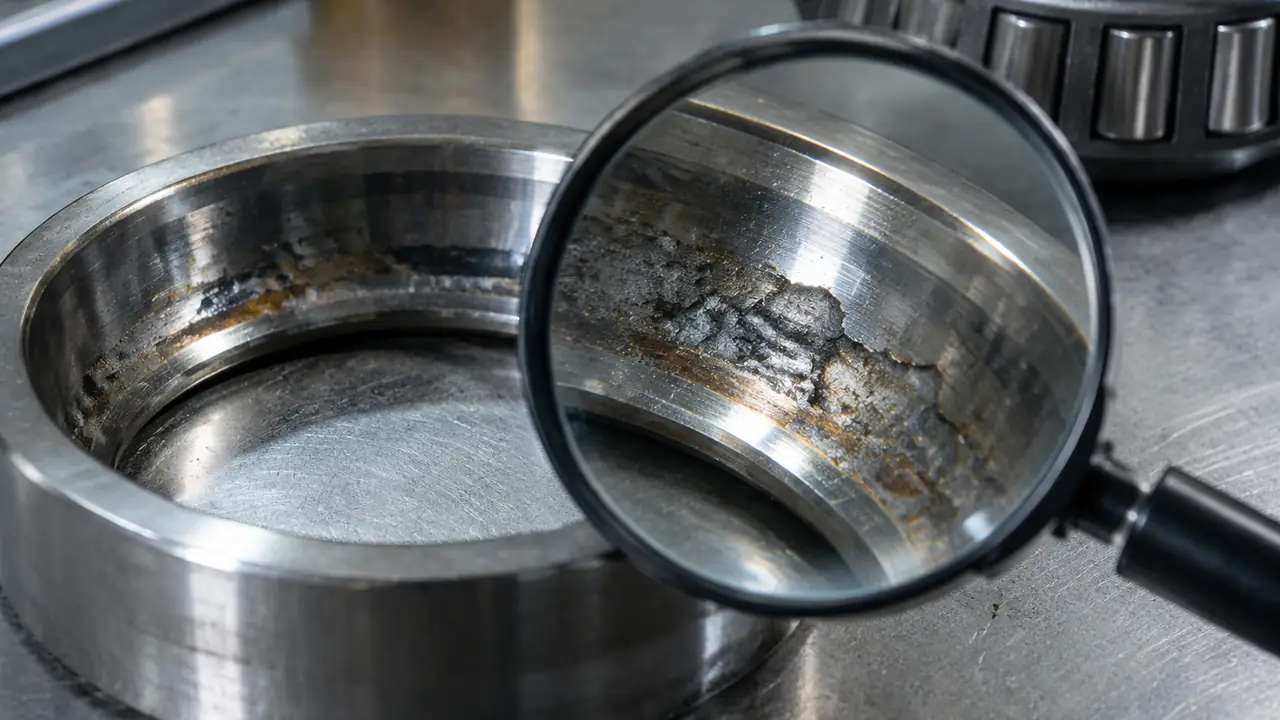
Once a bearing has surface damage, the noise is permanent and tends to worsen. The common origins are:
- Dents from impact during mounting or transport, which give a clicking or rumble once per ball pass.
- Particle indentation from dirt, giving a gritty rumble that rises with speed.
- Early spalling, giving a rough growl and later vibration; see reading spalling damage.
- Fluting from stray electrical current in motors, giving a regular whine; see electrical erosion.
- Standstill vibration damage during shipping, covered in false brinelling.
A first-check order that saves time
- Confirm the sound comes from the bearing: use a listening rod or stethoscope at the housing, and compare with a known good unit.
- Check mounting: loose bolts, soft foot, cover contact, belt tension and balance.
- Check temperature. A bearing that is noisy and warm points to clearance, fit or lubrication; one that is noisy and cool points to damage or looseness.
- Inspect the grease for colour, grit and quantity.
- Measure the seats if the bearing is loose, hot or showing fretting.
- Replace only after the cause is clear, and record the batch of the new bearing.
Frequency clues for maintenance teams
Where a vibration analyser is available, the frequency of the noise says more than the ear can. Damage on the outer ring repeats at a rate set by the number of rolling elements and the shaft speed, damage on the inner ring repeats at a slightly different rate with side bands at shaft speed, and damage on a rolling element or the cage appears at lower rates. The exact factors depend on bearing geometry and come from the supplier datasheet or a calculation for the specific designation; they should not be guessed. Even without an analyser, a simple observation helps: a sound that repeats once per shaft turn points toward shaft, coupling or balance, while a sound that repeats several times per turn points toward the bearing itself.
It also helps to separate load noise from speed noise. Noise that grows with load but not with speed suggests clearance or fit trouble; noise that grows with speed at constant load suggests lubrication, cage or surface condition. Writing these observations down before the bearing is removed gives the supplier or an independent lab a far better starting point than a bare statement that the bearing is noisy.
Specifying a quieter bearing
If the application needs low noise, state it in the request. A purchase specification with the designation, seal type, clearance, vibration grade and grease type gives the plant something to meet and test against. Typical examples are deep groove bearings with Z2 or Z3 vibration grade and low-noise grease for appliance motors. Samples are usually available in a few working days for stock sizes, with the timing confirmed in writing for each program; see MOQ and lead time for the reference ranges. The deep groove ball bearing page lists the series commonly used in quiet applications.