
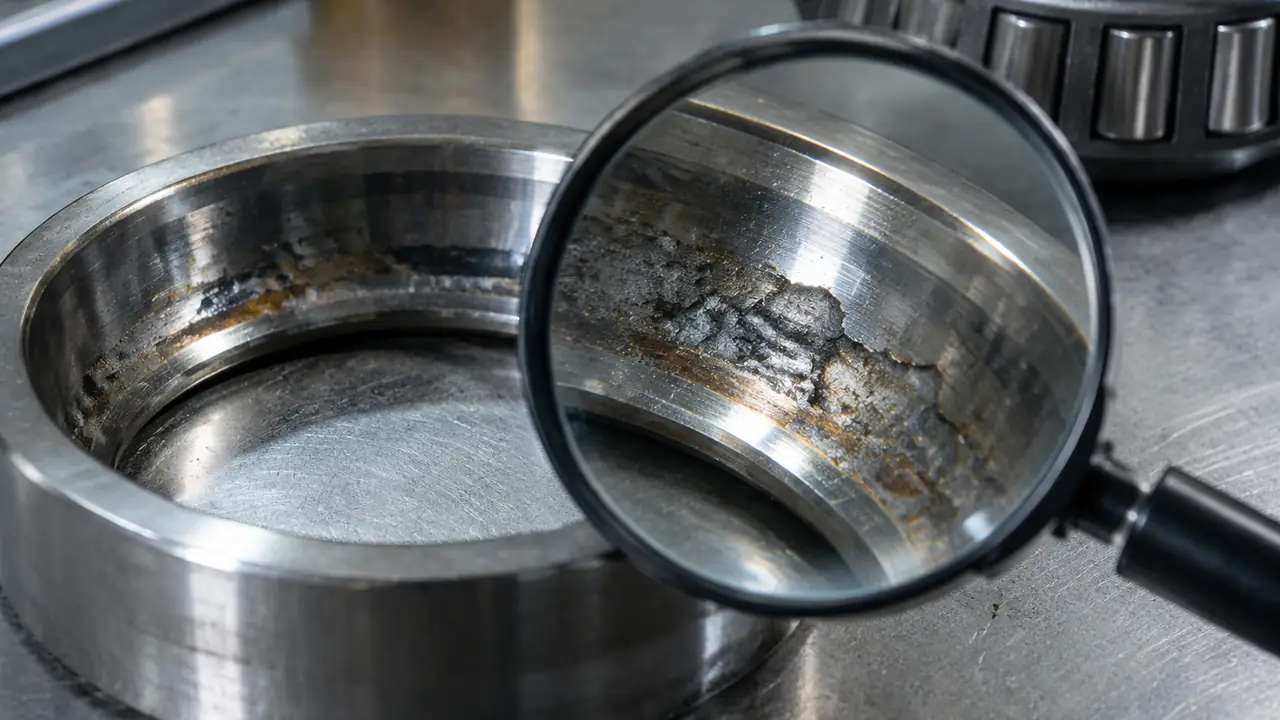
What false brinelling is
False brinelling is wear at the contacts of a bearing that does not rotate. It happens when small vibrations make the rolling elements oscillate by tiny amounts against the raceway. The oscillation squeezes out the lubricant film and rubs the two surfaces together. Tiny particles of steel are worn away and oxidise, forming reddish-brown debris, and the surface shows shallow, polished or etched marks exactly where the balls or rollers sat. The marks are spaced at the pitch of the rolling elements, which is why they look like true brinell dents.
In the general classification of ISO 15243 this falls under wear, a form of fretting. The name draws the comparison with true brinelling, which is permanent plastic deformation from overload. The difference matters because the cause, the evidence and the remedy are different.
False brinelling versus true brinelling
| Feature | False brinelling | True brinelling |
|---|---|---|
| Mechanism | Micro-movement and fretting wear at standstill | Plastic deformation of the raceway from overload or shock |
| Surface | Polished, etched or dull, often with rust-coloured debris; edges not raised | Smooth indentation with raised edges, matching the ball or roller |
| Depth | Shallow, wear-like | Dent of measurable depth |
| Lubricant | Squeezed out at the marks; grease may be dark | Normal |
| Typical cause | Vibration in transport, idle machines near running equipment | Impact, dropped bearing, hammering during mounting |
| Result in service | Noise, vibration at ball pass rate, fatigue starting at the marks | Same symptoms; depth often more severe |
It is not always possible to tell them apart by eye. A microscope or surface profile will show whether the edges are raised, and the history will indicate the cause. In both cases the marks sit at the rolling element pitch and later give a rhythmic noise.
How it happens in transport
Bearings travel in trucks, containers, trains and ships. Road and rail vibration, engine and wave motion, and handling shocks all deliver small, repeated movements. Bearings are not rotating, so the contact points are the same, and the lubricant film at each point is thin. A bearing fitted in a machine or axle and shipped assembled is at highest risk, because the weight of the machine rests on the same few contact points and vibration transmits straight in. Spare motors and gearboxes that sit on a shelf near a running press are another typical case.
Long sea freight in a vibrating container, followed by weeks of storage, has all the ingredients. A bearing that was perfect at the plant can have fretting wear at the contacts when the carton is opened. The timeline, route and packaging are part of the investigation if marks are found on a new bearing. Packaging methods are covered in bearing packaging with anti-rust oil and VCI bags and on the packaging and anti-rust page.
Why lubricant alone does not protect
In a rotating bearing, motion constantly drags fresh lubricant into the contact and rebuilds the film. At standstill with tiny oscillations, nothing refreshes the film. The rolling element moves a fraction of a millimetre, pushes lubricant out of the contact and rubs steel on steel. Debris produced by the wear is oxidised and acts as a mild abrasive, making the next cycle worse. The more cycles, the deeper the mark. Many thousands of cycles occur in a single hour on a vibrating truck or machine floor, so a long journey or a long period of standing near vibration is enough.
Grease type and bearing design change how quickly marks form: stiffer greases with anti-wear additives resist fretting better than light oils, and a bearing with more clearance can move more. Yet no lubricant removes the problem fully, which is why the practical controls are on the transport and storage side: restrict movement, keep load off the contacts and break the cycle of repeated micro-motion.
Reducing the risk
- Ship bearings in their own packs. A bearing in its individual box, wrapped, oiled and cushioned in the carton, takes less vibration than one loose in a bulk container.
- Keep heavy assemblies from resting on bearings. For machines shipped with bearings fitted, lock the shaft or support the weight with transit blocks so that the load does not rest on the rolling elements.
- Apply a small axial preload for transport where the design allows it, so the rolling elements cannot oscillate freely. Remove it before commissioning.
- Use sealed inner packs with VCI film and a rust-preventive coating, which also protect against corrosion that can follow fretting.
- Brace pallets and cartons so that they cannot shift or bounce, and avoid stacking heavy cartons on bearing boxes.
- Rotate spare machines occasionally during storage, turning the shaft by several revolutions at intervals so contact points change and fresh grease is spread.
Inspection on receipt
A buyer who receives bearings from an overseas program can reduce disputes by checking a sample on receipt. Inspect the pack for crushed corners, oil leaks and moisture marks. Open a few cartons and examine the raceway under a bright light, looking for dull or etched bands at regular spacing. Turn the bearing by hand: it should feel smooth, and any rhythmic roughness is a flag. Record the batch number and photograph any marks. This documentation supports a claim to the supplier or carrier, and matches the pre-shipment checks that can be agreed in advance; see testing and inspection for the typical items.
It is also worth agreeing the pack format in the order: carton strength, inner wrap, pallet type, strapping and what to do with machine-fitted bearings. A short written packing specification costs little and removes arguments about whether a mark came from the plant or the route. The sourcing desk coordinates such details with the partner plant for each program, confirmed in writing, and the logistics options are listed on the logistics and shipping page.
What happens if marks are found
If a mounted bearing shows false brinelling marks, the options depend on severity. Light fretting that is only superficial may not need replacement, but the safe approach for any application where noise, vibration or reliability matters is to replace the bearing, since the marks act as fatigue starters. Look at the whole shipment, not just the one bearing, and record the route, container, packing and storage time. For the wider failure family, see bearing failure causes, and for noise linked to damaged raceways, why bearings get noisy.