
Why classification matters
When a bearing comes out of a machine, the first reaction is usually to blame the bearing. In practice, the part is more often a witness than the cause. The damage on the raceways, rolling elements and cage records what happened during its life: how it was mounted, how it was lubricated, what got in, and which way the load pushed. Reading that record correctly is the difference between replacing the same bearing every few months and fixing the real problem.
The general classification of ISO 15243 groups damage into six main modes: fatigue, wear, corrosion, electrical erosion, plastic deformation and fracture or cracking. The standard also describes sub-modes within each, but for purchasing and maintenance teams the six headings are enough to start a useful conversation with a supplier. This note uses the same vocabulary so that photographs and descriptions sent with a complaint are understood the same way by everyone.
The six failure modes at a glance
| Failure mode | What you see | Typical root cause | First check |
|---|---|---|---|
| Fatigue | Flaking or pitting of the raceway surface, growing over time | Load above design, poor lubrication film, or simply end of rating life | Actual load versus rated load; running hours |
| Wear | Dull, scratched or polished surfaces; loose feel | Abrasive dirt, thin lubricant film, vibration | Seal condition and lubricant cleanliness |
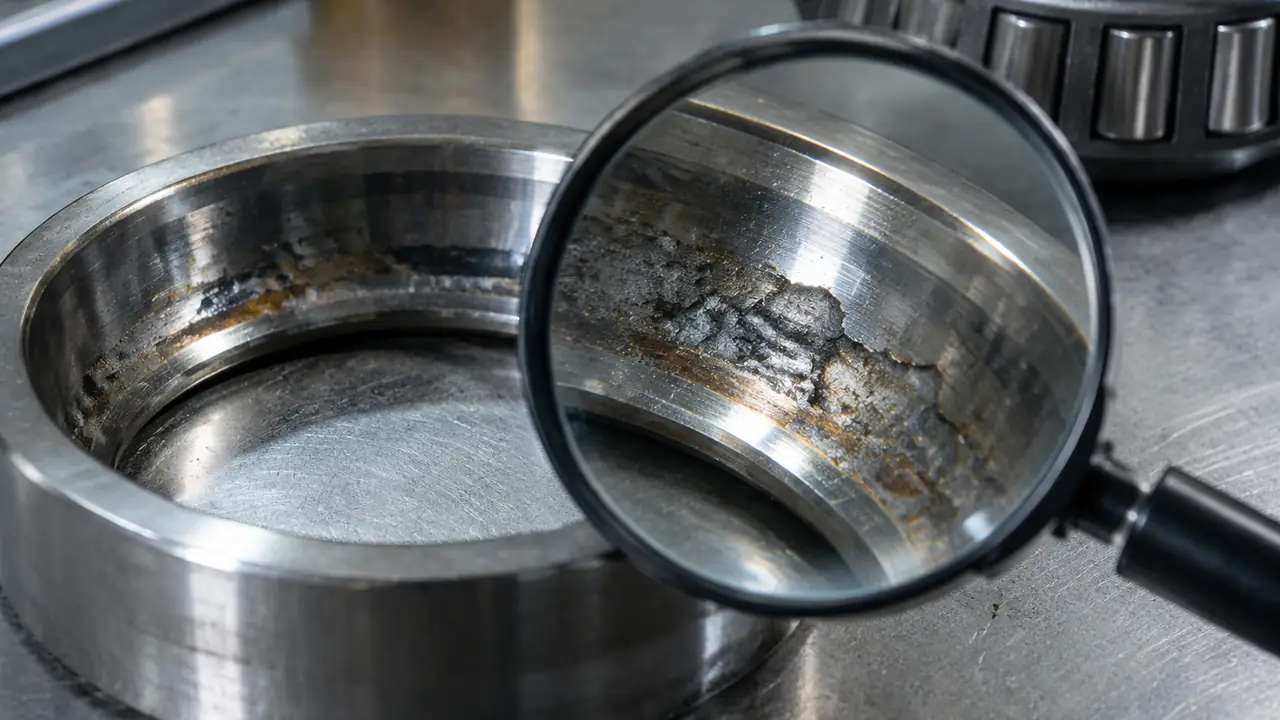
| Corrosion | Rust patches, brown stains, etched pits at roller spacing | Water, condensation, wrong storage | Seal fit, storage conditions, drain paths |
| Electrical erosion | Fine pits, grey frosted bands or fluting | Current passing through the bearing in motors and drives | Shaft grounding, insulated bearings |
| Plastic deformation | Dents in the raceway at ball or roller spacing | Shock load, mounting force through the rolling elements | Mounting method, handling, overload events |
| Fracture and cracking | Broken ring, cracked cage, split shoulder | Excess interference fit, hard impact, severe misalignment | Fit tolerances, housing stiffness, shock history |
Cage failure sits slightly apart from this table. A broken or deformed cage is usually a consequence of something else, such as speed, vibration, poor lubrication or a mounting error, and the cage fracture is the last visible event.
Fatigue is the end of life, not always the cause
Rolling contact fatigue is the one failure mode that every bearing will eventually reach if nothing else interferes. Under repeated stress the material below the surface develops cracks, which grow to the surface and release small flakes. This is the basis of the rating life in ISO 281, explained in the L10 calculation note. Fatigue at the calculated life is normal and expected.
Fatigue that arrives much earlier points to an upstream cause. Surface-initiated fatigue starts when the lubricant film is too thin to separate the surfaces, or when particles dent the raceway and create stress points. A bearing that fatigues at a fraction of its calculated life has usually been overloaded, run too hot or contaminated. The pattern of the spalling also carries information, which is why reading spalling and fatigue damage gets its own note.
Wear and contamination
Abrasive wear removes material slowly and leaves surfaces dull. The most common source is hard particles entering through a worn seal or a poorly cleaned housing. Wear also opens the internal clearance, so the bearing becomes noisy and the shaft runs looser long before any flaking is visible. Adhesive wear, sometimes called smearing, appears when rolling elements skid under light load or fast acceleration and the lubricant film breaks down; it leaves a smeared, discoloured band.
Contamination by dirt and water is the largest single group of premature failures in dusty and wet industries such as farming, mining and conveying. The mechanisms are covered in contamination damage in bearings. Choosing a better seal or a suitable grease costs little compared with a stopped line.
Mounting, fit and misalignment
A large share of early failures happen on the day of installation. Hammering a bearing on by the outer ring pushes force through the balls and leaves small dents, which later become noisy spots and fatigue origins. Too tight an interference fit removes internal clearance, so the bearing overheats; too loose a fit lets the ring creep on the shaft and wear the seat. Misalignment concentrates load on one edge of the raceway and shortens life. For the underlying numbers, see the tolerance and clearance guide and misalignment effects.
A practical sequence for a failure review
- Record the application, running hours, load, speed and temperature, and what the machine did before the failure.
- Photograph the bearing as removed, before cleaning, including seals, cage and grease.
- Check shaft and housing seats for size, roundness and fretting marks.
- Match the damage to a mode in the table above and note whether it is on one ring or both, on one side or all round.
- Compare with the specification that was ordered: clearance, seal type, grease, tolerance class and cage.
- Change one thing at a time in the next batch and keep the batch record.
For imported bearings, the same discipline applies to the supply side. Batch numbers, inspection records and agreed marking let a failure be traced to a production lot. This desk coordinates partner plants for exactly this kind of traceability, with details confirmed in writing for each program; see quality control for the checks that can be agreed before shipment.
Temperature, speed and the warning signs
Failure rarely arrives without notice. Rising temperature, a change in sound, grease leaking past the seal, increased vibration and a shaft that feels loose are all early signals. Recording temperature and vibration at regular intervals, even with a handheld instrument, shows a trend that a single reading cannot. A bearing that runs 20 degrees warmer than its twin on the same line deserves attention long before it makes noise.
When the bearing really is the problem
Sometimes the supplier is at fault: poor steel cleanliness, soft heat treatment, rough raceways or wrong internal clearance. These show up as scattered early failures across different machines, not in one position on one line. The way to separate the cases is a sample comparison on the same machine and a look at the inspection items listed under testing and inspection. A balanced review keeps both possibilities open until the evidence points one way.