
What L10 means
Identical bearings run under identical conditions do not fail at the same moment; fatigue life scatters widely. ISO 281 therefore defines the basic rating life, written L10, as the life that 90 percent of a large group of apparently identical bearings will reach or exceed before the first sign of fatigue. Put the other way round, about one in ten may fail earlier. The median life of the group is typically several times the L10 value, but the L10 is the design anchor because it is conservative.
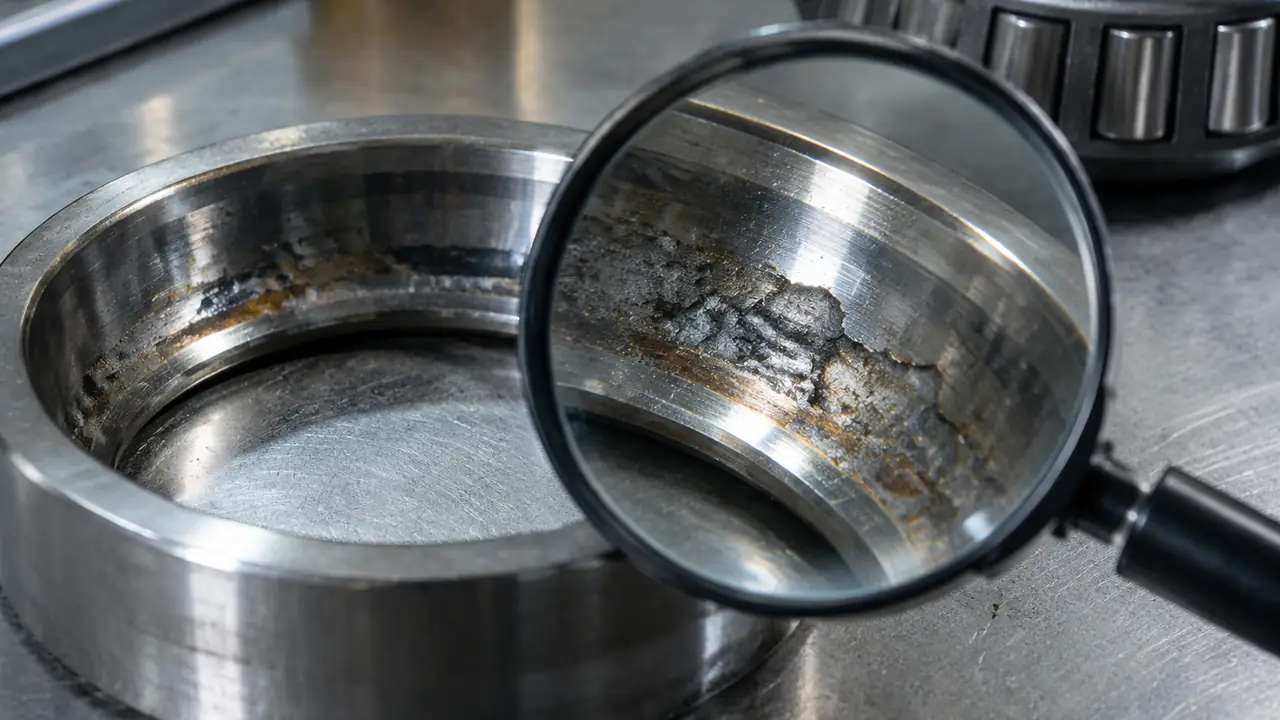
The result is stated in millions of revolutions, or converted to operating hours at a given speed. It describes fatigue life of a correctly mounted, lubricated, clean bearing at the rated load. It does not describe wear, corrosion, contamination or electrical damage, which are separate failure modes covered in bearing failure causes.
The basic formula
The basic rating life in millions of revolutions is:
L10 = (C / P)^p
where C is the basic dynamic load rating, P is the equivalent dynamic bearing load, and p is the life exponent. The exponent is p = 3 for ball bearings and p = 10/3 for roller bearings, reflecting the different contact geometry (point contact for balls, line contact for rollers).
| Symbol | Meaning | Where it comes from |
|---|---|---|
| C | Basic dynamic load rating: the constant load at which the bearing reaches one million revolutions of rating life | Supplier datasheet for the exact designation |
| P | Equivalent dynamic load: a single radial or axial load that has the same effect as the real combined loads | Calculated from radial load, axial load and factors X and Y |
| p | Life exponent: 3 for ball, 10/3 for roller | ISO 281 |
| n | Rotational speed in revolutions per minute | Application |
| L10h | Life in hours = (1,000,000 / (60 x n)) x L10 | Calculated |
Values of C come from the supplier's datasheet and are not stated here; they depend on the series, size and design. P is found from P = X x Fr + Y x Fa for combined loads, where Fr is radial load, Fa is axial load, and X and Y are factors listed for each bearing type and for the ratio of axial to radial load. For a pure radial load, P is simply Fr. The static rating C0 is a different quantity, defined in ISO 76, and is used for slow or stationary bearings; see the note on dynamic and static load ratings.
A worked example with hypothetical numbers
Assume a ball bearing with a hypothetical dynamic load rating C of 30 kN carries a pure radial load of 5 kN at 1,500 rpm.
- P = Fr = 5 kN, because there is no axial load.
- C / P = 30 / 5 = 6.
- L10 = 6^3 = 216 million revolutions.
- L10h = 1,000,000 / (60 x 1,500) x 216 = 2,400 hours.
Now take a roller bearing with the same hypothetical C of 30 kN, the same 5 kN load and the same speed. With p = 10/3, L10 = 6^(10/3), about 392 million revolutions, which is about 4,360 hours. The difference comes from the exponent only, since both examples share the same hypothetical ratio. A real roller bearing of the same size usually has a higher C than a ball bearing, widening the gap in practice.
The example also shows how steep the formula is. Doubling the load P halves C/P, and life falls by a factor of eight for a ball bearing (2 to the power 3) and about ten for a roller bearing (2 to the power 10/3). A modest overload, a belt that is too tight or an edge-loading misalignment cuts life dramatically, which links this calculation to misalignment.
What the basic formula leaves out
The basic L10 assumes ideal conditions. Real life can be shorter or longer. ISO 281 therefore also gives a modified rating life, which adjusts L10 with a reliability factor (for survival probabilities above 90 percent) and a life modification factor that accounts for lubrication quality, contamination and fatigue load limit. Good lubrication, clean conditions and moderate load can raise life well above the basic value; poor lubrication, dirt, heavy shocks or high temperature lower it. The supplier or the equipment maker can run this calculation with software for the exact designation.
- Lubrication. Film thickness relative to surface roughness; see the lubrication guide.
- Contamination. Particles dent the raceway and cut life; see contamination damage.
- Temperature. High temperature reduces hardness and film strength.
- Fit and clearance. Tight fits change internal clearance and load distribution.
- Load variation. Fluctuating load must be reduced to an equivalent load by a recognised method.
Using L10 when selecting a bearing
Equipment makers pick a target life based on duty: a few thousand hours for intermittent hand tools, tens of thousands for industrial gearboxes and continuous fans, and much more for critical process machines. The calculation then runs in reverse: with the loads and speed known, the required C is found, and a series and size are chosen with a margin. The step from there to a designation uses the designation guide and size chart.
Two cautions apply when comparing suppliers. First, C values are calculated by each manufacturer according to ISO 281 and should be treated as datasheet values to be confirmed, not as a quality ranking. Second, a high calculated life means nothing if the bearing is mounted badly or run dirty; sample testing and agreed inspection items give more information about real life than a catalogue number alone, as set out in testing and inspection.
What to send with an enquiry
If you want the desk to shortlist a bearing against a life target, send the radial and axial load, speed, operating temperature, required hours, environment and the shaft and housing size limits. The partner plants can then propose matched designations with datasheet ratings, and MOQ and lead time are confirmed in writing using the ranges on MOQ and lead time.