
How contaminants get in
A bearing is a precision part running on films of lubricant a fraction of a micrometre thick. Almost anything larger than that film can damage it. Contaminants reach the bearing by four routes: past the seals during operation; during storage and mounting, when the bearing or housing is handled with dirty hands or tools; with the lubricant, if the grease gun nozzle, bucket or fitting is dirty; and from the machine itself, in the form of wear debris from gears or other parts that circulates in the oil.
Water follows similar routes plus condensation. Temperature cycling pulls humid air into a housing as it cools, and the moisture condenses on cold surfaces. A bearing in a machine that sits idle in a damp shed will suffer even if no one hoses it down.
Damage mechanisms
| Contaminant | Mechanism | What you see | Typical result |
|---|---|---|---|
| Hard particles (sand, metal chips) | Indent the raceway as they roll through the contact | Small dents and scratches on tracks and balls | Noise, then fatigue spalling at the dents |
| Abrasive dust (cement, grain dust, soil) | Three-body wear, grinds surfaces and cage | Dull, matt, polished surfaces; wide clearance | Looseness, vibration, shorter life |
| Fine dust in grease | Acts as lapping paste | Dark, gritty grease | Gradual wear, rising noise |
| Free water | Washes out grease, reduces film, corrodes steel | Milky or emulsified grease; rust spots | Corrosion pits, then spalling |
| Condensation | Small amounts of water repeatedly formed | Etched marks at ball spacing while idle | Noise on start-up, pitting |
| Chemicals (acids, cleaning agents) | Attack steel and seals; break down thickener | Black stains, swollen seals | Corrosion and seal failure |
Dirt: from small dents to large damage
Contamination damage often starts invisible. A single hard particle passing through a ball contact leaves a tiny dent with a raised rim. The rim carries higher stress on every later pass, and fatigue starts there well before the calculated life. Dozens of dents add up to a rough raceway, rising vibration and heat, and shortened life. Because the damage is local to the rolling track, the bearing may look normal outside until noise appears. The progression is described in reading spalling and fatigue damage.
Fine abrasive dust causes wear instead of dents. It circulates with the grease, wears the cage pockets and raceways evenly and opens the internal clearance. A bearing that has lost clearance this way is usually noisy and has play at the shaft; the bore and outside diameter may also be worn where the rings creep.
Water: corrosion and grease breakdown
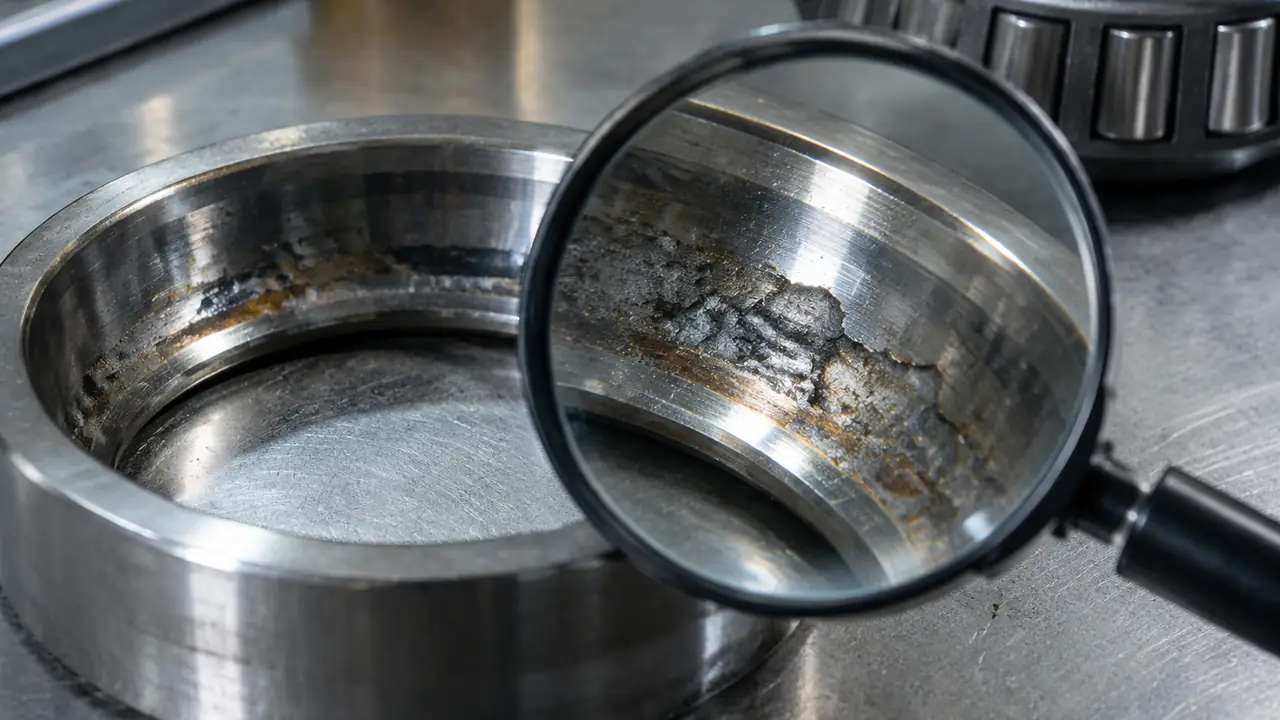
Water has two effects. It corrodes steel, particularly in the contact zone and in bearings that stand still, and it damages the lubricant. Grease can take up a small amount of water, but excess washes out thickener, turns the grease milky, reduces film strength and increases friction. Rust spots appear first where the rolling elements rest while the machine is stopped, leaving marks at the pitch of the rolling elements. These marks become noisy and start fatigue.
In food, beverage and marine environments, the combination of water, washdown chemicals and temperature swings is severe. Stainless bearings, specially formulated greases and sealed housings are the usual responses; see stainless steel bearings and the overview in food-grade lubricants.
Where contamination hides in a supply chain
Contamination is not only a field problem. Bearings can pick up dust, moisture and fingerprints on the way to the customer: during assembly at the plant, in open boxes at a distributor, on a damp quay or in a warehouse without climate control. Rust-preventive oil, sealed bags and clean cartons are the first barrier, and the pack should not be opened until mounting. A bearing that has been wiped, left on a bench and then fitted can arrive in the machine with dirt already inside the cage.
Imported shipments add sea transport, where humidity inside a container can swing with temperature. Packaging with VCI film and sealed inner bags, and sensible container handling, keep the steel dry. A good receiving routine checks the packs for dents, oil leaks and moisture marks before shelving, and logs any pack that was opened. Mounting areas should be clean and dry, with tools reserved for bearing work, because the cleanest bearing is no better than the hands and tools that fit it.
Defences that work
- Choose the seal for the duty. A two-lip contact seal keeps out dust better than a metal shield, at the cost of more friction and a lower speed limit. Compare options in 2RS vs ZZ bearings and the seals and shields pages.
- Use a housing with labyrinth or additional seals for dirty sites. Housed units for farm and conveyor use often have added slingers or double seals; see pillow block bearings.
- Keep grease clean. Wipe fittings before use, use dedicated guns for different greases and store tubs closed.
- Relubricate on schedule so that fresh grease purges contaminants outward through the seal; see relubrication intervals.
- Protect during storage and mounting. Keep bearings in original packs, in dry racks, and mount them in clean conditions; see storage and shelf life.
Diagnosing contamination in a failed bearing
- Photograph the bearing before cleaning and note the colour and consistency of the grease.
- Check the seals for cuts, rolled lips or hardening, and the shield or slinger for rubbing marks.
- Examine the raceway for dents, scratches, wear bands or rust at roller spacing.
- Check the housing for water paths, damaged covers or blocked drains.
- Compare with a bearing from a clean position on the same machine.
What buyers can specify
For dusty and wet applications, the request should state the contaminant (dust, mud, water, washdown), the cleaning method, temperature and speed. The partner plant can then propose a seal type, a grease with suitable water resistance, and where needed a stainless or coated option. Anti-rust protection for shipping and storage is separate and is covered in packaging and anti-rust. The agricultural and conveyor solution page, agriculture and conveyor, shows the usual combinations. For the broader view of failure modes, see bearing failure causes.