
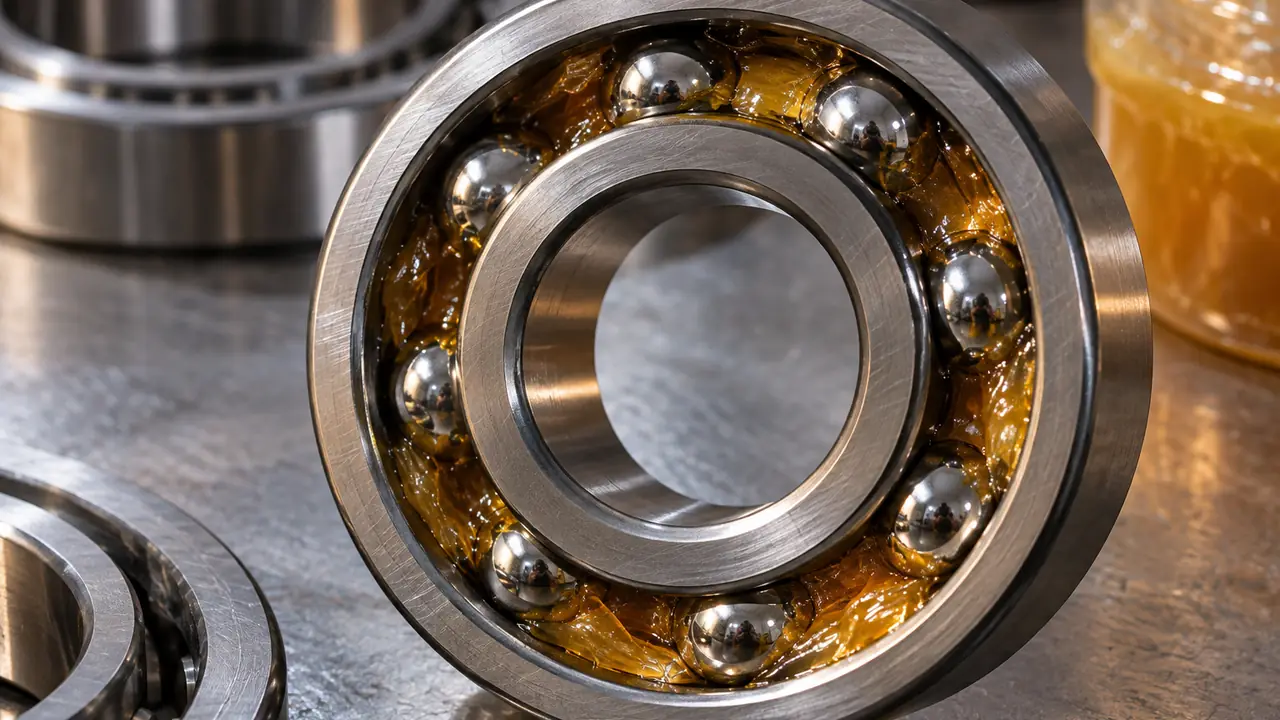
Why intervals are estimates
Grease does not last forever. In a running bearing it oxidises, loses oil, and is gradually pushed out or contaminated. Relubrication replaces the lost lubricant before the bearing starves. The interval depends mainly on speed, bearing size, temperature, grease quality, contamination and the load level. Because these variables interact, published intervals are best seen as starting points, and the real schedule comes from the machine's own history.
The method below follows widely published principles. It is not a substitute for the bearing and grease suppliers' recommendations; where they differ, follow them. The goal is to give plant teams and buyers of bearings for maintenance programs a clear way of thinking about the question.
Step 1: the speed factor
A common first step is to compute the speed factor n x dm, where n is rotational speed in rpm and dm is the mean bearing diameter in mm, found as (bore + outside diameter) / 2 using nominal values from the datasheet. The result shows how fast the bearing runs for its size. Higher values mean shorter grease life.
For example, a bearing with a nominal 25 mm bore and 52 mm outside diameter has dm = 38.5 mm. At 3,000 rpm that gives about 115,500. Such a figure is read from a supplier chart or table that links n x dm and bearing type with a basic interval in operating hours. Ball bearings generally allow longer intervals than roller bearings at the same speed factor, and thrust or spherical roller types allow shorter ones.
Step 2: correct for operating conditions
The basic interval is for clean, moderate conditions. Apply reductions for harsher ones. The table lists commonly used directions of correction rather than exact multipliers, which come from the supplier.
| Condition | Effect on interval | Typical response |
|---|---|---|
| Temperature above the grease's comfortable range | Shortens it sharply; a common rule of thumb halves grease life for each 15 C rise | Use a high-temperature grease, shorten the interval |
| Dust, dirt or process fines | Shortens it | Better seals, purge-style regreasing |
| Water, steam or washdown | Shortens it significantly | Water-resistant grease, frequent small additions |
| Vibration and shock | Shortens it | Higher NLGI grade, shorter interval |
| Vertical shaft | Often about half of the horizontal figure | Controlled fill, stiffer grease |
| High load | Shortens it | EP additive grease, shorter interval |
Conditions combine. A bearing in a hot, wet, dirty conveyor can see intervals that are a small fraction of the clean-room estimate. In those places, it is more reliable to relubricate in small, frequent shots and let old grease escape through a relief path than to rely on a long calculated interval.
A worked illustration
Consider a conveyor drive using a housed unit with a 40 mm shaft, running at 600 rpm in a dusty hall at moderate temperature. The speed factor is low because the shaft turns slowly, so the basic interval from the supplier chart is long. Dust, however, pushes the interval down, and the unit hangs on a frame that vibrates. A sensible plan is to start at a fraction of the chart figure, add a small measured shot, and let the old grease purge through the seal so that it carries dust out with it. After a few services, the maintenance team inspects the purged grease. If it is clean and soft, the interval can lengthen a little; if it is dark and gritty, the interval shortens or the sealing is upgraded.
The same bearing at 3,000 rpm in a clean motor would have a much shorter chart figure because of speed, but fewer corrections for dirt. This is why a single number such as one month or six months is misleading, and why plant teams record the reasoning behind each interval and not only the result.
Step 3: choose the strategy
- Lubricated for life: sealed bearings in small motors and appliances are filled once. The life of the grease is the life of the bearing, so choice of grease and operating temperature matter at the specification stage.
- Time-based relubrication: add a set quantity at set intervals. Simple to plan, suited to uniform duty.
- Condition-based relubrication: add grease when the monitoring indicates it is needed, for example from ultrasound, vibration trend or temperature. It avoids over-greasing but requires discipline and equipment.
- Continuous or automatic feed: single-point or centralised lubricators supply small quantities steadily. Check the output and settings against the bearing size.
Step 4: adjust from inspection
Treat the first interval as a trial. At each service, look at the grease that comes out or the grease in the housing. Healthy grease keeps its colour and consistency. Dark, hard or dry grease, grey metallic content or milky water-contaminated grease means the interval is too long or the sealing is inadequate. Clean, soft, abundant grease means you can lengthen the interval slightly. Pair this with temperature and vibration checks, as covered in the bearing maintenance checklist.
When changing intervals, change one variable at a time and watch bearing temperature and noise. A small drop in temperature after relubrication followed by a steady value is normal; a continuing climb points to over-greasing or a failing bearing.
Practical rules for plant teams
- Collect, for each lubrication point: bearing designation, speed, temperature, orientation and grease used.
- Calculate or look up the basic interval from the supplier chart, then apply condition corrections.
- Choose a conservative first interval and a defined quantity per shot.
- Do not mix grease types unless compatibility is confirmed; see bearing grease selection.
- Log each action, review quarterly, and adjust intervals using the condition of the grease and the trend of temperature and vibration.
Where purchasing fits
For OEM and MRO buyers, the lubrication plan starts at the order. Bearings with re-lubrication features such as grease grooves and holes, housed units with grease fittings, or sealed units with lifetime fill are each specified differently. Pillow block and flange units are often supplied with a fitting, as covered on the pillow block bearing page. Tell the desk how the bearing will be lubricated and send the request through the quote form; the partner plant confirms the grease and the options in writing for each program.