
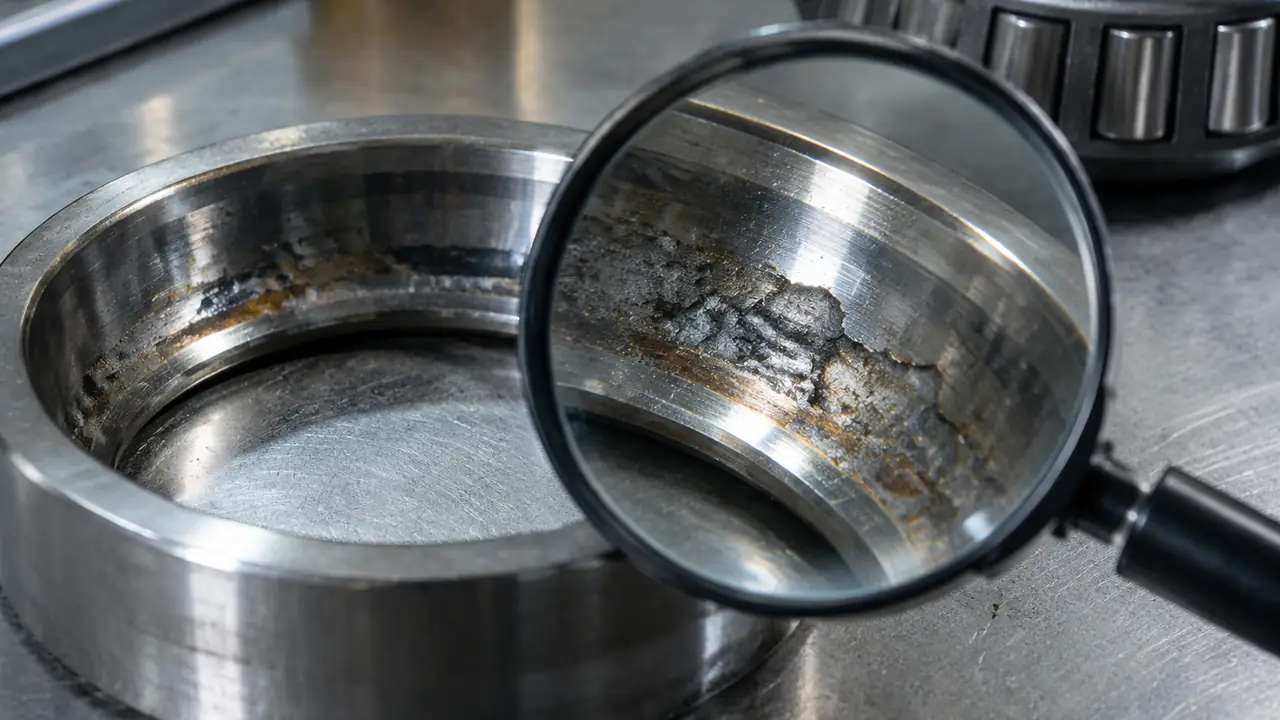
What a normal temperature looks like
Every running bearing warms up. Friction in the rolling contact, churning of the lubricant and seal drag turn into heat, and the bearing settles at a temperature where heat generated equals heat carried away through the shaft, housing and air. A new bearing often runs warmer for the first hours while grease distributes, then falls to a steady value. What matters is the steady value compared with the same position on a similar machine, and the trend over time.
There is no single safe number. Limits depend on the grease, the seal material, the steel's heat stabilisation and the clearance. Standard bearings are normally heat-treated to remain dimensionally stable up to a defined temperature, and seals and cages have their own limits, all of which come from the supplier datasheet. If a bearing is hot enough that a hand cannot rest on the housing for a few seconds, measure it with a contact thermometer instead of guessing, and compare with the equipment maker's limit.
Causes of overheating by group
| Group | Cause | Typical clue | First check |
|---|---|---|---|
| Lubrication | Too little grease or oil, or aged grease | Dry, dark or hardened grease; squeal | Grease type, quantity and relubrication date |
| Lubrication | Too much grease | Heat at start-up that falls over hours; grease pushed out | Fill level; purge path |
| Fit and clearance | Interference fit takes up internal clearance | Heat rising steadily after assembly | Shaft and housing size; clearance group |
| Load | Overload, belt over-tension or axial preload | Heat rising with load; rapid wear | Belt tension; thrust arrangement |
| Alignment | Misaligned housings or bent shaft | One-sided heat and wear | Alignment; shaft runout |
| Seals | Contact seals with high drag, or rubbing guard | Heat close to the seal lip | Seal type; rubbing marks |
| Environment | Hot process, motor or gearbox next to the bearing | Bearing hot even at idle | Ambient and neighbour temperatures |
| Contamination | Dirt raising friction | Gritty feel, discoloured grease | Seal and grease condition |
Lubrication: too little and too much
Insufficient lubricant is the textbook cause of overheating, but over-greasing is almost as common. A bearing packed completely full has to push excess grease aside as it turns, and the churning generates heat until the surplus works out through the seal or relief path. Many bearings run hot in the first hours after relubrication for this reason. Fill guidelines and intervals are covered in fill guidelines and relubrication intervals.
Grease type matters as much as quantity. A grease with too stiff a consistency or too viscous a base oil creates drag at speed, while one that is too soft slumps out of the bearing. High-temperature service needs a grease whose base oil and thickener tolerate it; mixing grease types can destroy structure and leak. The overview in the lubrication guide sets out the selection steps.
Fit, clearance and preload
When the inner ring is pressed on a shaft, it expands slightly; when the outer ring is pressed into a housing, it contracts. Both reduce the internal clearance. In motors and fans the inner ring also runs warmer than the outer ring in service, which reduces clearance further. If the remaining clearance goes to zero or negative, rolling elements are squeezed, friction and heat rise quickly, and the failure can be sudden. That is why clearance C3 is used in many electric motor bearings, as explained in C3 clearance explained, and why fits are chosen with the tolerance and clearance guide in hand.
Preload is deliberate in some designs, such as paired angular contact bearings and tapered roller bearings. Too much of it, or a thermal change that adds to it, causes heat and early fatigue. Thrust arrangements on long shafts also need one bearing to be free to move axially, or thermal growth will preload the whole line.
Heat that comes from outside
Before blaming the bearing, check where the heat is going. A bearing beside a hot gearbox or furnace will sit above ambient even if perfect. Poor ventilation, a blocked cooling fan, a painted-over housing or a cover that traps air raises the temperature further. Direct comparison of two identical positions on a line, one with the old bearing and one with the new, quickly shows whether the bearing or the surroundings is at fault.
Speed, seals and cages
Every bearing has a speed beyond which friction heat outruns cooling. The reference and limiting speeds on the datasheet assume specific lubrication and load conditions, and a bearing run near its limit with a heavy grease or a contact seal will be hot. Two-lip rubber seals add drag compared with metal shields, which is one reason high-speed motors often choose shielded bearings; the trade-off is described in 2RS vs ZZ bearings. Cage material also matters: pressed steel, brass and glass-fibre nylon cages tolerate different temperatures and speeds, and a cage rubbing the ring or a seal can raise heat locally.
When speed is raised on an existing machine, for example after a drive upgrade, the bearing should be re-checked against its limiting speed and a grease suited to the new duty. A bearing that ran cool for years may become hot simply because the machine now runs faster than the original selection assumed. The same applies to higher ambient temperature after a layout change and to heavier belt loads after a pulley swap.
First checks in order
- Measure the actual temperature at the housing and compare with the equipment maker's limit and with an identical position.
- Stop the machine safely and turn the shaft by hand: does it turn smoothly, or does it feel tight or notchy?
- Look at the grease: colour, consistency, quantity and signs of leakage.
- Check belt tension, coupling alignment and axial freedom.
- Check fits and the clearance group of the fitted bearing against the order.
- Only then remove the bearing, and keep it unwashed for inspection.
Temperature in the purchase specification
For applications that run hot, the request for quotation should state operating temperature, speed and environment, because the answer changes the grease, the seal material (see seals), the cage and sometimes the heat-stabilisation level. A request that includes these lets the desk shortlist partner plants that can supply matched options and confirm typical MOQs and lead times in writing, using the reference ranges in MOQ and lead time. Overheating also links to general failure causes; the wider picture is in bearing failure causes.