
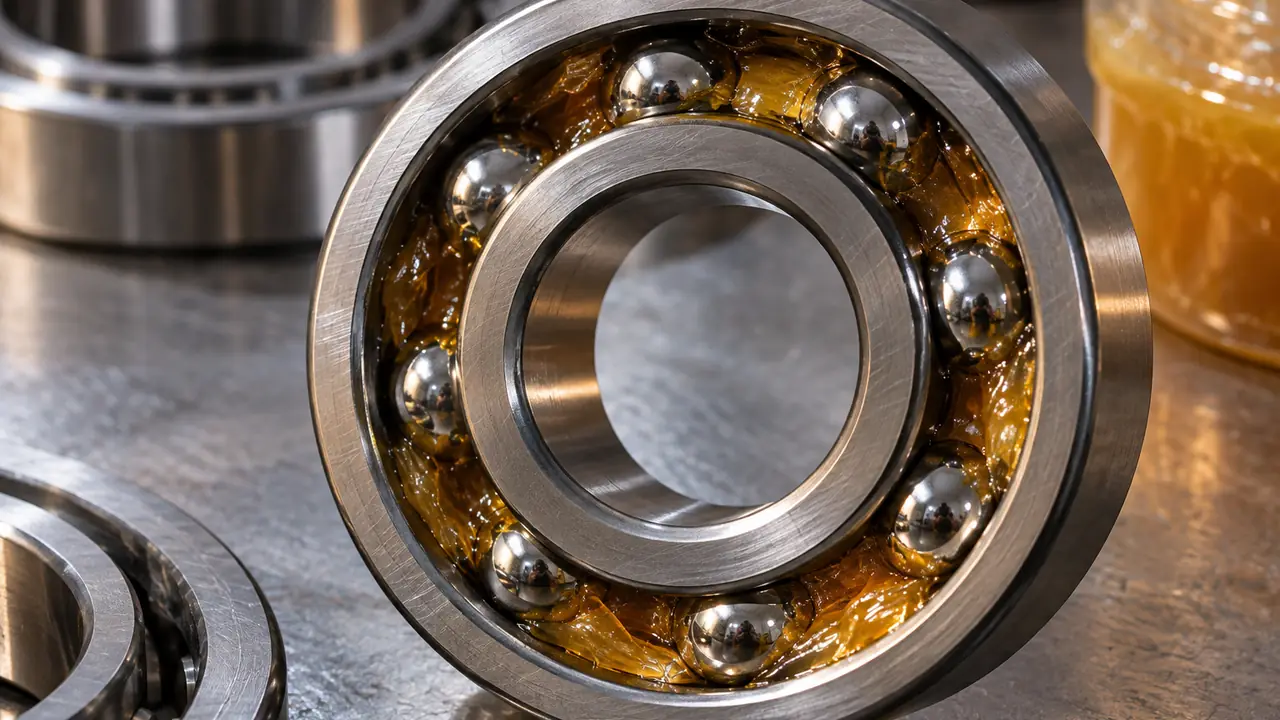
What heat does to grease
Above its comfortable working range, grease ages in several ways at once. The base oil oxidises and thickens, then forms deposits. Oil evaporates and bleeds out of the thickener, leaving a hard, dry residue. The thickener itself can soften and melt out of the bearing. Each effect shortens grease life, and the damage compounds: dry grease raises friction, which raises temperature, which speeds ageing.
A widely quoted rule of thumb says that grease life roughly halves for every 15 C rise in operating temperature above the grease's upper comfortable limit, and roughly doubles for every 15 C drop. It is a rough guide, not a law, and the grease supplier curve is the better reference. The practical message is that a modest margin below the upper limit pays back in longer intervals.
Two temperature numbers to read
Grease datasheets usually give a continuous operating range and sometimes a short-term peak. The two are not interchangeable.
- Upper operating limit: the temperature at which the grease can work for a long time. Choosing a grease whose limit equals the bearing temperature leaves no margin.
- Dropping point: the temperature where the thickener loses structure and the grease turns liquid in a standard test. It is higher than the working limit and is not a service limit.
Also look at the lower limit, because many hot machines start cold. A grease that is excellent at 150 C may be too stiff at start in freezing weather.
Typical limits by thickener and base oil
The values below are widely published approximate ranges. Individual products differ, so always follow the grease datasheet.
| Grease type | Rough upper range | Comment |
|---|---|---|
| Lithium soap, mineral oil | Around 100 to 120 C | General purpose; not for sustained heat |
| Lithium complex, mineral or PAO | Around 130 to 150 C | Common step up for hot motors |
| Calcium sulphonate complex | Around 140 to 160 C | Strong under load and in wet, hot sites |
| Polyurea, synthetic base oil | Around 150 to 180 C | Long life in sealed motor bearings |
| PFPE with PTFE thickener | Around 200 to 260 C and above | Furnaces, ovens, aggressive chemicals; higher cost |
Synthetic base oils such as PAO, ester and PFPE resist oxidation better than mineral oil, and that is where much of the high-temperature capability comes from. Esters can attack some elastomers, so check compatibility with the bearing seals.
The bearing must be ready for heat too
A suitable grease does nothing if other parts of the bearing fail first. Check these items together:
- Dimensional stability: standard bearing steel is heat treated for stability up to a certain operating temperature. Above that, order bearings with a specified stabilisation grade. The bearing datasheet states the limit.
- Clearance: a hot inner ring on a cooler housing loses internal clearance. C3 or C4 clearance is common for hot machines, as explained in C3 clearance explained.
- Seals: NBR seals are generally fine up to moderate temperatures; FKM seals tolerate more heat. Seal limits often set the bearing limit before grease does.
- Cage: nylon cages have a lower temperature limit than steel or brass cages. For hot duty, pressed steel or brass is the usual choice.
- Shields instead of contact seals: non-contact shields create less frictional heat than rubber contact seals.
Checking whether the grease is coping
Good practice in hot machines is to measure instead of assume. Fit a temperature label or a handheld probe to the housing and record the reading under steady load. Remember that the outer ring surface is cooler than the contact zone inside, so the true bearing temperature is higher than the housing reading; the supplier can suggest a typical offset for the construction. Compare the reading with the grease upper limit and keep a margin.
Take samples of the used grease during planned stops. Hardened crusts at the seal, a change from the normal colour to dark brown or black, and a stiff, dry texture are all signs of thermal ageing. Oil separation, where a clear liquid pools while the soap stays behind, suggests the thickener is overheated or the grease is the wrong type for the load. If a lab is available, a simple oxidation or infrared check on a sample tells you how much life is left.
Finally, look at the cause of the heat. Some of it comes from the process, such as a kiln or dryer, but some comes from the bearing: over-greasing, too little clearance, misalignment or overload. Reducing the second kind of heat is cheaper than buying exotic grease.
Relubrication in hot machines
Hot bearings should be relubricated more often and in smaller measured shots. A fixed interval from a chart is a starting point; look at the used grease. Dark, hard grease or a smell of burnt oil means the interval is too long. Methods are described in bearing relubrication intervals.
Avoid mixing greases. Many high-temperature greases are not compatible with ordinary lithium grease, and PFPE grease should never meet mineral oil in a bearing. If you change grease, purge thoroughly and, where possible, replace the bearing instead of trying to wash it clean.
When oil or a different bearing is the answer
At sustained high temperatures, grease may not be practical at all. Circulating oil removes heat and replaces the lubricant continuously (see oil vs grease lubrication). In extreme cases solid lubricants, ceramic rolling elements, or specially treated bearings are used. A ceramic or hybrid bearing tolerates heat better in some designs, but the lubricant and cage still limit the system.
Kiln cars, oven conveyors, dryer rolls and engine auxiliaries are typical hot sites. Lubricate frequently, keep an eye on bearing temperature with a handheld probe or sensor, and record the trend.
Specifying hot-duty bearings
When you request bearings for a hot application, give the continuous temperature, peak temperature, speed, and the atmosphere (dry, steam, chemical). Ask for the grease type, seal material and stabilisation or clearance grade to be written on the quotation. Any special grease, minimum quantity and lead time are confirmed in writing for each program. Use the quote form to send these details with a drawing or designation.