
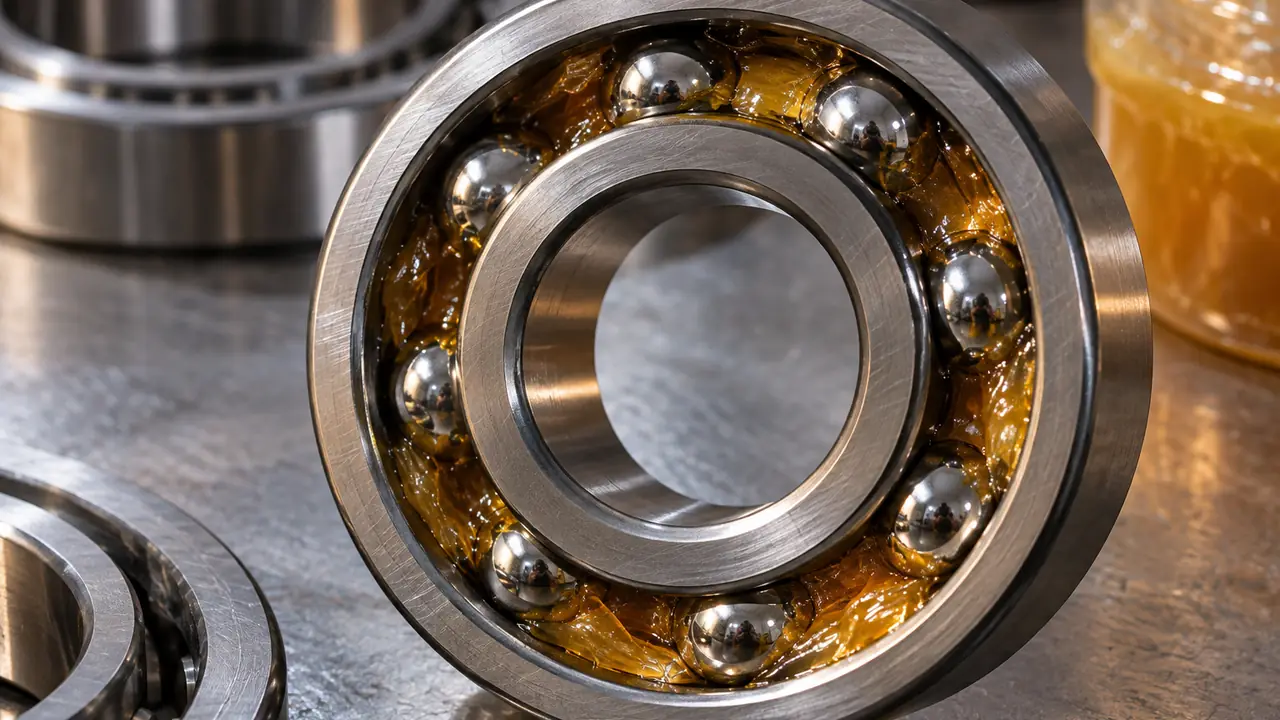
Two ways to put lubricant in a bearing
Every rolling bearing needs a film of lubricant between the rolling elements and raceways. Grease supplies it from a reservoir inside the bearing; oil supplies it from a bath, a spray or a circulating system. Both work well when matched to the job. The wrong choice shows up as heat, noise, early wear or a maintenance burden that the plant cannot sustain.
Roughly speaking, grease is the default for small and medium bearings at moderate speed, and oil takes over when the bearing is fast, hot, very large, or sits in a gearbox that already contains oil. The comparison below is based on widely published guidance and typical practice. For a specific machine, follow the bearing supplier's recommendation.
Side-by-side comparison
| Point | Grease | Oil |
|---|---|---|
| Speed | Moderate; high speed needs a light fill and special grease | Suits the highest speeds |
| Heat removal | Little; heat leaves through housing and shaft | Good when oil circulates through a cooler |
| Sealing against dirt | Grease acts as a barrier and helps the seal | Needs good seals; oil does not block contaminants by itself |
| Leakage risk | Low | Higher; needs gaskets, drain and level control |
| Orientation | Works in any position with the right grease | Easier with horizontal shafts and defined levels |
| Maintenance effort | Periodic relubrication or lubricated for life | Oil level, filter and change checks |
| System cost | Low | Higher: sumps, pumps, filters, lines |
| Contaminant removal | Only by purging | Filters can clean oil continuously |
When grease is the sensible choice
- Electric motors, fans, pumps and appliances where bearings are small to medium and the speed is moderate.
- Housed units on conveyors and farm machines, where grease is also a barrier against dust and splashing water.
- Vertical or tilted shafts, where oil would run away from the bearing.
- Sealed bearings, which are filled once for life and need no external system.
- Machines that run intermittently or are stored for long periods, where grease protects against corrosion.
A deep groove ball bearing with seals or shields and the right grease is the most common example of a lubricated-for-life design.
When oil is the better tool
- High speed, where grease would churn and overheat: machine tool spindles often use oil-air or oil mist, as discussed in the high-speed bearing overview.
- High temperature, where the bearing must be cooled by circulating oil.
- Gearboxes and engines, where the oil is already present and shared by gears and bearings.
- Very large bearings, such as in rolling mills or big spherical roller bearing applications, where oil circulation carries heat and debris away.
- Systems that require filtration of the lubricant, where fine particles would harm the bearing.
Oil methods at a glance
Oil bath. The bearing runs partly immersed in oil. A common rule of thumb for horizontal shafts is that the oil level at standstill should reach about the centre of the lowest rolling element. Too high a level causes churning and heat. Bath lubrication suits low to moderate speeds.
Oil splash. Gears or a flinger ring throw oil onto the bearing. Typical in gearboxes. Level and viscosity are critical.
Circulating oil. A pump feeds oil through a filter and cooler to the bearing and returns it to a tank. It allows control of temperature and cleanliness and suits heavy duty and high speed.
Oil mist and oil-air. Small metered quantities of oil are carried by air to the bearing, giving a minimal film with low drag. Oil-air is common on high-speed spindles. These systems require compressed air, metering equipment and exhaust handling.
Oil jet. A nozzle directs oil at the bearing at very high speeds. It is used in special high-speed applications.
Hybrid and borderline cases
Some machines sit between the two worlds. A gearbox output bearing may be oil splashed but have a grease-packed seal on the outer side to keep water out. A large electric motor may use grease for the drive-end roller bearing and a grease escape chamber to collect old grease. Pumps can use oil rings on plain bearings but grease on the rolling-bearing end. These mixed designs work because each lubricant is restricted to the area where it performs best, and a barrier separates them.
In borderline cases the decision often comes down to maintenance resources. A plant with a trained lubrication crew and oil analysis can run oil systems reliably. A distributed fleet of conveyors, pumps and farm machines may be better served by grease and sealed units, because the people who service them are not lubrication specialists and the machines sit outdoors.
Total cost is worth a look. Oil systems add pumps, filters, coolers, piping and monitoring, but they can extend bearing life in demanding duty and let you filter out particles. Grease adds almost no hardware, but it needs relubrication labour and disposal of used grease. Compare these over the life of the equipment instead of the purchase price of the lubricant.
Viscosity is the shared selection key
Whether oil or grease, the viscosity of the oil at operating temperature sets the lubricating film. The usual reasoning compares actual viscosity with the viscosity required for the bearing's mean diameter and speed, as described in the ISO 281 life calculation. A slow, loaded bearing needs higher viscosity; a fast, light bearing needs lower. The supplier datasheet or catalogue chart gives the required viscosity for the bearing size and speed. Use that figure rather than a generic oil grade.
Practical cautions
- If you convert a machine from grease to oil, check the seals, vents and drains; open bearings and oil-compatible seals are usually required.
- Never mix lubricants without confirming compatibility, and clean out old grease before filling with oil.
- Keep oil levels checked and sight glasses clean; level mistakes are a common cause of heat.
- Record oil type, grade and change intervals, and monitor temperature and vibration for trends, using the bearing maintenance checklist.
What to tell the supplier
If your machine uses oil lubrication, tell the desk at the quotation stage, because bearings for oil systems are usually open (no seals or shields) with cage and clearance chosen for the temperature. If grease is intended, specify sealed or shielded types and the grease family. The partner plant confirms the available options, the typical reference MOQ and the lead time in writing for each program. Send the details through the quote form, or see the bearing lubrication guide for the wider picture.