
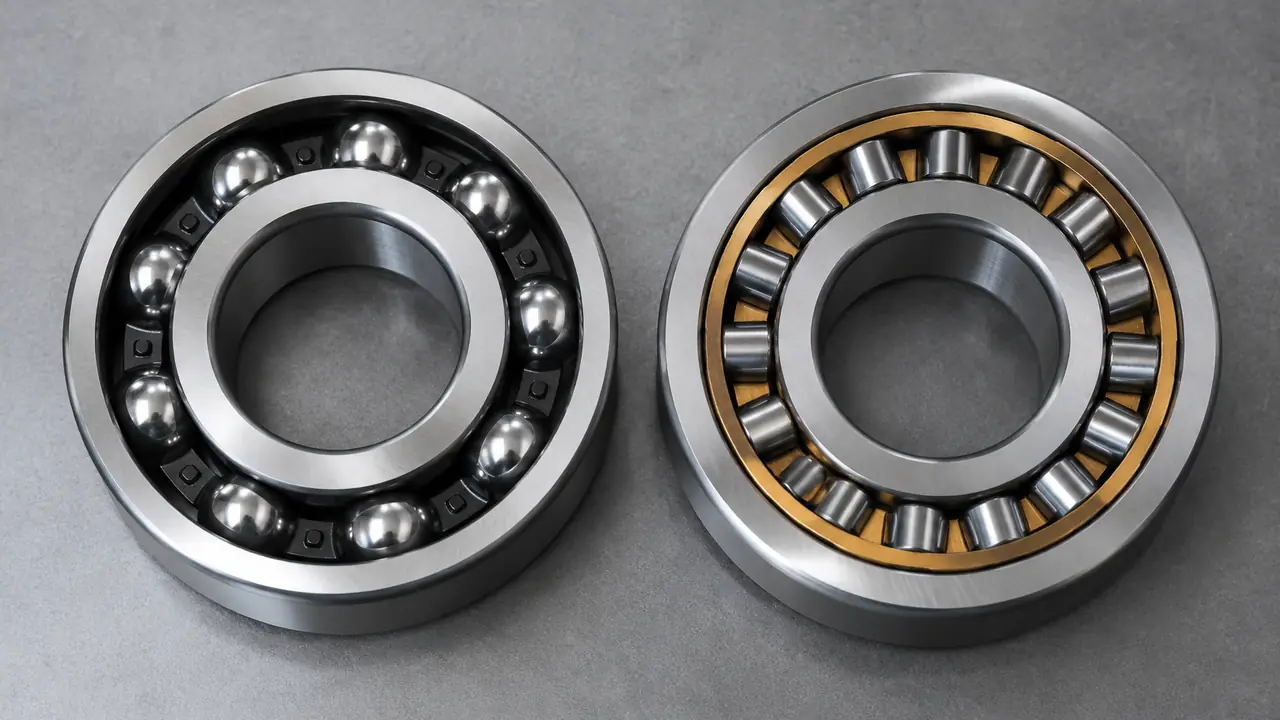
Three closure states
A standard ball bearing can be bought in three states. An open bearing has no closure, so grease or oil must be supplied by the machine. A shielded bearing (Z or ZZ) has a metal disc that does not touch the inner ring. A sealed bearing (RS or 2RS) has a rubber lip seal that rubs lightly on the inner ring. The comparison between ZZ and 2RS is in the earlier note on 2RS vs ZZ bearings; this note compares open against closed in general, because the main question is lubrication.
An open bearing is shipped with a coating of preservative oil, not with working grease. It must be cleaned or filled, and then it is lubricated from a housing, oil circuit or grease nipple. A closed bearing is filled with a measured quantity of grease at the plant, and is expected to run for its life on that fill. Each approach transfers responsibility differently: with open bearings the equipment designer or maintenance team owns the lubricant, with closed bearings the bearing plant does.
Side-by-side comparison
Comparisons are relative; load and speed ratings are identical in the datasheet because the closure does not change the raceway geometry, but limiting speed is lower with seals.
| Criterion | Open | Sealed or shielded |
|---|---|---|
| Load direction | Same as the bearing type | Same as the bearing type |
| Load capacity | Same raceway, same rating | Same raceway, same rating |
| Speed | Highest; no closure drag | Shield close to open; contact seal lower |
| Misalignment tolerance | As the bearing type allows | As the bearing type allows |
| Friction and noise | Lowest torque; lubricant condition sets noise | Slightly higher with seal; clean grease keeps noise low |
| Maintenance | Relubrication possible; needs a routine or a circuit | No relubrication; replace the bearing at end of grease life |
| Typical applications | Gearboxes, oil-lubricated spindles, housings with lubrication points | Motors, appliances, pumps, agricultural and conveyor equipment |
| Relative cost factors | Lowest bearing price; extra cost in housing, seals and maintenance | Slightly higher price; lower system and labour cost |
Who controls the lubricant
The real difference is not the metal and rubber but who decides what goes inside and when. In an oil-lubricated gearbox, bearings share the oil that serves the gears, and sealing the bearing would defeat the purpose. In a spindle, oil or grease is metered precisely, and a closure would interfere. These are open-bearing applications by design. In a small motor or a conveyor roller, nobody will ever grease the bearing, and a sealed bearing with the correct fill is the right answer.
Grease selection for closed bearings is therefore made once, at specification: base oil, thickener, additives and fill. A low-noise grease suits a motor; a wide-temperature grease suits outdoor equipment. Bad choices cannot be corrected later. The grease selection note explains the choices, and the bearing grease page lists the families.
Contamination and sealed life
Sealed bearings keep contaminants out and grease in, which is why they dominate where nobody maintains the bearing. Their life is limited by grease life: the oil in the grease oxidises and bleeds out with time, temperature and speed, and when it is gone the bearing runs dry and fails. A hot or fast application shortens that life considerably, and the datasheet or supplier can advise a realistic expectation. In dirty conditions an open bearing without a good external seal fails faster than a sealed bearing, because grease is soon contaminated; a sealed bearing in the same place survives longer but still depends on the housing.
It is a mistake to think a sealed bearing is permanent. If it must last beyond its grease life, you need a plan: a design with a relubrication path, an exchange interval, or condition monitoring. Notes on this are in relubrication intervals.
What goes wrong when the choice is wrong
The failure patterns are easy to recognise. An open bearing fitted where nobody lubricates it runs dry, overheats, and shows discoloured, smeared raceways. A sealed bearing fitted in a hot, fast position shows dark, hardened grease, a squeal from the seal, and sometimes a cracked rubber lip. A shielded bearing used where water splashes shows rust at the raceway edge, with grease washed out through the gap. In every case the bearing itself was made correctly; the specification and the application did not match. Reviewing the closure type is therefore one of the first steps in any failure review, as set out in the bearing failure causes note.
Another common mistake is mixing greases. An open bearing refilled with a grease that does not suit the original may soften or harden and lose its film. Keep records of the grease used and top up only with a compatible product.
Packing and transport
Open bearings arrive coated with preservative and can rust if packaging is damaged; sealed bearings are protected externally and by internal grease, but the outer surfaces are oiled. Both need correct packaging, as described on the packaging and anti-rust page. For repair stock lines, keep open and closed variants separated and clearly labelled, since mixed stock leads to the wrong bearing in the wrong machine.
Costs in words
A sealed bearing costs a little more than an open bearing because of the closure parts, grease fill and extra assembly. But the system cost often runs the other way: an open bearing requires a lubrication circuit, external seals, grease nipples and periodic work. Compare total cost of ownership, not only the unit price. The reference MOQ and lead time ranges on the MOQ and lead time page apply, confirmed in writing for each program.
How to decide
- Will anyone relubricate? If not, choose sealed or shielded.
- Is the bearing in an oil bath, oil mist or circulating system? Choose open.
- Is the site dusty or wet? Choose a contact-sealed bearing, and check the housing seal too.
- Is the speed high relative to the size? Choose shielded or open with controlled lubrication.
- Is the service life longer than the grease life? Choose an open bearing in a housing with a relubrication path.
- Write the closure, grease and fill in the order next to the designation.
List the lubrication arrangement of your machine in the quote form.