
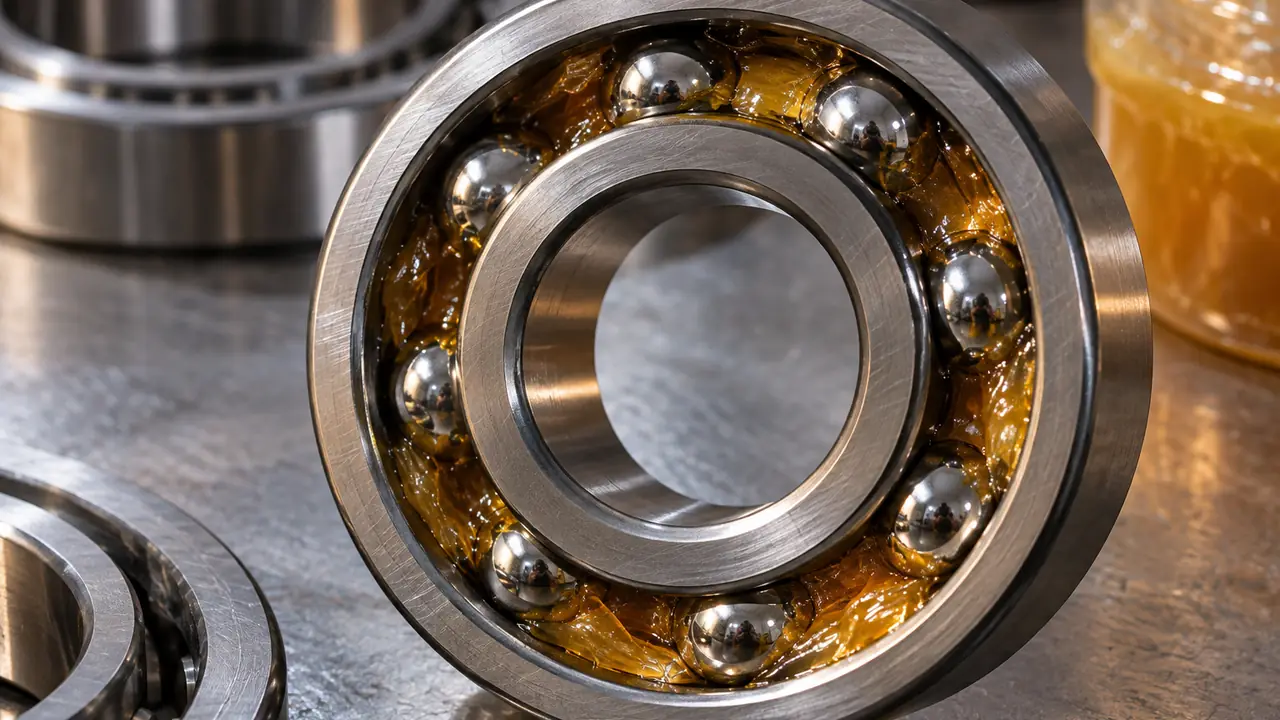
What grease actually is
Bearing grease has three ingredients: a base oil that does the lubricating, a thickener that holds the oil like a sponge, and additives that add protection. In a running bearing, the thickener slowly releases oil to the rolling contacts, while the rest of the grease stays in the bearing as a reservoir and a barrier against dirt. That is why grease suits sealed bearings, vertical shafts and machines where a circulating oil system would be impractical.
Most selection mistakes come from treating grease as one product. Two greases with the same colour and the same NLGI number can differ a great deal in temperature range, water resistance and noise. The datasheet of the grease, not the label on the tub, is the reference. What follows is a set of widely published starting points; always follow the grease supplier and the bearing supplier data for the final choice.
Base oil: type and viscosity
The base oil is usually mineral oil or a synthetic such as PAO, ester or PFPE. Mineral oils are the common general-purpose choice. Synthetics widen the temperature window and resist oxidation better, at a higher grease cost. Fluorinated oils are reserved for extreme heat or aggressive chemicals.
Viscosity matters more than the type. A common rule of thumb is that fast, light-load bearings such as small motors and spindles want a lower base oil viscosity, while slow, heavily loaded bearings such as conveyor rollers and crusher shafts want a higher one, so the oil film stays intact under load. The designer sizes this from the operating viscosity ratio defined in the ISO 281 approach; the supplier datasheet usually gives the base oil viscosity at 40 C and 100 C so you can compare candidates.
Thickener families compared
| Thickener | Typical strengths | Watch points |
|---|---|---|
| Lithium soap | Good all-round performance, widely available, water resistant | Moderate upper temperature limit |
| Lithium complex | Higher temperature range than simple lithium, good mechanical stability | Check compatibility before mixing |
| Calcium sulphonate complex | Strong water and corrosion resistance, good under heavy load | Can be stiff at low temperature |
| Polyurea | Long life, quiet running, popular for sealed-for-life motor bearings | Often incompatible with soap greases |
| Aluminium complex | Good water resistance, often used in food-grade greases | Narrower range of suppliers |
The thickener also sets the compatibility rules. A bearing full of polyurea grease that is relubricated with a lithium grease may soften or harden, and the oil can separate. If the previous grease is unknown, the safest approach is to purge old grease with the new one, or to ask the supplier for a compatibility statement.
NLGI grade: how stiff the grease is
NLGI numbers describe consistency, from soft (000) to hard (6). Grade 2 is the most common for rolling bearings and is the default starting point. Grade 3 is sometimes used for vertical shafts or hot, vibrating applications where softer greases would slump or leak. Grade 1 and softer are used where a pump or centralised system must push the grease through lines, or at low temperature. Consistency changes with working: a grease that is soft after long shearing may leak from a vertical bearing, so mechanical stability matters.
Additives and special requirements
Additives are chosen for the problem you have, not stacked for their own sake:
- EP and anti-wear additives help in heavily loaded, slow or shock-loaded bearings. They are rarely needed in light, fast bearings.
- Corrosion inhibitors matter in wet or humid sites and for bearings stored for long periods.
- Solid lubricants such as molybdenum disulphide help at very low speed or oscillating motion, but they raise noise and are generally not used in quiet motor bearings.
- Low-noise grades are filtered to remove particles; they matter for appliance and motor bearings graded by noise, for example Z2 or Z3 vibration groups.
Food-contact machines need greases registered for incidental contact; that topic has its own note on food-grade bearing lubricants. Hot environments are covered in high-temperature bearing grease.
A practical selection routine
- Write down temperature range, speed, load type, and exposure to water, dust or chemicals.
- Pick the thickener family for temperature and water exposure, and confirm it against any grease already in the machine.
- Choose base oil viscosity from speed and load; ask the grease supplier for the recommended range for the bearing size.
- Select the NLGI grade (grade 2 unless the orientation or feed system says otherwise).
- Add only the additives the application justifies, and check noise grade if the machine is sensitive.
- Check the quantity and relubrication plan, covered in how much grease goes in a bearing and relubrication intervals.
Common selection mistakes
Choosing by temperature rating alone. A grease sold for a wide range may still age quickly near the top of that range. A widely used rule of thumb is that oxidation life of grease roughly halves for every 15 C rise above the grease's comfortable operating temperature, so a margin below the upper limit pays back in relubrication intervals. Treat this as a rough guide and use the supplier curve for real planning.
Ignoring speed. A stiff, high-viscosity grease in a small fast bearing creates churning, heat and drag. A thin, soft grease in a slow heavy bearing can leave the contact poorly protected. Match the grease to the speed factor of the bearing, which combines size and rotational speed; the bearing datasheet gives the reference limits.
Forgetting the seal material. Some base oils swell or shrink certain elastomers. NBR seals suit most mineral and PAO greases, while high-temperature seals in FKM tolerate more varieties. If you change grease, check the seal compatibility too.
Over-greasing. More grease is not better. Too much grease causes heat and leakage and is the most frequent cause of avoidable grease failure in electric motors.
Specifying grease on a purchase order
For pre-greased bearings, say which grease family you want and the operating temperature window, or accept the plant standard grease for your bearing type. Typical deep groove ball bearings with seals are supplied with a general-purpose lithium-based or polyurea grease unless you request otherwise. Changing grease for a program is a customisation: the partner plant confirms availability, minimums and lead time in writing for each program. Put the requirement in your quotation request and ask for the grease datasheet along with the bearing drawing.