
Why quantity matters
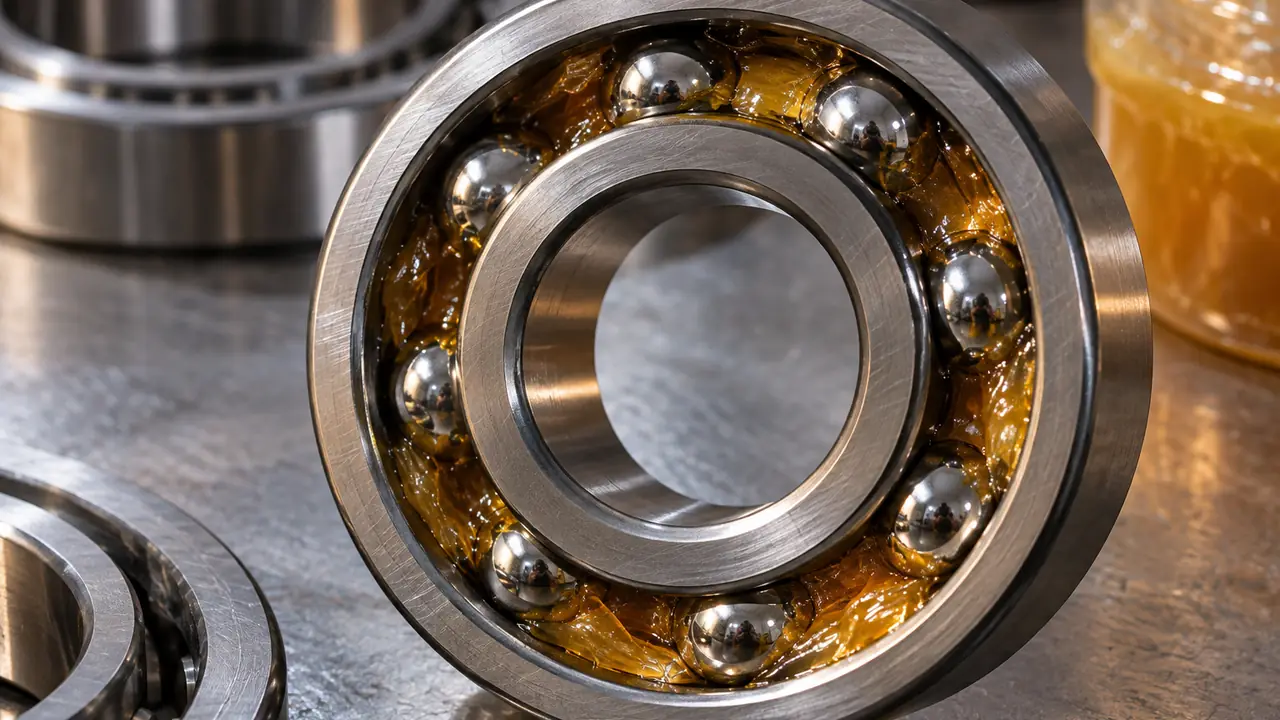
A rolling bearing needs a thin film of lubricant between balls or rollers and raceways. The grease in the bearing does two jobs: it feeds oil to the contacts, and it fills space so dirt and water have fewer places to settle. When the bearing runs, the grease is pushed aside by the rolling elements, forms a small reservoir on both sides and then stays largely at rest. A bearing that is full to the brim cannot move grease aside, so the rolling elements churn it. The result is rising temperature, grease breakdown and leakage past the seals.
Because of this, the right fill depends on speed. Fast bearings need a small fill; slow bearings tolerate and benefit from a larger one. The numbers below are typical starting points taken from commonly published guidance. Always follow the bearing supplier and the grease supplier data for the machine you are building.
Initial fill: percentage of free volume
Free volume is the space inside the bearing not occupied by rings, rolling elements and cage. For a first fill, many references suggest filling the free volume by a fraction that falls as speed rises.
| Operating speed | Typical initial fill of free volume | Reason |
|---|---|---|
| Low speed | Roughly two thirds to full | Little churning; extra grease helps sealing and protection |
| Medium speed | About one third to one half | Balance between lubricant supply and churning |
| High speed | About one quarter to one third | Limits temperature rise and drag |
The housing is usually packed more generously than the bearing itself in slow machines, often filling one third to one half of the housing cavity. In fast machines, the housing is left mostly empty. Treat these ranges as typical starting points and adjust after a test run.
Relubrication quantity: a common formula
For bearings that can be regreased through a fitting, a widely published rule of thumb gives the quantity of grease to add at each interval as a function of bearing size:
G = 0.005 x D x B, where G is grease mass in grams, D is the bearing outside diameter in mm and B is the bearing width in mm.
For example, a bearing with a nominal outside diameter of 80 mm and width of 18 mm would give 0.005 x 80 x 18 = 7.2 g per relubrication. Use nominal dimensions from the datasheet or the size chart, and confirm them against the drawing. This formula is a starting point only; the supplier formula, the machine builder and field experience override it.
How to pack an open bearing
- Work in clean conditions with clean hands, gloves and tools; grease the bearing as close to mounting as possible.
- Press grease into the gaps between rolling elements from one side until it appears on the opposite side. For tapered roller bearings, work grease into the cone from the large end.
- Spread a thin film over the outer surfaces to protect against corrosion during fitting.
- Fill the housing to the planned level, not to the brim. Leave room on the seal side for expansion and venting.
- Rotate the bearing by hand a few turns and wipe off excess. Record the grease type and quantity.
Sealed and shielded bearings
Bearings with seals or shields are filled at the factory, normally with a fill chosen to balance noise, torque and life. A standard fill for sealed bearings commonly sits at roughly 25 to 35 percent of free volume, but this varies by series and by supplier. You can request a different fill, for example a lighter fill for low torque or a heavier fill for slow, dirty conditions; the partner plant confirms the option and its minimums in writing for each program. Details of the two closures are compared in open vs sealed bearings.
Signs the fill is wrong
- Too much grease: temperature rises soon after startup and then settles, grease escapes at the seal, and motor current is slightly higher. After the excess is expelled, temperature often falls.
- Too little grease: higher friction noise, discolouration of raceways, and early metal-to-metal wear. In the worst case the bearing runs hot and seizes.
- Wrong grease: dried, hardened or runny grease in the housing and a darkened bearing area.
When a new bearing runs hotter than expected, check the quantity before assuming a defect. Start with the fill, the grease type and the fit, then compare with the guidance in relubrication intervals.
Grease fill and bearing size at a glance
The table shows how the formula scales for a few common nominal sizes. Outside diameter and width are nominal ISO values; confirm them against the datasheet before use.
| Designation | Nominal OD x width (mm) | G = 0.005 x D x B |
|---|---|---|
| 6204 | 47 x 14 | about 3.3 g |
| 6205 | 52 x 15 | about 3.9 g |
| 6305 | 62 x 17 | about 5.3 g |
| 6308 | 90 x 23 | about 10.4 g |
These numbers are the quantity added at one relubrication, not the total grease in the bearing. Small bearings hold only a few grams, so a grease gun stroke can easily deliver several times the intended amount. Use a hand pump with a known output per stroke, count the strokes, and write the count on the machine's maintenance card. In sites with several operators, a fixed number of strokes per point avoids differences between shifts.
Measuring and controlling the dose
Many plants never weigh grease. A simple calibration helps: pump ten strokes into a clean container, weigh the grease, and divide by ten. That gives grams per stroke for that gun and that grease; thicker grease gives a smaller output per stroke. Repeat the check when you change guns or grease. Where fittings sit in places that are hard to reach, automatic single-point lubricators can deliver a set quantity over weeks or months, but they still need correct setting for the bearing size, speed and temperature.
Record each addition. A log of date, point, grease and quantity makes later troubleshooting far easier, and it shows whether intervals are too short or too long when you look at the temperature or vibration trend.
Adjusting for the application
Vertical shafts need grease that stays put, usually a higher NLGI grade and a controlled fill, because gravity pulls grease away from the upper bearing. Wet or dusty machines benefit from a fuller housing and a purge-style grease path, where fresh grease pushes old grease and contaminants out of the seal. Hot environments need a smaller fill and shorter intervals because grease ages faster, as discussed in high-temperature bearing grease.
When you source pre-greased bearings for a program, state the speed range, temperature and orientation in your quote request, and ask which grease and fill the partner plant proposes.