
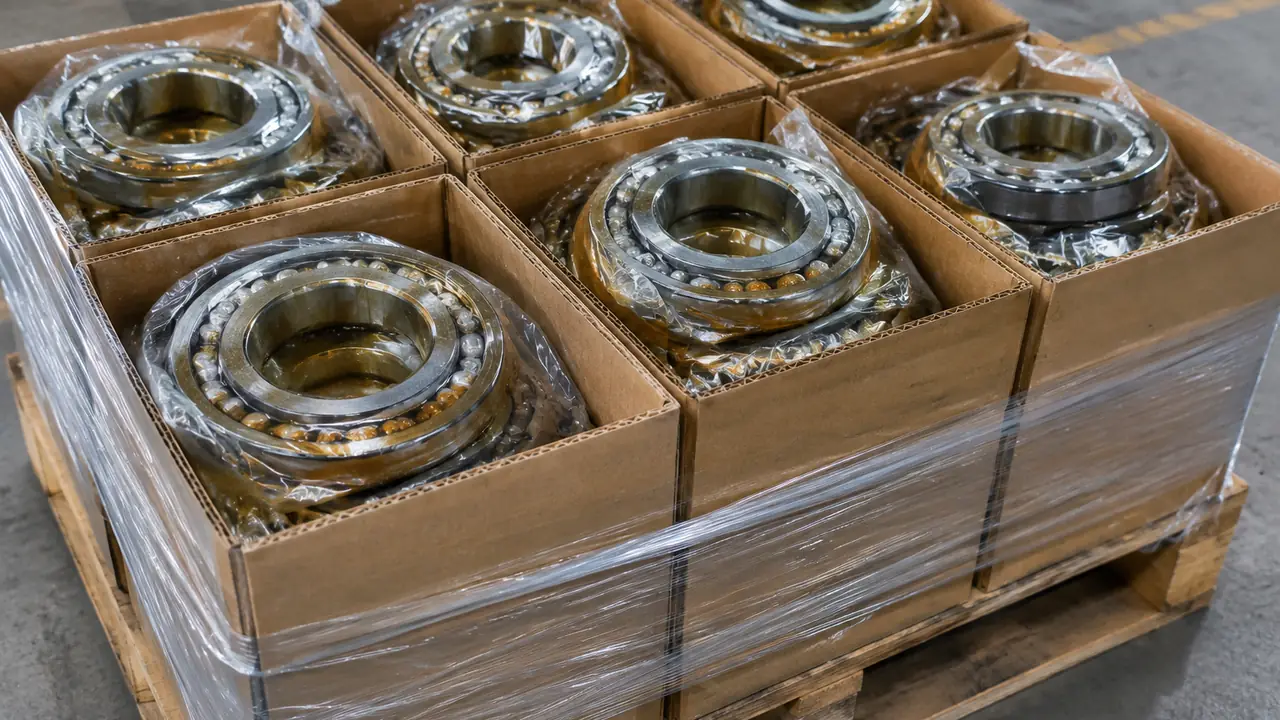
Why bearing packaging matters
Bearings are precision steel parts with ground raceways. Two things damage them between the plant and your line: moisture, which starts rust within days in humid air or condensation, and mechanical stress, which can mark the raceway without any visible rust. Sea freight adds both, because containers heat and cool, producing condensation, and long voyages deliver continuous vibration. For this reason packaging is not an afterthought on a bearing order. It is part of the specification and is checked at final inspection against an approved sample.
Layers of protection
Partner plants build protection in layers, from the part outward:
- Anti-rust oil. After washing and final inspection, each bearing receives a thin film of anti-rust oil. It is compatible with the grease in sealed bearings, and for open bearings it is a preservative, not the working lubricant.
- Wrap. Oiled paper, a VCI (volatile corrosion inhibitor) paper or a VCI bag surrounds the bearing. VCI releases vapour that settles on metal and slows corrosion inside the closed pack.
- Unit pack. An individual box, a tube, a plastic bag or an industrial bulk pack, depending on how you handle the part.
- Inner carton. Several unit packs are grouped in a carton with fillers so the bearings cannot shift.
- Export carton and pallet. Cartons are stacked on wooden pallets, strapped, and film-wrapped. Heavy bearings may go in wooden cases.
Choosing the unit pack
| Pack | Description | Best for |
|---|---|---|
| Individual box | Carton or colour box, one bearing, often with oiled paper | Distributors and counter sales; branded versions possible |
| Tube or sleeve | Plastic or card tube with several bearings stacked | Small bearings, automated assembly |
| Industrial pack | Plain wrap in bulk, VCI bag, minimal printing | OEM lines that unpack in volume |
| VCI bag | Sealed film bag with corrosion inhibitor | Humid routes, long storage, sea freight |
| Wooden case | Case with bracing for each bearing | Large and heavy bearings |
Plain industrial packs keep cost and waste down; boxed packs protect against handling damage and speak better on a shelf. Many programs use boxes for the distributor lines and bulk packs for the production line, from the same partner plant.
False brinelling and transit damage
False brinelling is wear on a raceway caused by tiny movements of the balls or rollers while the bearing is not turning, typically from vibration in a vehicle, ship or train. The surface shows shallow marks at ball pitch, and the bearing may later run noisily even though it was never operated. The cure is mechanical: keep the bearing from moving freely in its pack, avoid loose stacking and pack it in a snug carton with fillers, with heavy bearings supported on their end faces and not rolling on a loose layer. Pallets are strapped so cartons do not shift, and stacking height is limited to avoid crushing. Where the program is sensitive, such as precision spindle bearings, the desk can request extra bracing or single-bearing cartons. Read bearing failure causes for how pre-damage shows up later.
Packing checks before shipment
At final inspection the packing is compared with the approved sample, not only with the order text. The inspector looks at the oil film and wrap condition, whether seals and shields are intact, whether the right bearing sits in the right box, and whether the carton count and weight match the packing list. A few boxes are opened at random to confirm that nothing has been mixed between designations. Photographs of the packed pallets are supplied, so you can see the condition before the goods leave the plant.
Labelling
Each unit and each carton carries a label that matches the order: designation with suffixes, quantity, batch or date code and, if required, a barcode. Pallets carry a packing list. Consistent labels mean receiving staff can check by eye against the purchase order and avoid mixing C3 and normal clearance parts, which look identical. Label formats are agreed before production, and for private label they follow your artwork; see OEM and private label.
What to specify
State the transport mode, the storage time you expect before use, the unit pack type, the carton or pallet size limits and any labelling needs. Longer storage or humid destinations suggest VCI bags and a thicker preservative film, while air shipments of small parcels can use lighter packs. Packaging is inspected as part of the final check listed in testing and inspection, and shipping modes are described in logistics and shipping. On your side, store bearings indoors in the original pack, away from damp floors and temperature swings, and do not unwrap them until fitting. Reference timing and quantities appear on the MOQ and lead time page.