
| Designation | Type | d bore | D outside | B width |
|---|---|---|---|---|
| 7000 | Angular contact ball | 10 | 26 | 8 |
| 7002 | Angular contact ball | 15 | 32 | 9 |
| 7004 | Angular contact ball | 20 | 42 | 12 |
| 7006 | Angular contact ball | 30 | 55 | 13 |
| 7008 | Angular contact ball | 40 | 68 | 15 |
| 7010 | Angular contact ball | 50 | 80 | 16 |
| 7200 | Angular contact ball | 10 | 30 | 9 |
| 7204 | Angular contact ball | 20 | 47 | 14 |
| 7206 | Angular contact ball | 30 | 62 | 16 |
Nominal ISO boundary dimensions for reference. Confirm against your drawing and the supplier datasheet.
What makes a bearing high-speed
A high-speed bearing is not defined by one feature but by a combination: tight geometric accuracy, controlled internal geometry, light rolling elements, a cage that stays stable at high rotational speed and a lubrication method that carries away heat. The most common form is the precision angular contact ball bearing used in pairs or sets in machine tool spindles, electric spindles, grinding heads, turbomolecular pumps and high-speed motors. This page covers sourcing; the numbers for any given bearing, including limiting speed, come from the supplier datasheet and depend on lubrication and preload.
Precision work is concentrated around Luoyang, where research institutes and precision bearing makers are based, with further capability in Jiangsu and elsewhere. The desk shortlists plants by tolerance class, matching capability and the test equipment available, then verifies the audit trail in writing for each project.
Series and precision classes
| Series | Section | Example, nominal mm |
|---|---|---|
| 719xx | Extra light, high speed priority | Slim sections for compact spindles |
| 70xx | Light, the most used spindle series | 7004: 20 x 42 x 12; 7006: 30 x 55 x 13 |
| 72xx | Medium, more capacity | 7206: 30 x 62 x 16 |
Precision is defined in ISO 492: P5 is ISO class 5 and P4 is class 4, tighter than the normal P0. Higher classes limit radial runout, ring width variation and bore and outside diameter deviation. Higher precision costs more to produce and inspect, so specify the class the spindle needs and not the highest available. Dimensions shown are nominal and must be confirmed against the datasheet.
Hybrid ceramic balls
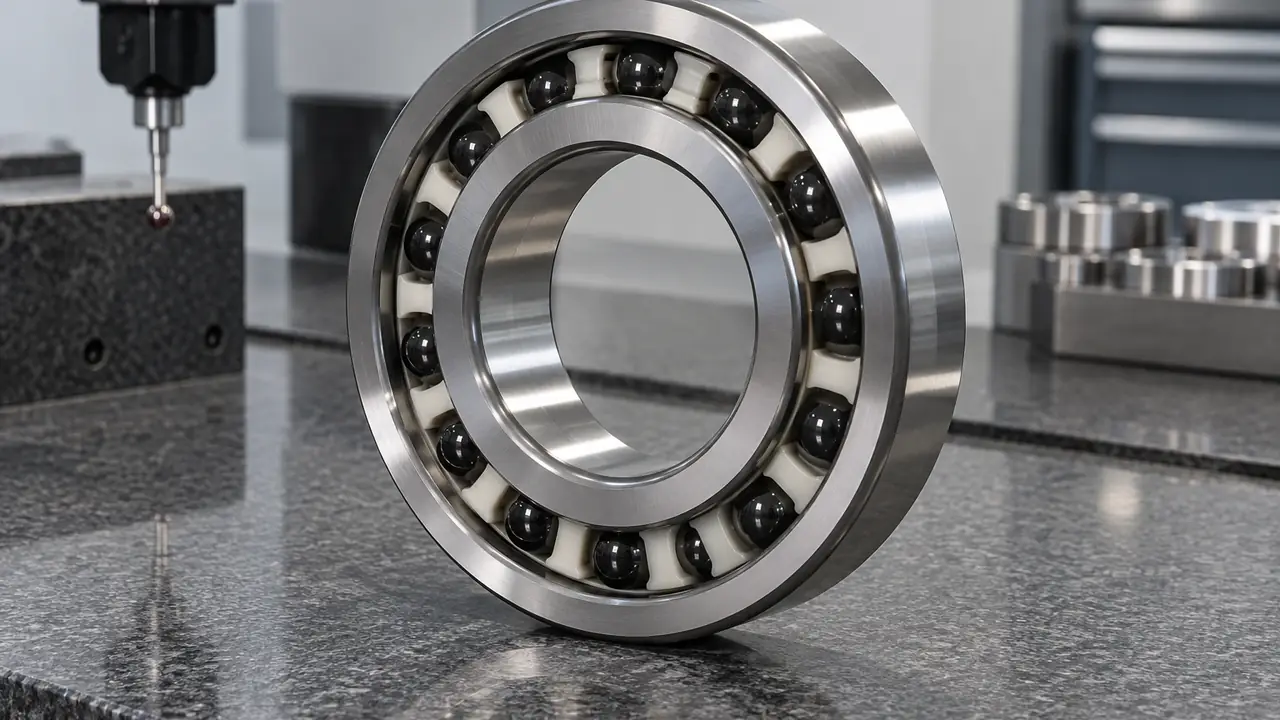
Hybrid bearings use silicon nitride (Si3N4) balls in steel rings. Ceramic balls are lighter and harder than steel and have a smoother surface, which lowers centrifugal load on the outer ring and reduces heat. They also resist smearing and give longer grease life in suitable conditions. Hybrid versions are common on grinding spindles and high-speed electric motors, and they also provide electrical insulation, as covered on the ceramic bearing page. Ask the plant for the ceramic grade and its certificate, since quality differs.
Contact angle, sets and preload
Spindle bearings are normally 15 or 25 degrees contact angle and are supplied as matched sets in DB, DF, DT or multiple arrangements, with preload built into the set. Preload controls spindle stiffness and the way the bearings heat up: heavy preload gives stiffness but raises temperature and reduces the allowable speed. The right class depends on the cutting load, the speed range and the method of lubrication; the machine builder normally specifies it, and the desk confirms what the plant can provide before ordering.
- Order bearings as sets and keep them together, with the V-mark or set marking aligned at assembly.
- Do not mix bearings from different sets; the grinding matching is lost.
- Check the shaft and housing for roundness and squareness, as errors there show up as spindle runout.
Lubrication
High-speed bearings are lubricated by grease for lower speeds and compact designs, or by oil-air or oil mist where speed and heat require it. Grease type, quantity and run-in procedure make a large difference to temperature and life. Over-filling is a frequent cause of overheating. State the lubrication method, the grease type if supplied pre-greased and the run-in procedure. See the lubrication guide.
Mounting and run-in
Precision bearings repay careful installation. Work in a clean area, check that the shaft shoulder and housing shoulder faces are square to the bore, and use the specified locknut torque or spacer arrangement so the set carries the intended preload. Spacers between bearings, where used, must be ground flat and parallel to the same tolerance as the bearings themselves. After assembly, a staged run-in at rising speed lets the grease distribute and the temperature settle before the spindle goes to full duty. Skipping run-in is a common reason for early temperature spikes.
Typical users include machine tool builders, woodworking and engraving spindle makers, dental and medical handpiece makers and automation integrators. For sourcing through the desk, supply a drawing or the spindle specification where possible, because the arrangement and preload are as important as the bearing designation.
Inspection and ordering
Typical checks per lot include dimensions and runout against the ordered class, set matching marks, preload or axial play on the set, ball grade and material records, cleanliness and appearance. A report ships with the lot. Quantities are assessed per program because precision sets are made to order; samples and lead times are confirmed in writing. Send designations, class and preload requirements through the quote form.