
| Designation | Type | d bore | D outside | B width |
|---|---|---|---|---|
| 7200 | Angular contact ball | 10 | 30 | 9 |
| 7202 | Angular contact ball | 15 | 35 | 11 |
| 7204 | Angular contact ball | 20 | 47 | 14 |
| 7205 | Angular contact ball | 25 | 52 | 15 |
| 7206 | Angular contact ball | 30 | 62 | 16 |
| 7208 | Angular contact ball | 40 | 80 | 18 |
| 7210 | Angular contact ball | 50 | 90 | 20 |
| 7000 | Angular contact ball | 10 | 26 | 8 |
| 7004 | Angular contact ball | 20 | 42 | 12 |
| 7006 | Angular contact ball | 30 | 55 | 13 |
| 7008 | Angular contact ball | 40 | 68 | 15 |
Nominal ISO boundary dimensions for reference. Confirm against your drawing and the supplier datasheet.
How an angular contact bearing works
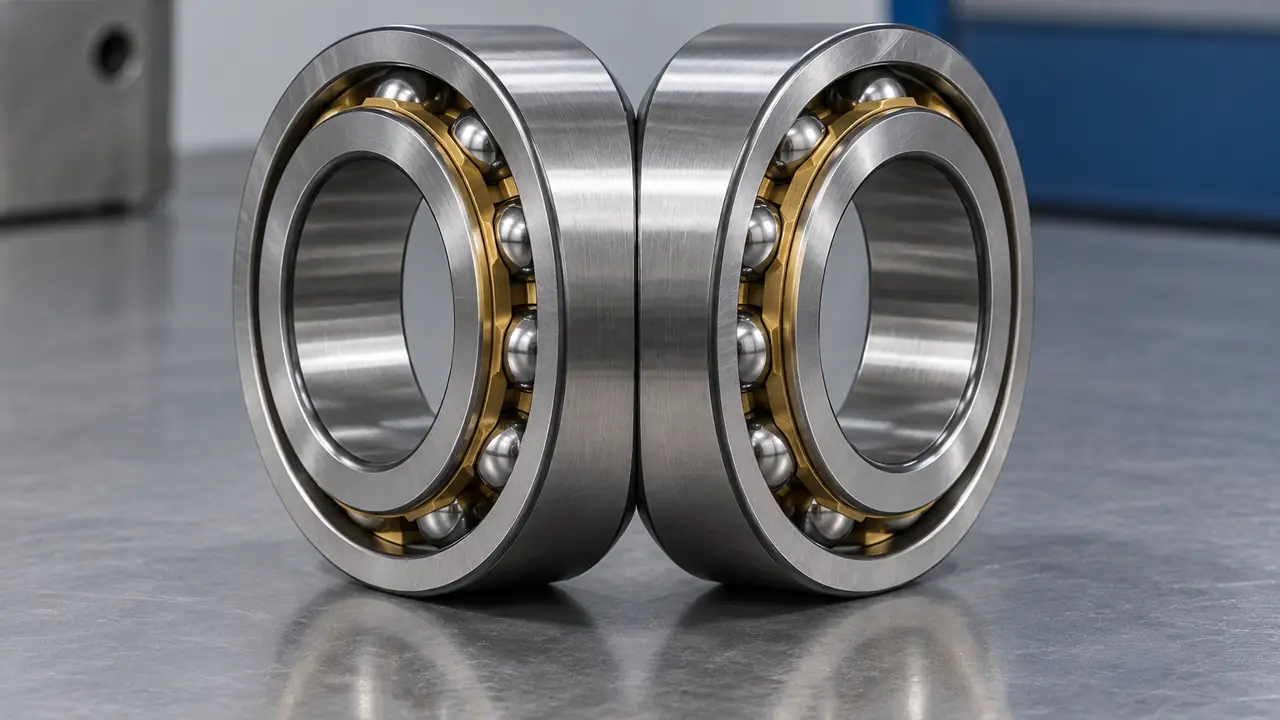
In an angular contact ball bearing the line that joins the contact points of ball and raceways is tilted relative to the bearing plane. One ring has a high shoulder on one side and a low shoulder on the other, so the bearing can take a substantial axial load in one direction as well as radial load. That is the key difference from a deep groove ball bearing, which takes only moderate axial load but in both directions. A single angular contact bearing can never be left alone to hold a shaft against reversing thrust: it needs a second bearing, or a counter-bearing, acting the other way.
Because the bearing is designed to be adjusted against another one, it is widely used where stiffness and accurate shaft location matter: gearbox shafts, pumps, compressors, worm drives, machine tool heads and automotive wheel units. Boundary dimensions of the standard series follow ISO 15, so a 7205 is nominally 25 mm bore, 52 mm outside diameter and 15 mm wide.
Contact angle and suffix
The contact angle sets the balance between axial capacity and speed. A larger angle carries more thrust but gives up speed and radial stiffness; a smaller angle runs faster and is stiffer radially.
| Suffix | Nominal angle | Character | Typical use |
|---|---|---|---|
| C | 15 deg | Faster, stiffer radially, lower axial capacity | Spindles, motors, pumps with moderate thrust |
| AC | 25 deg | Balanced | Gearboxes, compressors, general machinery |
| B | 40 deg | Highest axial capacity, lower speed | Screw supports, worm shafts, high thrust |
Suffix conventions differ slightly between plants, so the desk confirms the angle in writing against the drawing instead of relying on the letter alone. A 7205B and a 7205C share the same size but are not substitutes.
Series and sizes
The 70 series is the light, thin-section range, the 72 series is the medium range and the 73 series is heavier with larger balls. As with other types, the same bore appears in several series, so always check outside diameter and width. Example nominal sizes from the 72 series:
- 7204: 20 x 47 x 14 mm
- 7206: 30 x 62 x 16 mm
- 7208: 40 x 80 x 18 mm
Confirm all dimensions against the drawing and the supplier datasheet. Load ratings and limiting speeds are taken from the datasheet for each designation, not from this page.
Paired and matched arrangements
Because one bearing resists thrust in one direction only, angular contact bearings are commonly mounted in pairs, and the arrangement changes how the pair behaves.
- DB (back-to-back). Load lines diverge toward the bearing axis. High moment stiffness and good tilt resistance; the usual choice for shaft supports.
- DF (face-to-face). Load lines converge. More tolerant of slight misalignment, less moment stiffness.
- DT (tandem). Both bearings face the same way and share one-direction thrust, doubling axial capacity.
Pairs are supplied as matched sets, ground so that preload or clearance after mounting is predictable. Ask for the set to be marked and shipped together so it is installed in the intended order, and tell the desk whether the sets are for first fit or for replacement, since mixing bearings from different sets removes the matching.
Preload and fits
Preload is an axial force applied to remove internal clearance, increasing rigidity and reducing runout. Too little gives play under changing load; too much raises temperature and shortens life. Preload classes are usually light, medium and heavy, and the correct choice depends on speed, lubrication and the stiffness the machine needs. State the intended class and the housing and shaft fits, and see tolerance and clearance for how fits change internal clearance. For high precision work, the high-speed bearing page covers P4 and P5 sets.
Options, inspection and ordering
Besides angle and arrangement, specify cage (nylon, brass or steel), tolerance class, seals if required, grease and material. Typical checks per lot are bore and outside diameter, width, matched-set marking, runout where the class requires it and rotation smoothness; the report is supplied with the lot. See testing and inspection.
Standard sizes typically start at 100-500 pieces per designation; matched pairs and special preloads are assessed per program. Stock samples ship in 3-7 working days; batch production commonly runs 25-45 days. All figures are typical reference ranges, confirmed in writing. Send designations through the quote form.