
| Designation | Type | d bore | D outside | B width |
|---|---|---|---|---|
| 51100 | Thrust ball | 10 | 24 | 9 |
| 51102 | Thrust ball | 15 | 28 | 9 |
| 51104 | Thrust ball | 20 | 35 | 10 |
| 51106 | Thrust ball | 30 | 47 | 11 |
| 51108 | Thrust ball | 40 | 60 | 13 |
| 51110 | Thrust ball | 50 | 70 | 14 |
| 51200 | Thrust ball | 10 | 26 | 11 |
| 51204 | Thrust ball | 20 | 40 | 14 |
| 51206 | Thrust ball | 30 | 52 | 16 |
| 51208 | Thrust ball | 40 | 68 | 19 |
| 51210 | Thrust ball | 50 | 78 | 22 |
Nominal ISO boundary dimensions for reference. Confirm against your drawing and the supplier datasheet.
What a thrust ball bearing does
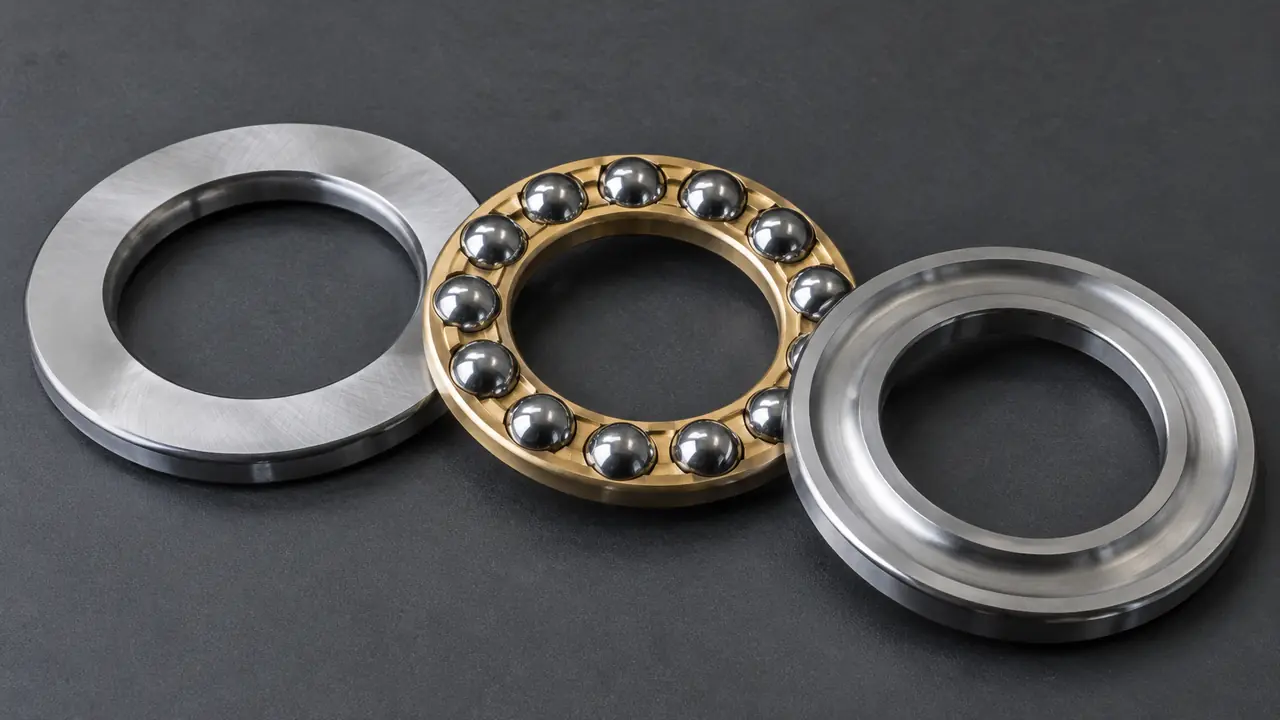
A thrust ball bearing is built from a shaft washer, a housing washer and a cage holding a ring of steel balls between them. The washers have grooved raceways in their faces, and the load travels parallel to the shaft axis. The bearing cannot carry radial load at all. Its job is to take an axial force, for example the weight of a vertical shaft, the thrust of a screw or the reaction of a clamp, while another bearing supports the radial load and locates the shaft.
Because the balls are pushed outward by centrifugal force at speed, they lose contact with the inner washer groove and begin to skid. Thrust ball bearings are therefore a low to moderate speed design. When axial load and speed are both high, an angular contact bearing is a better choice, and for very heavy axial load, see thrust roller bearings.
Single and double direction
A single-direction bearing resists axial load in one direction only, with the housing washer taking the thrust. A double-direction bearing has a middle washer fixed to the shaft and two ball sets, so it resists axial load in both directions. Examples are vertical pumps, turntables, hand-operated jacks, swivel hooks and screw-driven presses. Where load reverses, either use a double-direction unit or place two single bearings on either side of a shoulder.
Series and sizes
The three dimension series mainly differ in height and outside diameter at a given bore.
| Designation | Series | Bore d | Outside D | Height H |
|---|---|---|---|---|
| 51104 | 511, light | 20 | 35 | 10 |
| 51204 | 512, medium | 20 | 40 | 14 |
| 51205 | 512, medium | 25 | 47 | 15 |
| 51108 | 511, light | 40 | 60 | 13 |
The 513 series is the heavier dimension series for the same bore. The last two digits of the designation follow the usual bore code: multiply by five from 04 upward. Load ratings and limiting speeds come from the supplier datasheet, not from this page.
Minimum axial load and alignment
Thrust ball bearings need a minimum axial load to keep the balls in position and prevent skidding. In vertical shafts the dead weight may be enough, but with horizontal shafts or light loads it often is not, and a spring preload is sometimes added. The datasheet gives the minimum load for each designation.
The washers also need accurate seating. The supporting faces must be square to the shaft axis and flat; tilt makes the load concentrate on a few balls. Where tilt is unavoidable, versions with a spherical seat washer, mounted in a matching seat ring, compensate for small angular errors. The housing washer should be a loose fit in the bore so it can centre itself, and the shaft washer should be a light interference fit on the shaft.
Lubrication and handling
Thrust ball bearings are usually open and are lubricated by grease or oil from the surrounding machine. Grease suits slow, intermittent duty such as jacks and swivels. Oil, by bath or drip feed, is preferred for continuous rotation because it carries heat away. Because the washers are separate pieces, handle the parts as a set: keep the shaft washer, ball and cage assembly and housing washer together until fitting, and keep them oiled and wrapped during storage so no corrosion forms on the faces. Packing for shipment uses anti-rust oil and VCI bags; see packaging and anti-rust.
Choosing between thrust types
- Light axial load, slow speed. Thrust ball bearing in the 511 or 512 series.
- Higher axial load in a compact space. The 513 series, or a thrust roller design.
- Axial load plus radial load plus speed. Angular contact ball bearings in pairs.
- Load that reverses. Double-direction thrust bearing, or two bearings with a shoulder between them.
Options and inspection
State direction, seat washer type, cage material, tolerance class and grease. Typical checks per lot are bore and outside diameter, height, washer flatness and parallelism as the class requires, raceway appearance and rotation smoothness, with the report supplied for each lot. See testing and inspection.
Standard sizes typically start at 100-500 pieces per designation; samples ship in 3-7 working days from stock and batch production commonly takes 25-45 days. These are typical reference ranges, confirmed in writing for each program. Send designations through the quote form.