
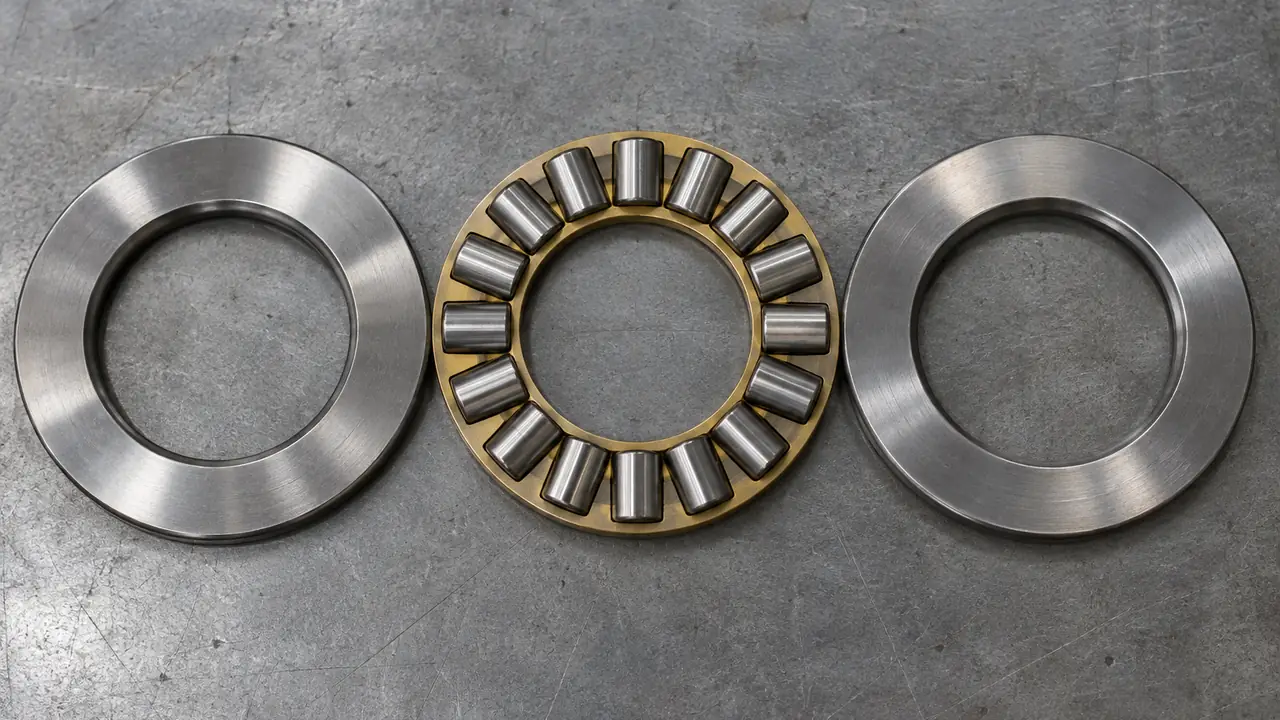
What a thrust roller bearing does
A thrust roller bearing has two washers, one on the shaft and one in the housing, with rollers in a cage between them. The load acts along the shaft, so the rollers carry it in line contact, and capacity is far higher than the point contact of a thrust ball bearing. These bearings are chosen for heavy axial thrust at low to moderate speed: extruder screws, crane hooks, vertical pumps and machine tool tables. They cannot take any radial load, so another bearing must support the shaft radially and keep the two washers concentric.
Rolling in a thrust bearing is never as clean as in a radial one. The rollers have to follow different paths on a flat washer, so there is always some sliding, which generates heat and limits speed. Good lubrication, usually oil or a stable grease, is essential.
Three forms and when to use them
| Form | Series | Misalignment | Typical use |
|---|---|---|---|
| Cylindrical roller thrust | 811, 812 | None; needs accurate seats | Gear drives, presses, machine tools |
| Spherical roller thrust | 292, 293, 294 | Yes, small angle | Extruders, large vertical pumps, crane slewing |
| Tapered roller thrust | Application specific | None | Rolling-mill necks, heavy tables |
Cylindrical roller thrust (811, 812). One or two rows of short rollers, or a set of needle-like rollers in a cage assembly. They are compact, stiff and cost-effective, and the 811 and 812 series are the common heights for general gear and machine tool work. Cage-and-roller assemblies can run against hardened surfaces of the machine itself, which saves height.
Spherical roller thrust (293, 294). Barrel rollers on an inclined raceway with a spherical housing washer. They take heavy axial load, accept misalignment between shaft and housing, and also support light radial load when the shaft is oil lubricated. They are the usual choice for vertical shafts with heavy weight.
Tapered roller thrust. Conical rollers on flat or conical washers, supplied for specific heavy-duty or custom applications. These are normally treated as drawing or datasheet items and quoted case by case.
Mounting and fit
- Seats must be flat and square. The housing and shaft shoulders should be hardened or backed by precise flat surfaces; a tilt of the seat concentrates load on one side of the rollers.
- Radial location. The shaft washer is normally a light fit on the shaft and the housing washer sits with radial clearance, so the radial bearing, not the thrust bearing, controls position.
- Lubricant. Maintain a film at the roller ends; oil bath or circulation is typical on heavy duty, while grease needs a slow speed and regular relubrication.
- Washers. Separate washers and shaft or housing washers are listed under bearing washers.
Because the housing washer must stay centred without radial support, sloppy housings and loose washers are a common cause of early failure. See misalignment effects.
How to specify
A useful quotation request for a thrust roller bearing names the type and full designation, the direction and size of the axial load, the shaft speed, whether the load is steady or shock, and the lubrication method. Add the radial bearing used on the same shaft, the housing and shaft seat dimensions, and whether you want the complete assembly or individual washers and cages. With that, the desk can tell you whether the series fits the envelope and which plant runs it, and the supplier datasheet then gives the capacity and speed limit for the exact part. Rolvane does not publish generic capacity numbers for thrust types.
Applications
Typical uses include plastic extruders, crane and lifting hooks, vertical pump and generator shafts, machine tool rotary tables, steering turntables, gearbox shafts with helical gears and mining equipment. Where the axial load is moderate and speed is higher, an angular contact or thrust ball arrangement may be the economical alternative, and the desk will say so rather than quote the heavier option.
Inspection and ordering
Typical checkpoints: bore, outside diameter and height of each washer and assembly, flatness and parallelism of the washers, roller set matching and cage fit, surface finish and hardness, and rust protection. Washers and cages are often supplied as separate items; state whether you need the full assembly. Standard designations commonly start from 100-500 pieces; heavy sizes may be quoted in smaller lots and larger custom types are assessed from the drawing. Stock samples take 3-7 working days and production 25-45 days, typical reference ranges confirmed in writing. Send designations through the quote form.