
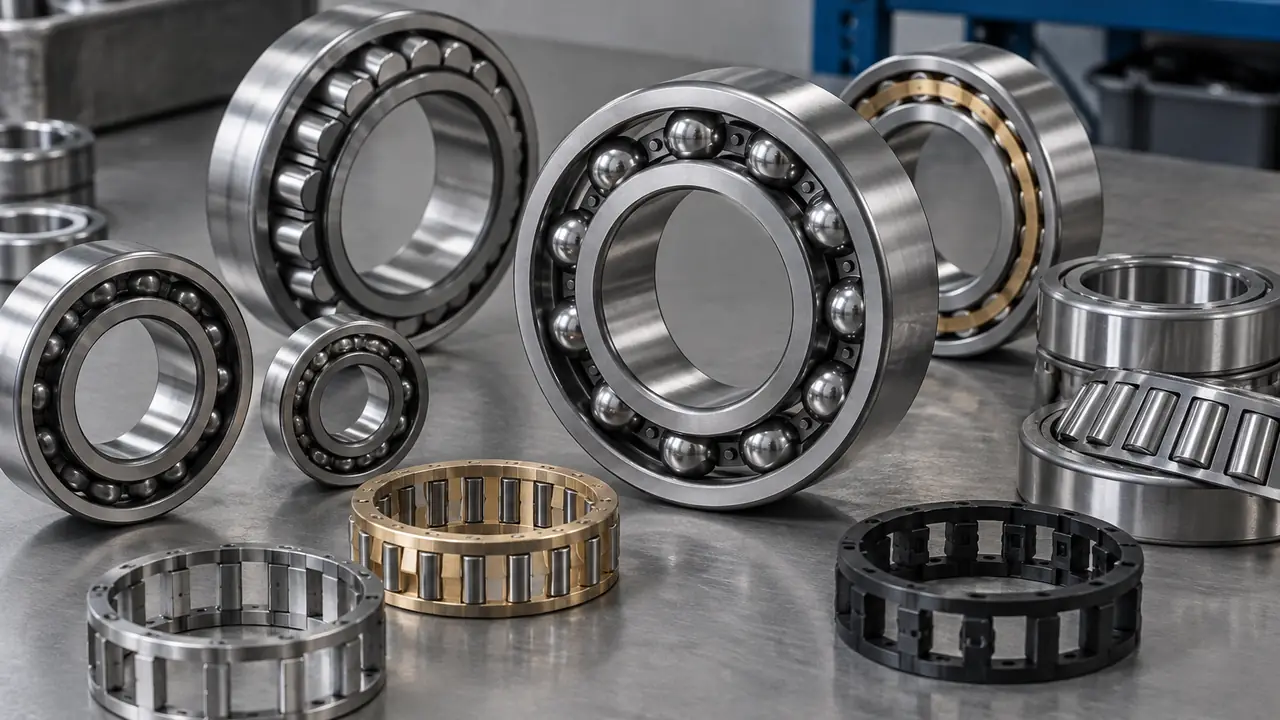
What the cage does
Without a cage, balls or rollers would crowd together and rub against each other, creating friction and heat. The cage holds them at even spacing, guides them through the load zone and lets them return smoothly. It also keeps the rolling elements in place when the bearing is handled before it is mounted. A cage carries no load itself, but its material, design and fit affect noise, friction, temperature limit and the speed the bearing can reach. Most bearing noise complaints and many high-speed failures trace back to cage design or cage quality.
Cage materials
| Material | Character | Typical use |
|---|---|---|
| Pressed steel | Low cost, strong, accepts moderate temperatures | Standard deep groove and many other bearings |
| Machined brass | Strong, good with vibration and shock, heat tolerant | Larger bearings, heavy-duty and high-load use |
| PA66 glass-fibre | Quiet, light, injection moulded; limited temperature range | Motors, appliances, low-noise ball bearings |
| Phenolic (laminated) | Light, tolerates high speed, low friction | Precision and high-speed bearings |
Temperature is the main limit for polymer cages. PA66-GF suits normal operating temperatures, and the temperature and grease should be checked together on the datasheet before use in warm or hot applications. For higher temperatures or heavy shock, a steel or brass cage is the safer choice.
Cage types
- Ribbon (pressed, two-piece) cage. Two stamped halves riveted or joined around the balls. Common in deep groove ball bearings and economical at volume.
- Crown (snap) cage. A single moulded piece, usually in PA66-GF, with pockets that snap over the balls from one side. Quiet and light; popular in 2RS appliance and motor bearings.
- Window cage. Machined from brass or steel with individual window pockets. Strong and rigid, used in larger and heavier bearings, with cylindrical and spherical roller types.
- Roller cages. Stamped or machined cages designed for tapered, cylindrical and needle rollers, sometimes as a full cage assembly with rollers.
The right cage depends on bearing type and size. A tapered roller bearing needs a cage matched to the rollers' taper; a deep groove ball bearing of the same bore may use ribbon or crown cage depending on the series and seal. See the deep groove and cylindrical roller pages.
Cage guidance and lubrication
Cages are guided in one of three ways: by the rolling elements, by the inner ring, or by the outer ring. Ball-guided pressed and crown cages are standard in general bearings. Ring-guided brass and phenolic cages are used where speed is high or loads are shifting, because the cage then runs in controlled contact with a ring land and needs a steady oil or grease film there. Cage material and guidance therefore interact with the grease: some polymer cages should not be paired with certain additives at high temperature, and brass cages can react with sulphur-bearing oils. State the grease and temperature on the enquiry; see bearing lubrication.
Where cages are made
Industry analyses describe Yandian in Linqing, in the Liaocheng area of Shandong, as the largest cage production base in China, with makers around Zhengjia town and a local market for bearing parts. Plants range from high-volume stamping lines for ribbon cages to injection moulding for PA66-GF and CNC machining for brass cages. Many bearing plants across the other clusters buy cages from this base. The desk shortlists the cage maker by material and process, since a good stamping plant is not necessarily a good brass machining plant. Read more about the clusters.
What is checked on a cage lot
- Pocket size and spacing against the drawing, since this sets ball fit and clearance.
- Material and, for PA66-GF, fibre content and moulding quality on a sample.
- For pressed cages, rivet or joint strength and burr-free edges.
- For brass cages, machined surface finish and freedom from burrs and swarf.
- A fit test with the rolling elements or the finished bearing.
Burrs and sharp edges can scratch raceways or add noise, so edge condition is checked as carefully as dimensions. Inspection details are on testing and inspection.
Ordering cages
Cages are counted in thousands. A standard stamped or moulded cage often starts at the order of ten thousand pieces per specification; machined brass cages for larger bearings are quoted from the drawing at lower volumes. Sample time for stock cages is typically 3-7 working days, and custom cages typically take 15-30 days; batch lead times commonly fall in the 25-45 day range, and tooling for a new moulded cage takes longer. All figures are typical reference ranges, confirmed in writing for each program. Send the designation, material and annual quantity through the quote form, or go back to the components hub.