
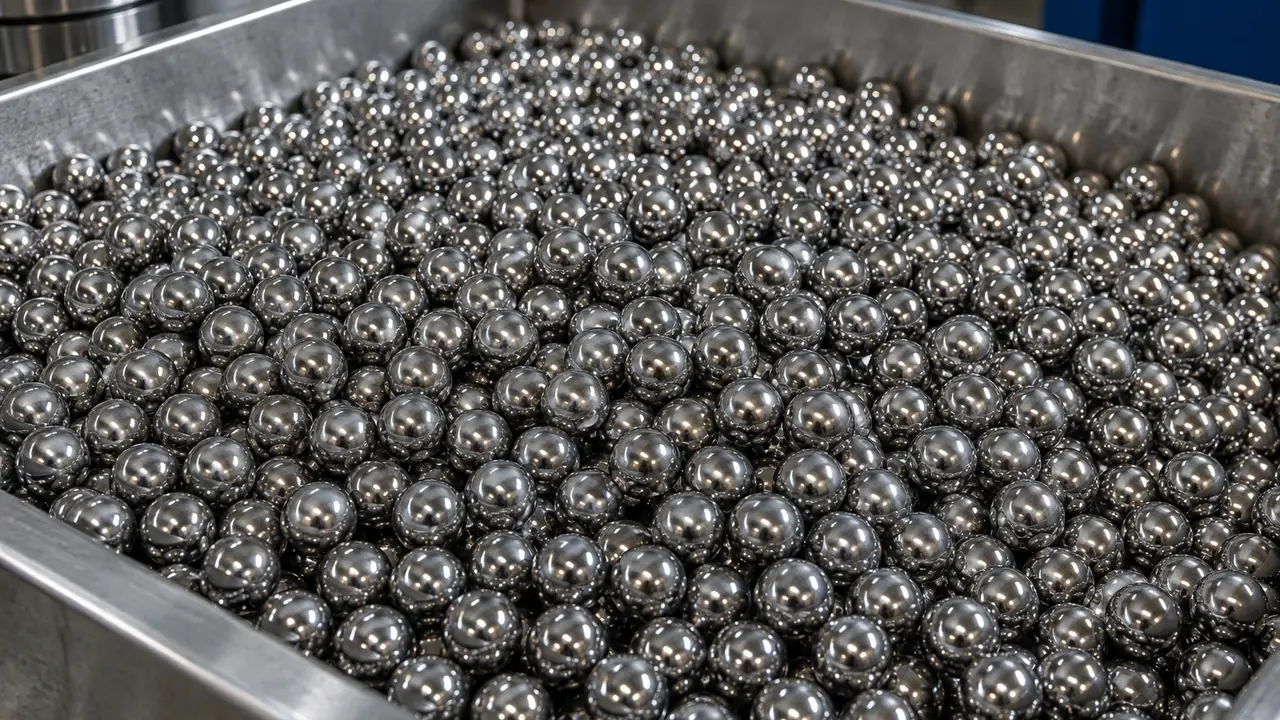
What a bearing ball must do
A bearing ball is a hardened, polished sphere that rolls between two raceways at high contact stress, millions of times. It must be round to a very small deviation, uniform in size across a lot, smooth on the surface and free of internal defects. Variation in ball size inside one bearing causes uneven load sharing, noise and early fatigue, which is why balls are made, graded and sorted to a standard, ISO 3290, rather than just cut and polished.
Buyers of balls include bearing assemblers, repairers, and makers of products that use precision balls without a full bearing: drawer slides, sliders, valves, pumps, bicycle parts and similar. The desk sources them as graded lots from specialist makers.
ISO 3290 grades explained
ISO 3290 sets the grades for steel balls for rolling bearings, from the finest, G3, up to G200 for general-purpose uses. The number is, loosely, a measure of allowed deviation: a lower number means a rounder ball, a tighter diameter variation within the lot and a smoother surface. The standard defines limits for each grade for sphericity, diameter variation and surface roughness, and the exact limits come from the standard itself, not from this page.
| Grade range | Character | Typical use |
|---|---|---|
| G3, G5 | Highest precision, tightest lots | Precision spindles, instruments, high-speed bearings |
| G10 | High precision | Quiet motor bearings, precision machinery |
| G16 | Good precision | General-purpose bearings in motors, appliances |
| G25 | Standard commercial | General machinery, automotive and agricultural bearings |
| G40 to G100 | Lower precision | Low-speed or non-critical bearings, sliders, valves |
| G200 | General balls | Non-bearing applications: toys, hardware, bicycle parts |
Grade choice follows the bearing tolerance class. A P0 general bearing generally uses a different grade from a P5 precision bearing, and a motor bearing aimed at a low vibration group generally uses a finer grade than a farm-machinery bearing. The plant's practice should be confirmed in the datasheet. For ring tolerances see bearing rings and tolerance and clearance.
Materials
- Chrome steel. High-carbon chromium steel GCr15, comparable to AISI 52100 and 100Cr6, is the standard for bearing balls. It is through-hardened and gives the best fatigue life for the cost. See bearing steel.
- Stainless steel (440C). Used where moisture, washdown or mild corrosive exposure would rust chrome steel. Lower load capacity than chrome steel; see stainless steel bearings.
- Ceramic. Silicon nitride or zirconia balls are lighter, harder and electrically insulating, and tolerate high speed and poor lubrication. Hybrid bearings combine ceramic balls with steel rings. See ceramic bearings.
Other balls, such as carbon steel and aluminium, are used outside rolling bearings; state the use so the desk can select the right route.
Ball size and matching to the bearing
Ball diameter is set by the bearing design: the raceway groove radius is matched to the ball, and the ball count is set by the cage. Replacing balls in a used bearing with a different diameter or a different grade changes the internal clearance and the contact, so repair buyers should measure the original balls and match the nominal diameter, material and grade. Ball diameters are given in millimetres or in inch fractions, and both are used across the market, so always state the unit. Nominal bearing dimensions are in the size chart; ball size for a particular designation should be confirmed with the plant's drawing.
Where balls are made
Steel ball making is a specialised, volume process: wire or rod is headed into blanks, flashed, ground, lapped and polished in several stages, then sorted, inspected and packed. The Liaocheng area of Shandong, close to the Linqing bearing-parts base, is a recognised source of steel balls for bearing plants across other clusters. The desk matches the ball maker to the grade: a plant strong in G25 and G40 lots for general bearings is not automatically a source for G10 or finer. More about the clusters.
Lot checks
- Diameter and diameter variation within the lot, against the grade.
- Sphericity and surface roughness, sampled and measured.
- Hardness, typically about 58-65 HRC for through-hardened chrome steel balls.
- Surface defects, checked visually or under magnification.
- Lot identification, rust protection and sealed packing.
Balls are packed in sealed, oiled drums or bags with the lot number. A lot should not be mixed with another lot in the same bearing, because balls from different lots may differ slightly in size. See testing and inspection.
Ordering balls
Balls are counted in thousands or by weight. Typical reference ranges: samples from stock 3-7 working days, batch lead times often 25-45 days, subject to written confirmation for each program. Provide the material, diameter (metric or inch), grade and annual quantity through the quote form, or go back to the components hub.