
| Designation | Type | d bore | D outside | B width |
|---|---|---|---|---|
| 608 | Deep groove ball | 8 | 22 | 7 |
| 6000 | Deep groove ball | 10 | 26 | 8 |
| 6001 | Deep groove ball | 12 | 28 | 8 |
| 6200 | Deep groove ball | 10 | 30 | 9 |
| 6201 | Deep groove ball | 12 | 32 | 10 |
| 6202 | Deep groove ball | 15 | 35 | 11 |
| 6203 | Deep groove ball | 17 | 40 | 12 |
| 6204 | Deep groove ball | 20 | 47 | 14 |
| 6800 | Deep groove ball | 10 | 19 | 5 |
| 6900 | Deep groove ball | 10 | 22 | 6 |
Nominal ISO boundary dimensions for reference. Confirm against your drawing and the supplier datasheet.
What ceramic bearings are
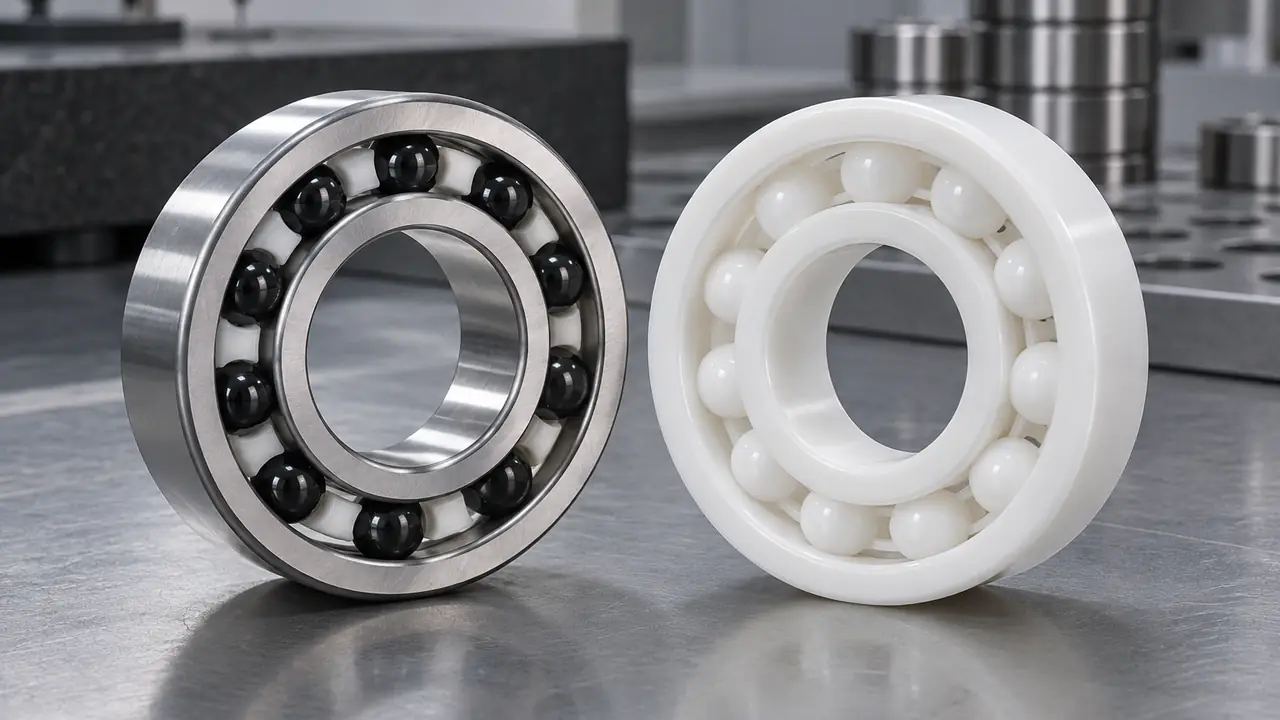
A ceramic bearing uses technical ceramic in place of steel for the rolling elements, or for the whole bearing. Two constructions are common. A hybrid ceramic bearing has steel rings and silicon nitride (Si3N4) balls; it keeps the toughness of steel rings and gains the benefits of the ceramic balls. A full ceramic bearing has rings and balls made of ceramic, typically zirconia (ZrO2) or silicon nitride, with a polymer cage, and is used where steel cannot survive at all - strong chemicals, vacuum or high-temperature conditions beyond what lubricated steel allows.
Ceramic is harder and lighter than bearing steel, does not conduct electricity, and does not rust. These properties solve specific problems; they do not make a ceramic bearing better in every duty.
Hybrid versus full ceramic
| Feature | Hybrid (steel rings, Si3N4 balls) | Full ceramic (ZrO2 or Si3N4) |
|---|---|---|
| Electrical insulation | Interrupts current path at the balls | Fully insulating |
| Corrosion | Rings can still rust unless stainless | Immune to water and most chemicals |
| Speed capability | High, with lower ball mass and heat | High, but check speed limits for the ceramic grade |
| Shock tolerance | Better, with tough steel rings | Poor; brittle under impact |
| Load capacity | Close to steel at moderate load; see datasheet | Lower than steel; see datasheet |
| Relative cost | Moderate premium | Highest |
For most buyers, the hybrid is the practical choice; full ceramic is a niche part for severe chemical, vacuum or non-magnetic environments. Hybrids use the same ISO 15 boundary dimensions as standard bearings, so a 6204 hybrid fits the same housing as a steel 6204. Load ratings and speed limits come from the supplier datasheet.
Why choose ceramic
- Electrical insulation. In variable-frequency-drive motors, stray current can pass through a steel bearing and pit the raceways with a fluted pattern. Ceramic balls break the current path. This is a common reason to specify hybrids in motors and generators. See the electrical erosion article. Shaft grounding rings and insulated housings are other remedies; the choice depends on the drive and the motor frame, and a hybrid is often the simplest retrofit because the bearing size does not change.
- Speed. Ceramic balls weigh less than steel balls, which lowers centrifugal force and heat at high speed. Machine tool spindles use hybrids for this reason; see high-speed bearings.
- Corrosion and chemicals. Full ceramic resists water, acids and solvents where steel and even stainless would suffer.
- Lubricant tolerance. Ceramic is less prone to adhesive wear, so it copes with marginal lubrication better than steel, within limits.
- Non-magnetic. Full ceramic suits instruments and equipment that cannot tolerate magnetic parts.
Handling and fit: the brittleness caveat
Ceramic is hard but brittle. A hit from a hammer, a sharp shock load, a badly aligned press fit or a dropped part can crack a ball or a ceramic ring. Fit hybrids with the same care as steel bearings but avoid impact, press only through the ring that is being fitted, and respect the shaft and housing tolerances specified in the datasheet. For full ceramic, thermal expansion is lower than steel, so fits with steel housings change with temperature and need the supplier's guidance. Cage material for ceramic bearings is usually nylon, PEEK or PTFE; the temperature limit follows the cage.
Cost factors
Ceramic bearings cost more than steel bearings of the same size. The cost depends mainly on the ceramic material and grade, the ball quality, the ring material (standard steel or stainless), the tolerance class, the volume per order and the grease. Hybrids carry a moderate premium; full ceramic costs most. The desk compares total cost against steel by looking at service life, downtime and the cost of a failure - a hybrid in a motor that otherwise needs regular replacement can be economical despite a higher piece cost. No prices are quoted on this page; request a figure through the quote form.
Ordering notes
State the designation, whether hybrid or full ceramic, the ceramic material, the ring material, the cage, the seals and the grease. Standard stock sizes commonly start from 100-500 pieces; non-standard sizes or materials are assessed from the drawing. Stock samples ship in 3-7 working days; batch production commonly takes 25-45 days, as typical reference ranges confirmed in writing. For corrosion alone, stainless steel bearings are often cheaper. More lines on the specialty bearings page.