
Noise is a specification, not an accident
Motor and appliance bearings are judged by ear. A washing machine drum, a fan, a power tool or a servo motor can fail a customer's expectations with a bearing that is dimensionally correct but slightly rough. The reasons are well known: waviness on the raceways, uneven balls, a loose cage, unsuitable grease or too tight a fit that eats the internal clearance. For this reason noise and vibration are written into the order as a grade and a test method, instead of being left to general quality.
Rolvane works as a sourcing desk. It shortlists partner plants that actually produce quiet bearings in volume, typically in eastern Zhejiang, where small and medium deep groove and miniature bearings are a speciality, and it organises inspection and shipping. The shortlist is based on the vibration grade and quantity, not on price alone.
Vibration grades
Vibration groups such as Z1, Z2 and Z3 and V1, V2 and V3 are used by plants to classify how quiet a bearing runs on a test rig. The scheme is part of Chinese bearing practice and related standard families, and details of the test method, frequency bands and limits are set by the plant or by the order, so a letter and number alone do not define a measured value. The desk therefore asks the plant for its test method and the limit that applies to each grade, and writes them into the order. Never assume that a Z2 from one plant equals a Z2 from another without the written criteria.
| Factor | Typical option | Effect |
|---|---|---|
| Vibration grade | Z1, Z2, Z3 or V1, V2, V3 by order | Defines how quiet the bearing runs on the plant's test rig |
| Tolerance class | P0 for general use, P6 or P5 for quiet motors | Better raceway and ball form, lower noise |
| Internal clearance | CN or C3 | C3 absorbs heat expansion and interference fits |
| Cage | Pressed steel or nylon | Nylon is often quieter within its temperature limit |
| Seal | ZZ shield or 2RS seal | Shields run freer; rubber seals add friction and sound |
| Grease | Low-noise grease | Reduces rumble and hum, fill amount agreed |
C3 clearance and fits
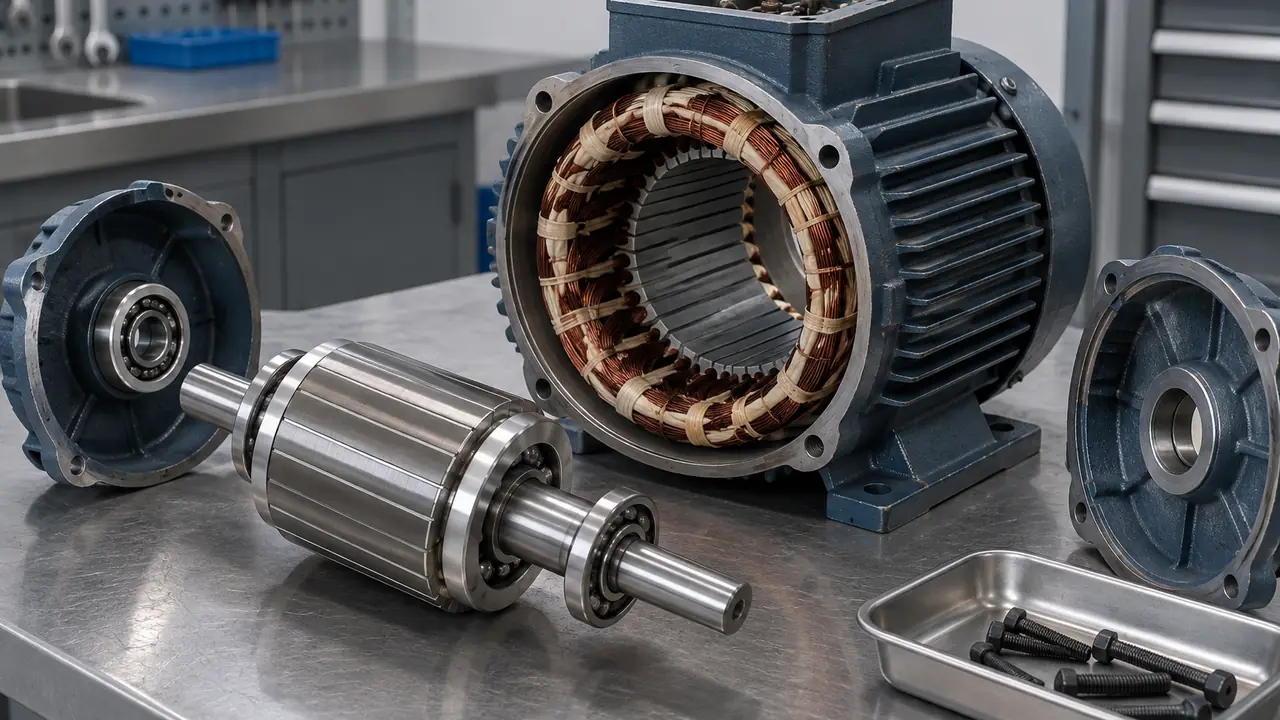
Most electric motor bearings use C3, a radial internal clearance larger than normal. The rotor shaft is usually a tight fit in the inner ring, and the motor runs warm, so the inner ring expands and clearance falls in service. With normal clearance the bearing can end up preloaded and noisy. C3 leaves room for that expansion. The right choice depends on the actual fits, temperatures and loads of your motor, which is why the desk asks for them. Read C3 clearance explained and tolerance and clearance.
Grease for low noise
Low-noise greases use a base oil and thickener chosen to be clean and consistent, with filtering that keeps hard particles out. They are specified by type and fill, not by name alone. The desk requests a grease datasheet with temperature range, and for appliances in contact with food or water, any required declarations. See the lubrication guide and bearing grease.
Miniature bearings
Miniature bearings, with bores of about 10 mm and below, appear in small motors, fans, tools, shavers and instruments. At that size cleanliness and handling dominate: a single hard particle can create audible roughness. Options include shielded or sealed versions, flanged outer rings, low-torque grease and stainless steel. The desk asks for the noise grade and the starting torque expected, and the inspection plan covers rotation and noise sampling for each lot.
Electrical erosion: insulated and hybrid options
In motors driven by frequency converters, shaft voltage can discharge through the bearing, leaving pitting and fluting in the raceway that sounds like a growl and ends in failure. Remedies include insulated bearings with a coated outer ring, hybrid bearings with ceramic balls, grounding brushes and shaft rings. A hybrid bearing is a mechanical solution inside the part; the others work on the motor design. The desk can quote insulated and hybrid versions and discusses which route suits your drive before sampling.
Ordering notes
Typical reference ranges: 100-500 pieces per standard designation, stock samples in 3-7 working days, batch production in 25-45 days. Motor makers often order in large repeating lots, in which case a frame agreement and lot records as described in the OEM program apply. All terms are confirmed in writing for each program. Send designations, the vibration grade, the clearance group and your motor details through the quote form.