
| Designation | Type | d bore | D outside | B width |
|---|---|---|---|---|
| 623 | Deep groove ball | 3 | 10 | 4 |
| 624 | Deep groove ball | 4 | 13 | 5 |
| 625 | Deep groove ball | 5 | 16 | 5 |
| 626 | Deep groove ball | 6 | 19 | 6 |
| 608 | Deep groove ball | 8 | 22 | 7 |
| 684 | Deep groove ball | 4 | 9 | 2.5 |
| 685 | Deep groove ball | 5 | 11 | 3 |
| 688 | Deep groove ball | 8 | 16 | 4 |
| 693 | Deep groove ball | 3 | 8 | 3 |
| 695 | Deep groove ball | 5 | 13 | 4 |
| MR63 | Deep groove ball | 3 | 6 | 2 |
| MR85 | Deep groove ball | 5 | 8 | 2 |
| MR105 | Deep groove ball | 5 | 10 | 3 |
| MR128 | Deep groove ball | 8 | 12 | 3.5 |
Nominal ISO boundary dimensions for reference. Confirm against your drawing and the supplier datasheet.
What counts as a miniature bearing
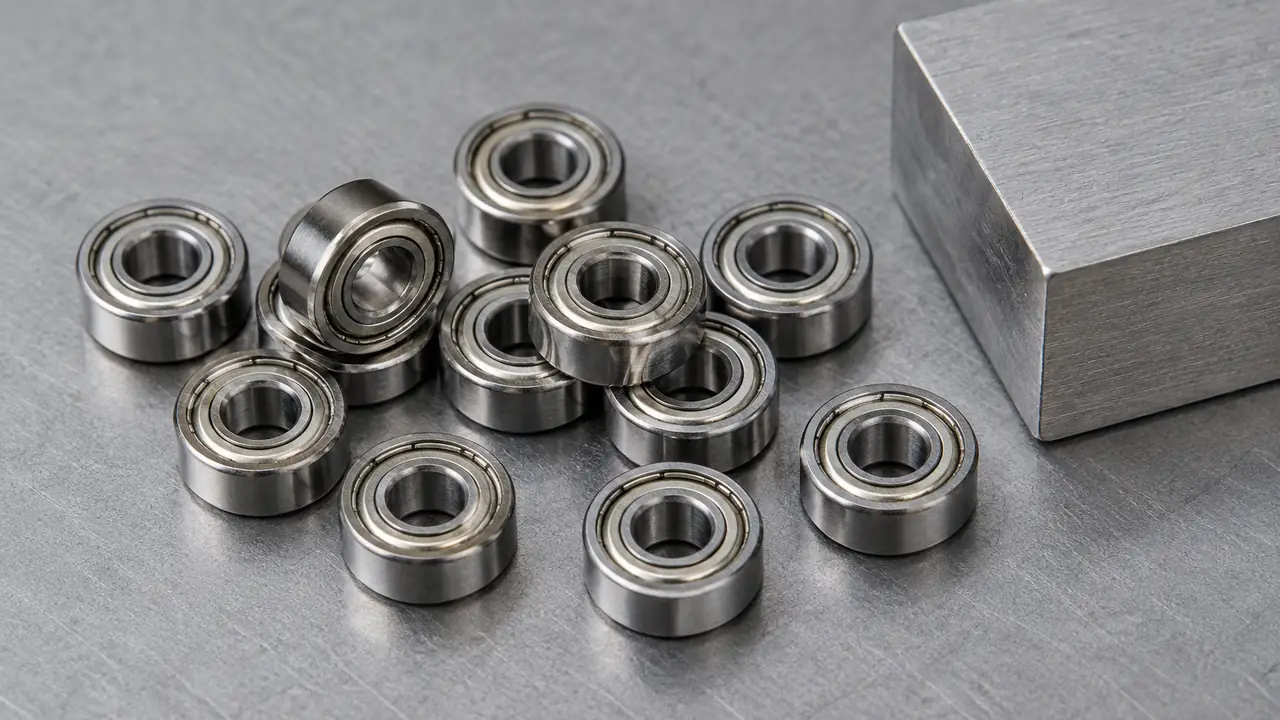
A miniature bearing is a small deep groove ball bearing with a bore below about 10 mm. The design is the same as a standard deep groove ball bearing, scaled down, and the sizes sit in the ISO 15 tables. Because the parts are so small, the difficulty is not capacity but control: tiny balls, thin rings, precise raceways and very small amounts of grease. A good miniature bearing runs quietly, turns freely under a light touch and keeps its performance in applications where a few micrometres matter.
Miniature bearings are centred on eastern Zhejiang, where clusters around Cixi and Ningbo specialise in small and miniature types. The desk shortlists plants by the noise grade, cleanliness and tolerance class the application needs, not just by size.
Series and nominal sizes
The naming follows the same logic as larger deep groove bearings. The 6xx numbers such as 623, 625 and 608 are the standard small sizes of the 62 and 60 style; 68x and 69x are thinner sections with the same bore; MR designations denote metric miniature sizes, often with a flange variant.
| Designation | Bore d | Outside D | Width B |
|---|---|---|---|
| 625 | 5 | 16 | 5 |
| 608 | 8 | 22 | 7 |
| 684 | 4 | 9 | 2.5 |
| 695 | 5 | 13 | 4 |
| MR105 | 5 | 10 | 3 |
| MR128 | 8 | 12 | 3.5 |
The same 5 mm bore appears in 625, 695 and MR105 with very different outside diameters and widths, so give all three dimensions when you ask for a part. Load ratings and limiting speeds come from the supplier datasheet.
Noise, cleanliness and grease
In small motors and instruments, a miniature bearing is often the main source of audible noise. Noise depends on raceway finish, ball grade (ISO 3290 grades are defined for steel balls), cage design and above all on cleanliness during assembly. A single particle can raise noise noticeably in a bearing this small. Ask for a stated noise or vibration grade, and the desk will agree on a test method with the plant before production.
Grease selection matters in the same way. Low-noise greases with a fine base oil are common for small motors; instrument oils and very light fills suit devices with low starting torque. Overfilling raises friction and heat. State the temperature range and whether the bearing should be filled or run with a light film.
Handling and storage
- Keep bearings in their sealed bags or boxes until fitting; do not wash off the preservative unless the process requires it.
- Use clean gloves or tweezers and a clean bench. Fingerprints and dust add noise and corrosion risk.
- Press the bearing in by the ring that has the interference fit, never through the balls.
- Avoid axial shock. Small balls dent easily and the damage shows up later as a vibration.
Typical applications
Small electric motors and fans, printers and office equipment, power tools, fishing reels and model vehicles, dental handpieces and medical devices, sensors, cameras and precision instruments. Medical and instrument projects usually add requirements for cleanliness, material (including stainless steel) and documentation, which are agreed in writing before an order.
Fits and tolerances at small sizes
At bores of a few millimetres, the shaft and housing fits have to be tight in tolerance and correct in form. A shaft that is a few micrometres oversize can remove the radial clearance completely, and a housing that is out of round squeezes the outer ring and raises torque. Most miniature bearings are made to P0 or P6 and, for quiet motors and precision instruments, P5. Radial clearance is small and is often stated as a special group for miniature types; confirm it with the plant rather than assuming the C3 group used for larger sizes. When bearings are mounted in pairs with a spring preload, the preload force must be low enough that the thin rings are not deformed.
Axial loading is limited as well. A miniature bearing can take a light axial load in both directions, but sustained thrust belongs on a bigger bearing or a purpose-built unit.
Options and ordering
Specify open, ZZ or 2RS, flange or plain, cage material, noise grade, grease and tolerance class. Typical checks per lot are bore, outside diameter and width, radial clearance, noise on a rig and rotation smoothness, reported with the lot. See testing and inspection and tolerance and clearance.
Standard sizes typically start at 100-500 pieces per designation, with samples in 3-7 working days from stock and batch production commonly in 25-45 days, all confirmed in writing. Send designations through the quote form.