
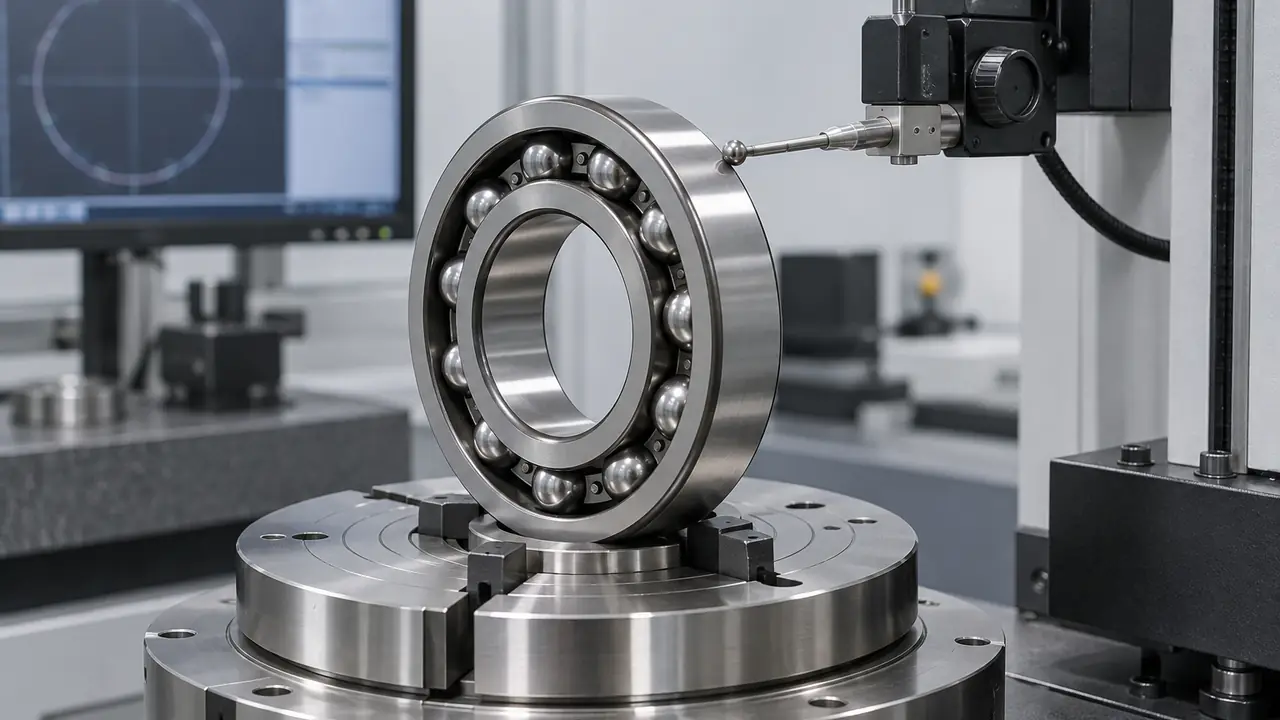
What internal clearance is
Radial internal clearance is the total distance one ring can move relative to the other, in the radial direction, when the bearing is unmounted and unloaded. Picture the inner ring held still and the outer ring pushed up and down: the movement is the clearance. It is tiny, measured in micrometres, but it has a large effect on how the bearing behaves once it is on a shaft and in a housing.
Clearance is not a defect. It is designed in, because a bearing with no free space would bind as soon as the rings change size. Three things change that size in service: the press fit on the shaft, the press fit in the housing, and the temperature difference between the rings.
The clearance groups
International and GB/T standards define internal clearance in groups, and ISO 492 handles dimensional tolerance separately, so the two requirements never replace each other. The group is written as a suffix after the designation. The numeric limits depend on bearing type and bore size and are given in the standard and the supplier datasheet, so we describe the groups by their relationship only.
| Suffix | Name | Relative to normal | Typical reason |
|---|---|---|---|
| C2 | Smaller than normal | Tighter | Precision running, light-load accuracy, alternating loads |
| CN (or none) | Normal | Reference group | Standard fits and temperatures |
| C3 | Larger than normal | Looser | Interference fits, temperature difference, motors |
| C4 | Larger than C3 | Looser still | Heavy interference fits, large heat gain |
| C5 | Larger than C4 | Largest | Rare, severe conditions |
The groups step up in order. Each group has a lower and an upper limit, and the upper limit of one group usually meets the lower limit of the next. The full comparison is in internal clearance groups C2 to C4.
Why normal is sometimes not enough
Normal clearance suits a bearing mounted with moderate fits and running near room temperature. Real machines often do not meet those conditions, and the clearance that remains in service, called the operating clearance, can be much smaller than the clearance on the shelf. Two effects do the work.
Interference fit. When an inner ring is pressed onto a shaft, it expands slightly. When an outer ring is pressed into a housing, it shrinks slightly. Both reduce clearance. The tighter the fit, the more clearance is lost. Rotating inner rings on shafts normally take a tight fit, so a normal-clearance bearing may be left with very little room.
Temperature difference. In a motor or gearbox, the shaft and inner ring run hotter than the housing and outer ring. The inner ring grows more than the outer, which reduces clearance again. Higher operating temperature or faster start-up makes the effect stronger.
If the operating clearance falls to zero or becomes negative, the balls are squeezed between the rings. Friction rises, heat rises, the lubricant ages and the bearing can fail in a short time. C3 gives the bearing room to absorb both effects.
Where C3 is the usual choice
- Electric motors. Rotor shafts run warm and take tight fits, so C3 deep groove ball bearings are common, for example 6203 or 6205 sizes. See deep groove ball bearings for the series.
- Fans, blowers and pumps. Heat and temperature differences are routine.
- Gearboxes and drives. Inner rings with interference fits and oil heated by operation.
- Heavy-duty and farm machinery. Shock, heat and sometimes tight shaft fits.
- Roller bearings. Cylindrical roller bearings often use C3 for the same reasons, and spherical roller bearings use C3 on adapter sleeves.
Conversely, C2 or CN is better where low play matters more than heat tolerance: precision spindles, instruments, and applications with alternating loads where play would cause noise. A tighter clearance can also help when the bearing is mounted with a very light fit in both rings.
How to order C3 correctly
C3 is a suffix on the designation, such as 6205-2RS C3 or 6205 ZZ C3. Write it in the same position as it appears in the catalogue and state it in words on the enquiry as well, because suffixes are easily lost in translation or when copying part numbers into a spreadsheet. A "6205" without the suffix will normally be supplied with normal clearance.
Ask the supplier to confirm the following in the quotation:
- The clearance group and the standard it refers to.
- How clearance was checked on the batch, for example on a clearance gauge or with a recorded sample.
- Marking: whether the suffix is printed on the box and etched on the ring.
- Combination with other suffixes, such as seals, precision class and grease.
Common mistakes
The most frequent error is treating C3 as a general upgrade. More clearance means more play, a little more noise at light load, and in some applications less precise positioning. Use it where the fit and temperature call for it, not by default.
A second error is changing clearance without reviewing the fit. If the existing bearing runs hot, a C3 replacement may help, but it can also hide a shaft that is oversize or out of round. Check the fit using the guidance in shaft and housing fits for bearings.
A third error is mixing groups in a pair. When two bearings share one shaft, give them the same clearance group unless the design calls for a locating and a floating bearing with different requirements.
A quick way to sanity-check the choice
Before settling on C3, run a short check. Ask whether the inner ring has an interference fit, which is the normal case for a rotating shaft. Ask whether the shaft runs hotter than the housing, which is the normal case for motors, fans and gearboxes. If both answers are yes, normal clearance is likely to be consumed, and C3 is a sound starting point. If the shaft is slow, cool and lightly fitted, normal clearance is usually enough and avoids extra play.
For anything critical, the bearing supplier can calculate the expected operating clearance from the fits and temperatures you give. Treat that calculation as the final word, and record the chosen group on the drawing so that every later order repeats it.
Asking the desk
The desk shortlists partner plants that can supply the clearance group you need, in the series you use, and agrees the checks before shipment. Typical reference MOQ and lead time are on the MOQ and lead time page and are confirmed in writing for each order. Send the designation, clearance group, seal, tolerance class, application and quantity via the quote form.