
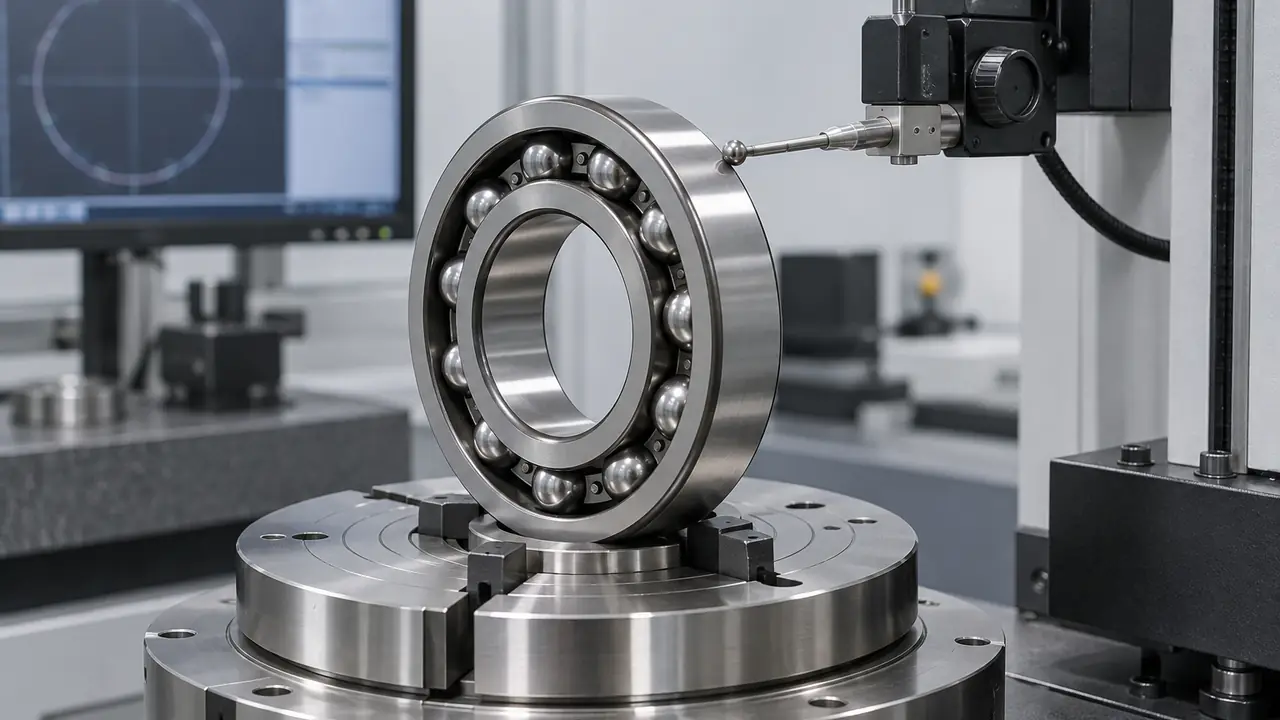
Why fits matter
A bearing ring that is loose on its seat will creep, turning slowly against the shaft or housing under load. Creep wears the seat, produces fretting rust, generates noise and heat, and eventually destroys both the bearing and the seat. A ring that is too tight loses internal clearance, runs hot and can crack. The fit is the controlled relationship between ring and seat that avoids both problems.
Bearing fits are written with the ISO system of limits and fits, using letters for position and numbers for tolerance grade. Lowercase letters are used for shafts (for example k5, m5, m6, j6, h6) and uppercase letters for housing bores (for example H7, J7, K7, P7). The bearing bore and outside diameter themselves are held to the bearing tolerance class under ISO 492; the fit class you choose controls the mating seat.
The first question: which ring turns relative to the load?
The key concept is how the load moves relative to each ring.
- Circumferential load. The load rotates relative to the ring, so every point of the ring sees the load in turn. Example: a fixed radial load on a rotating inner ring. This ring needs a tight, interference fit to stop creep.
- Point load. The load stays at one spot on the ring. Example: the same fixed load on a stationary outer ring. This ring can have a looser fit, and a transition or small clearance fit is common.
- Rotating-housing cases. In wheel hubs and idler pulleys, the outer ring turns with the load fixed relative to the shaft. The situation reverses: the outer ring needs the tighter fit, and the inner ring on the stationary shaft can be looser.
Most machines have a rotating shaft and a fixed housing, which is why the textbook case is an interference fit on the shaft and a looser fit in the housing.
Common fit classes as typical examples
The table lists classes frequently met in practice. These are typical examples, not selections; use the bearing supplier's fit tables for the final choice, since the right class depends on load, speed, bearing size and shaft material.
| Seat | Class | General nature | Typical situation |
|---|---|---|---|
| Shaft | j6 | Transition, light interference possible | Light loads, easy dismounting, precision |
| Shaft | k5 / k6 | Slight interference | Normal loads, precision and electric motor shafts |
| Shaft | m5 / m6 | More interference | Heavier or shock loads on the inner ring |
| Housing | H7 | Close sliding fit | Stationary outer ring, split housings, light loads |
| Housing | J7 | Transition | Normal loads, a little more security |
| Housing | P7 | Interference | Rotating outer ring under heavy load |
The exact limits, in micrometres, for each class depend on the diameter band. They are published in the ISO system of limits and fits and in the bearing supplier's guidance. We do not reproduce them here.
Factors that push the choice tighter or looser
Several conditions modify the baseline choice.
- Load size. Heavier and shock loads need tighter fits because they deform the ring and encourage creep.
- Speed and vibration. Higher speed and vibration increase the tendency to creep and favour tighter fits.
- Temperature. A hot inner ring expands and increases the effective interference. A light-alloy housing expands more than steel and can loosen an outer ring.
- Housing material and wall thickness. A thin-wall or light-alloy housing needs a tighter fit than a heavy cast iron one for the same retention.
- Mounting and dismounting. A separable bearing makes tighter fits easy; a non-separable bearing needs a fit that can be assembled by press without damage.
- Clearance group. Tighter fits reduce clearance. That is why motor bearings combine tight shaft fits with C3. See C3 clearance explained.
Shaft and housing quality matters as much as the class
The fit class assumes seats that are round, straight and clean. A tolerance class cannot help if the shaft is out of round, has a taper along the seat or a rough finish. Bearing makers also ask for limits on shoulder squareness, because a shoulder that is not square tilts the ring and creates misalignment. For precision classes, the seats should be held to tighter geometric limits, as discussed in precision classes compared. Hard shaft materials and thin, hollow shafts also change the effective interference, so check with the supplier when either applies.
Locating and floating bearings
A shaft supported on two bearings needs one of them to fix its axial position, called the locating bearing, while the other must be free to follow thermal expansion, called the floating bearing. The fit differs between the two. The locating bearing is held on both rings by shoulders, circlips or covers. The floating bearing has an axial path, usually provided in one of two ways. With a non-separable ball bearing, the outer ring is given a looser housing fit so it can slide in the bore. With a separable cylindrical roller bearing such as the NU type, both rings can be fitted tightly and the rollers slide on the raceway.
If both bearings are locked axially without allowance for expansion, the shaft can push the bearings into axial preload as it heats, and the symptoms are the same as a lost clearance: heat, noise and short life. When a replacement bearing behaves differently from the original, check whether it is sitting in the same axial role before looking at the bearing itself.
Mounting and checking
- Measure the shaft seat and housing bore at two or three positions and in two directions, and record the values.
- Compare them with the supplier's table for your bearing bore or outside diameter and class.
- Clean the seats and the bearing, apply a thin film of oil, and press the ring squarely on the ring being fitted, not through the rolling elements.
- Check by hand that the bearing turns freely after mounting. A bearing that feels tight after fitting may have lost too much clearance.
Ordering with fits in mind
Fit selection is an engineering decision that sits between the bearing supplier and the machine designer. When you send an enquiry, list the shaft and housing tolerances in your drawing, the clearance group you expect and the precision class. This lets the supplier check whether the combination works and whether, for example, a C3 bearing would be more appropriate than normal clearance. For adapter sleeves, withdrawal sleeves and locknuts used to fix bearings on shafts, see bearing accessories. Send the details through the quote form.