
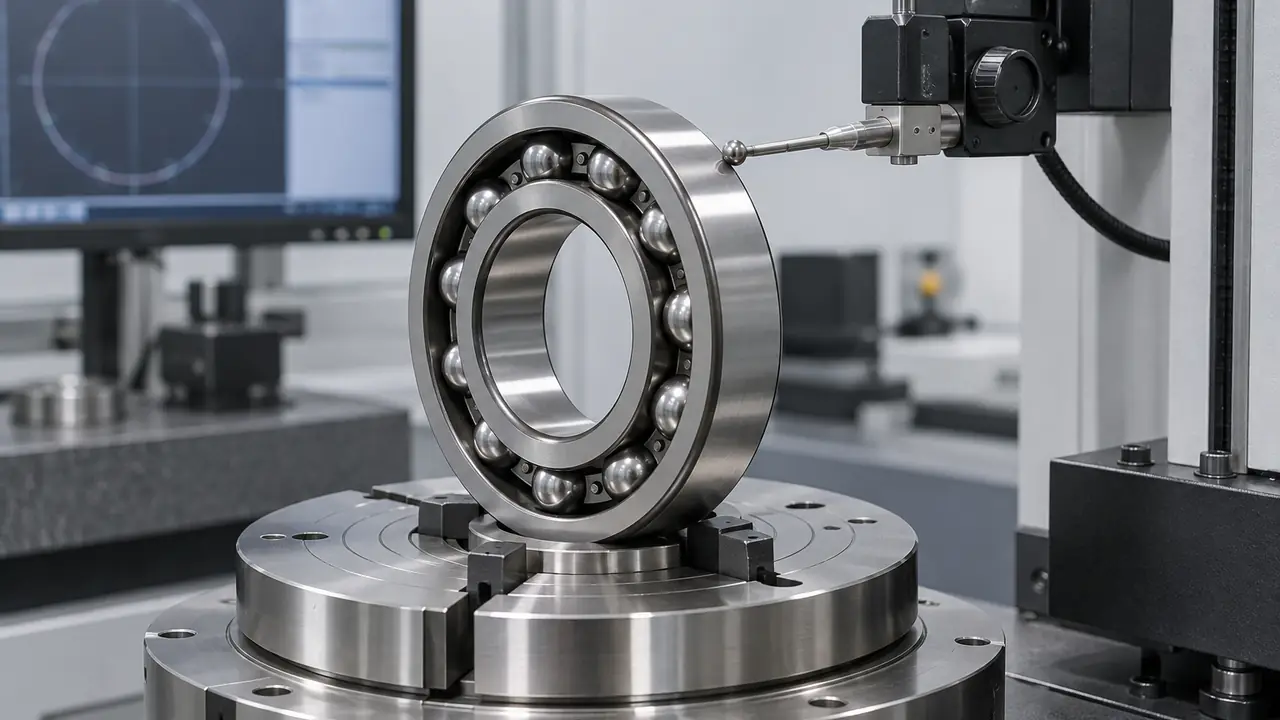
Radial and axial clearance
Internal clearance has two directions. Radial internal clearance is the total movement of one ring relative to the other at right angles to the bearing axis. Axial internal clearance is the same movement along the axis. In a deep groove ball bearing the two are linked through the groove geometry, so specifying radial clearance is enough. In angular contact, tapered roller and some paired arrangements, axial setting is the working quantity and is adjusted at assembly, sometimes with a preload.
The groups C2, CN, C3, C4 and C5 refer to radial clearance of single-row radial bearings such as deep groove ball bearings, cylindrical roller bearings and spherical bearings. The suffix goes after the designation, for example 6306 C3.
How the groups relate
| Group | Position on the scale | Thinking behind it |
|---|---|---|
| C2 | Below normal | Little play needed; fits are light or loads alternate |
| CN | Normal, the reference | Moderate fits, ordinary temperature difference |
| C3 | Above normal | Interference fits, hot inner ring, motor duty |
| C4 | Above C3 | Heavier interference fits or larger temperature gain |
| C5 | Above C4 | Severe conditions and special programs |
Within each group the limits are a range, and the range is defined for each bore size. A 25 mm bore and a 100 mm bore have different limits for the same group, because larger bearings need larger absolute clearance to absorb the same relative change. This is why a clearance chart is organised by bore, with columns for each group and a minimum and maximum value in micrometres.
Reading a clearance chart
Standards and supplier datasheets present clearance as a table. We do not reproduce the numbers because they depend on bearing type, and a deep groove table is not valid for a cylindrical roller bearing. When you receive the table, use it in this order.
- Pick the correct table for your bearing type: deep groove, cylindrical roller, spherical roller and so on.
- Find the row that covers your bore diameter. Rows are bands, such as "over 18 up to 24", not single sizes.
- Read the minimum and maximum for the group you want.
- Check that the supplier's inspection method matches the standard's measuring load, because clearance readings shift with the load applied during the measurement.
That last point is often missed. Clearance is measured under a small defined gauge load, and the figure differs slightly from the free value. A measured value that sits near a group limit may move between groups depending on the method, so agree the method with the plant.
What changes clearance after mounting
The clearance on the shelf is not the clearance in operation. Three effects shift it, and they are best treated as a short budget.
- Inner ring fit. Pressing the inner ring onto the shaft expands it and reduces clearance. A heavier interference means a larger reduction.
- Outer ring fit. Pressing the outer ring into a housing compresses it and reduces clearance by a smaller amount.
- Temperature. If the inner ring runs hotter than the outer, it expands more and clearance falls further. If the outer ring is hotter, such as in a hot housing with a cool shaft, clearance increases.
The sum of these effects is subtracted from the initial clearance to give the operating clearance. A healthy ball bearing operates with a small positive clearance, so that the lubricant film forms and the load is shared across several balls. A negative operating clearance, which is a preload, is deliberate in precision pairs but is a fault in an ordinary bearing.
Choosing a group from the application
| Situation | Likely group |
|---|---|
| Standard fits, room temperature, general machinery | CN |
| Rotor shaft with tight inner ring fit, warm running | C3 |
| Large temperature difference between shaft and housing | C3 or C4 |
| Instruments, low-noise small motors with light fits | C2 or CN |
| Alternating loads, where play causes noise | C2 or CN |
Treat the table as a starting point. Fit classes for common shafts, such as k5 or m5, are discussed in shaft and housing fits for bearings, and the supplier's fit tables give the exact reduction in clearance for each fit.
Clearance in non-ball bearings
The same groups apply to roller bearings, with a few differences worth knowing. Cylindrical roller bearings with a separable inner ring, such as the NU and N types, are often supplied with interchangeable rings, and the clearance is only fixed when the rings are matched at assembly. Buyers who mix rings from different lots may find clearance outside the group, so ask for matched sets or for interchangeable-ring parts with a stated tolerance. See cylindrical roller bearings for the structures.
Spherical roller bearings with a tapered bore are mounted on adapter sleeves, and the clearance is reduced deliberately by driving the bearing up the taper. Here the working figure is the reduction in clearance during mounting, which the supplier states, not the initial group alone. Tapered roller and paired angular contact bearings are set by axial adjustment, so the group label matters less than the setting procedure.
Practical points when ordering
Write the group in the designation and in words in the enquiry. Check whether your preferred seal or shield and grease are compatible with the group, because a few combinations are not standard. If a bearing family is normally supplied as CN, a C3 version may need a short extra lead time or a higher reference MOQ per designation; the typical ranges are on the MOQ and lead time page and are confirmed in writing for each program.
Also keep the group consistent across your own stock. If one batch of 6305 arrives as CN and the next as C3 with the same label, workers at the line will mix them. Mark the suffix on the box and, if required, on the ring. Marking options are covered in OEM and private label.
Where to read the values and ask for support
Exact limits come from the standard and the supplier datasheet for your bearing type and bore. For engineering input, the desk can ask the partner plant to calculate operating clearance from your fits and temperatures. Start from the tolerance and clearance guide and send the designation and application through the quote form.