
The basic idea: roll instead of slide
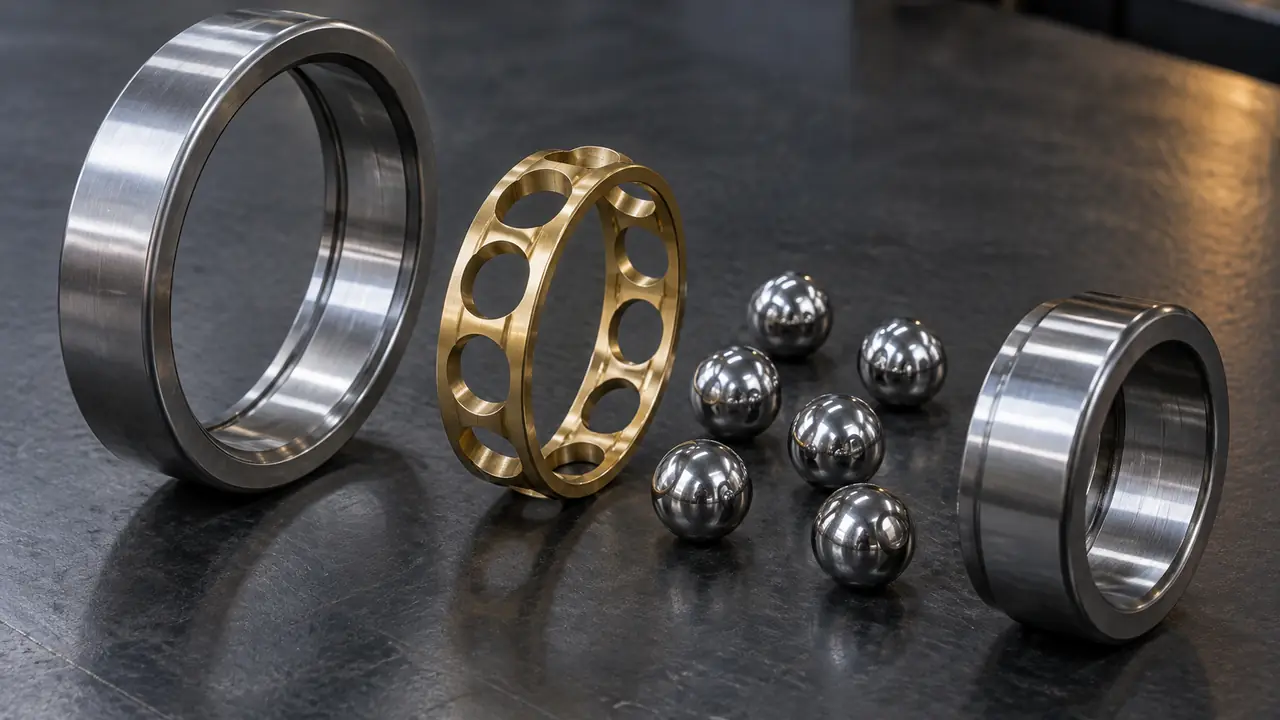
When two surfaces slide, friction acts across the whole contact area and turns into heat and wear. When a ball sits between them, each surface rolls over the ball and the sliding component almost disappears. A ball bearing is a precise way of making that happen: two hardened rings with grooves, a set of balls running between them, and a cage that keeps the balls spaced.
The inner ring turns with the shaft, the outer ring is held by the housing, and the balls travel round the circuit between them. A ball completes one lap of the raceway for every two or so turns of the shaft, because the cage carries the balls at about half the shaft speed when the outer ring is stationary. That detail explains why cage design affects noise and why a worn cage can cause a rattle long before the rings are damaged.
Where the load actually goes
Load travels in a straight line from the shaft to the housing, and only a few balls carry most of it. Take a shaft with a downward radial load. The balls at the bottom of the bearing are squeezed between the inner and outer raceway, the ones at the sides carry less, and the ones at the top carry almost nothing. Each ball therefore passes in and out of the loaded zone once per revolution.
The contact between a hard ball and a hard raceway is tiny. Under load the steel deforms elastically into a small oval patch, a fraction of a millimetre across. The pressure inside that patch is very high, which is why bearing steel must be clean, hard and uniformly heat-treated. Fatigue starts just beneath the surface at those contact points, and it is the origin of the rating life method in ISO 281.
Why the raceway has a groove
If the raceway were flat, the balls would wander sideways. A groove cut slightly larger than the ball radius keeps the ball centred and spreads the contact. A closer fit supports more load but adds friction; a looser fit lowers friction but concentrates stress. Deep groove ball bearings use a groove deep enough to take moderate axial load as well as radial, which is the main reason they are the most widely used bearing in the world.
Angular contact bearings cut the groove with a shoulder on only one side of each ring, so that the contact line is tilted. A tilted contact carries axial load in one direction efficiently, and pairs of them are mounted face to face or back to back. Details are on the angular contact page.
Internal clearance and why it matters
Inside a ball bearing there is a small gap between balls and raceways before it is mounted. That gap is the internal clearance. It leaves room for the thermal expansion of the inner ring, for press-fit shrinkage and for the lubricant film. Normal clearance is described by the group name CN, and larger clearance by C3 or C4. Smaller groups are C2.
| Condition | What happens to clearance | Typical response |
|---|---|---|
| Tight press fit on the shaft | Inner ring expands, clearance falls | Choose C3 |
| Hot shaft, cooler housing | Inner ring grows more than outer | Choose C3 or C4 |
| Light load, precision running | Low play needed for accuracy | Choose C2 or preloaded pair |
| Normal fit, moderate temperature | Little change | Choose CN |
The numeric limits for each group depend on bore size and are set out in the supplier datasheet; the principle is explained in C3 clearance explained. A bearing that loses all its clearance after fitting heats up quickly, which is a common cause of early failure in motors.
The lubricant film is part of the bearing
Even rolling contact has some sliding, and metal-to-metal touch would wear the surfaces. A thin film of oil, held in grease by a thickener, separates the balls from the raceways at speed. If the film is too thin because of low speed, high temperature or the wrong viscosity, the surfaces touch and wear accelerates. If the grease fill is too high, the balls churn it and overheat. For that reason bearings are filled to a fraction of free volume, not packed solid. Selection of grease is covered in the lubrication guide.
Speed, heat and noise
As speed rises, centrifugal force pushes the balls outward, and the cage and grease generate more heat. That is why ball bearings are the usual choice for fast shafts and why ceramic balls, which are lighter, appear in high-speed spindles. For electric motors and appliances, bearing noise is also a quality issue: raceway waviness, ball roundness and cage fit all contribute. Plants control this by grinding and honing the raceways and by grading balls under ISO 3290. Vibration grades such as Z1 to Z3 are agreed with the supplier for each order.
The role of the cage and seals
The cage is the least visible part of a ball bearing and one of the most influential. It stops neighbouring balls from rubbing against each other, which would double the relative sliding speed at the contact, and it guides the balls through the unloaded zone. Pressed steel cages are light and economical and suit most general-purpose bearings. Machined brass cages are stronger for shock and vibration, and glass-fibre nylon cages run quietly but have a temperature limit set by the polymer. The bearing cage page compares the options.
Seals and shields close the sides of the bearing. A metal shield leaves a small gap and adds almost no friction, so it suits higher speed and dry conditions. A contact rubber seal presses lightly against the inner ring, keeps out water and dust better, and adds some drag and heat. Choosing between them is a trade of speed against protection, not a question of one being better.
What to check when sourcing
For ordinary deep groove ball bearings the checks are practical ones:
- Confirm designation, seal type, clearance group and tolerance class on the sample and on the label.
- Turn the bearing by hand; it should rotate smoothly with no grinding or tight spots.
- Compare noise and vibration against an agreed reference sample.
- Check grease type and fill against the application temperature.
- Ask for hardness and dimensional records from the partner plant for the batch.
Send the details through the quote form and the desk will coordinate samples and record the agreed parameters.