
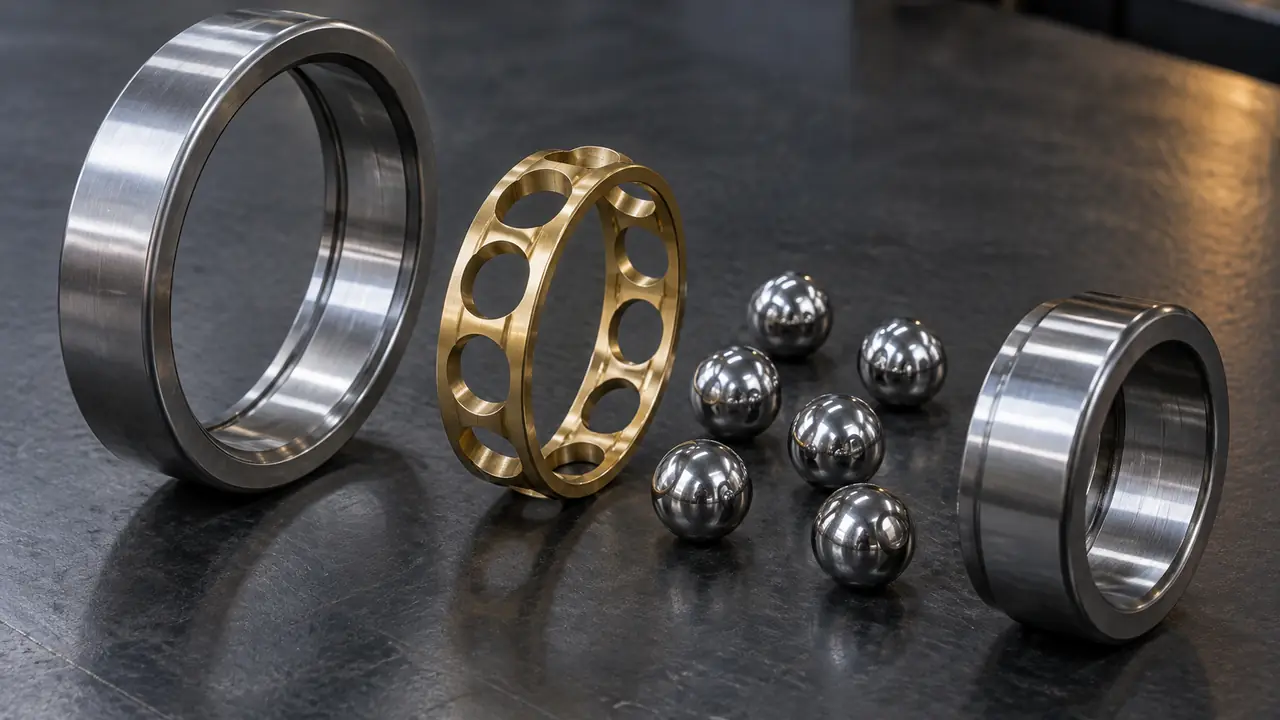
Three families, one decision tree
Every bearing in a catalogue belongs to one of three families. Ball bearings carry load through point contact between steel or ceramic balls and the raceways. Roller bearings use cylinders, cones, barrels or thin needles that touch the raceways along a line. Plain bearings have no rolling elements at all; the shaft slides on a bush, a polymer liner or an oil film.
Within each family, the geometry of the raceways and the direction of the contact decide which loads the bearing can take. Rather than memorising dozens of names, it is quicker to work from the application backwards. The four questions below cover most real selections.
Question 1: which way does the load act?
Radial load pushes across the shaft; axial load pushes along it. Many shafts see both. The type name usually tells you the answer once you know the pattern.
| Load pattern | Ball option | Roller option |
|---|---|---|
| Mainly radial | Deep groove | Cylindrical roller |
| Radial plus one-way axial | Angular contact | Tapered roller |
| Axial only | Thrust ball | Thrust roller |
| Heavy radial plus misalignment | Self-aligning ball (light duty) | Spherical roller |
Deep groove ball bearings are the exception that proves the rule: although they are classed as radial bearings, the deep raceway groove lets them carry moderate axial load in both directions, which is why they are the default choice for motors and appliances.
Question 2: how fast and how heavy?
Point contact has less friction and generates less heat, so ball bearings tolerate higher speed. Line contact spreads the load over a larger area, so roller bearings carry more for the same envelope. The usual guidance holds across the whole catalogue: pick a ball bearing when speed, low noise and low torque matter, and pick a roller bearing when load, shock or stiffness matter.
Two points are worth adding. First, a roller bearing running too lightly loaded can skid instead of roll, which damages the raceway; a ball bearing is more forgiving at low load. Second, speed ratings and load ratings are published by the bearing supplier for each designation. We do not quote them in general articles because they depend on size, cage, lubricant and tolerance class, so ask for the datasheet values when you request a quotation.
Question 3: can the shaft stay aligned?
Rolling bearings are designed for a shaft that sits square in its housing. A long shaft that bends under load, or two housings bolted to a frame that flexes, will push the bearing out of line. A standard deep groove or cylindrical roller bearing tolerates only a small angle before noise and heat appear.
If misalignment is unavoidable, specify a bearing with a spherical outer raceway: self-aligning ball, spherical roller, or a housed unit with a spherical outside surface that rocks in its seat. Conveyor idlers, agricultural shafts and long drive lines are typical homes for these designs.
Question 4: how much space is there?
Space often settles the choice before load does. A needle roller bearing has a very small radial section, so it fits where a ball bearing would not. A thrust bearing is thin axially. A miniature bearing has a bore under about 10 mm for instruments and small motors. A plain bushing takes less radial space still, and can be pressed straight into a bore.
- Tight radial space: needle roller or plain bush.
- Tight axial space: thrust needle or thin-section ball.
- Small shaft: miniature bearing.
- Frame mounting without machined housing: housed unit.
Where plain bearings fit in
Plain bearings are often passed over in catalogue comparisons, but they solve problems rolling bearings do not. They handle slow oscillation, shock load, dirt and wet conditions well, and composite or bronze bushes can run without grease. Their weaknesses are higher friction at start-up and the need for a correctly finished shaft surface. If the motion is a short swing rather than continuous rotation, a plain or spherical plain bearing is usually a better answer than a ball bearing. The trade-offs are covered in rolling vs sliding bearings.
Selection mistakes we see most often
Most wrong choices come from a short list of habits, and they are easy to avoid once named.
- Copying the old part without checking why it failed. If a deep groove bearing keeps failing in a gearbox, swapping in another deep groove bearing repeats the problem. The pattern of damage usually points to a different family, such as a tapered roller pair that carries the axial component properly.
- Choosing by bore alone. Many families share the same bore, but a thrust washer, a deep groove bearing and a cylindrical roller bearing on a 25 mm shaft behave very differently under load. Bore tells you what fits on the shaft, not what the bearing can do.
- Ignoring the mounting. Separable bearings such as tapered and cylindrical roller types are convenient for press fits on heavy shafts, while non-separable ball bearings suit simple assembly lines. Check how the unit will be installed and removed before settling on the type.
- Mixing speed and load ratings. A high load rating does not imply a high speed rating. Read both from the datasheet for the exact designation, cage and lubricant.
For buyers who source across many machines, the practical outcome is a short internal list of preferred types, each tied to a standard designation range. That list makes quotations faster and keeps stock manageable, and the desk can then group requests across several partner plants rather than starting from zero each time.
Turning the answer into an enquiry
Once you have a family and a line, narrow down to a designation. Existing parts can be read off the old bearing; new designs start with the shaft diameter and the series. The size chart shows nominal ISO bore, outside diameter and width. Then add the details that change the supply: seal type, internal clearance, tolerance class, cage and grease. The desk then shortlists partner plants for the reference MOQ and lead time on the MOQ and lead time page, confirmed in writing for each program.