
| Designation | Type | d bore | D outside | B width |
|---|---|---|---|---|
| HK0609 | Needle roller | 6 | 10 | 9 |
| HK0808 | Needle roller | 8 | 12 | 8 |
| HK1010 | Needle roller | 10 | 14 | 10 |
| HK1212 | Needle roller | 12 | 18 | 12 |
| HK1612 | Needle roller | 16 | 22 | 12 |
| HK2012 | Needle roller | 20 | 26 | 12 |
| HK2516 | Needle roller | 25 | 32 | 16 |
| HK3016 | Needle roller | 30 | 37 | 16 |
| NA4900 | Needle roller | 10 | 22 | 13 |
| NA4902 | Needle roller | 15 | 28 | 13 |
| NA4904 | Needle roller | 20 | 37 | 17 |
| NA4906 | Needle roller | 30 | 47 | 17 |
Nominal ISO boundary dimensions for reference. Confirm against your drawing and the supplier datasheet.
What a needle roller bearing does
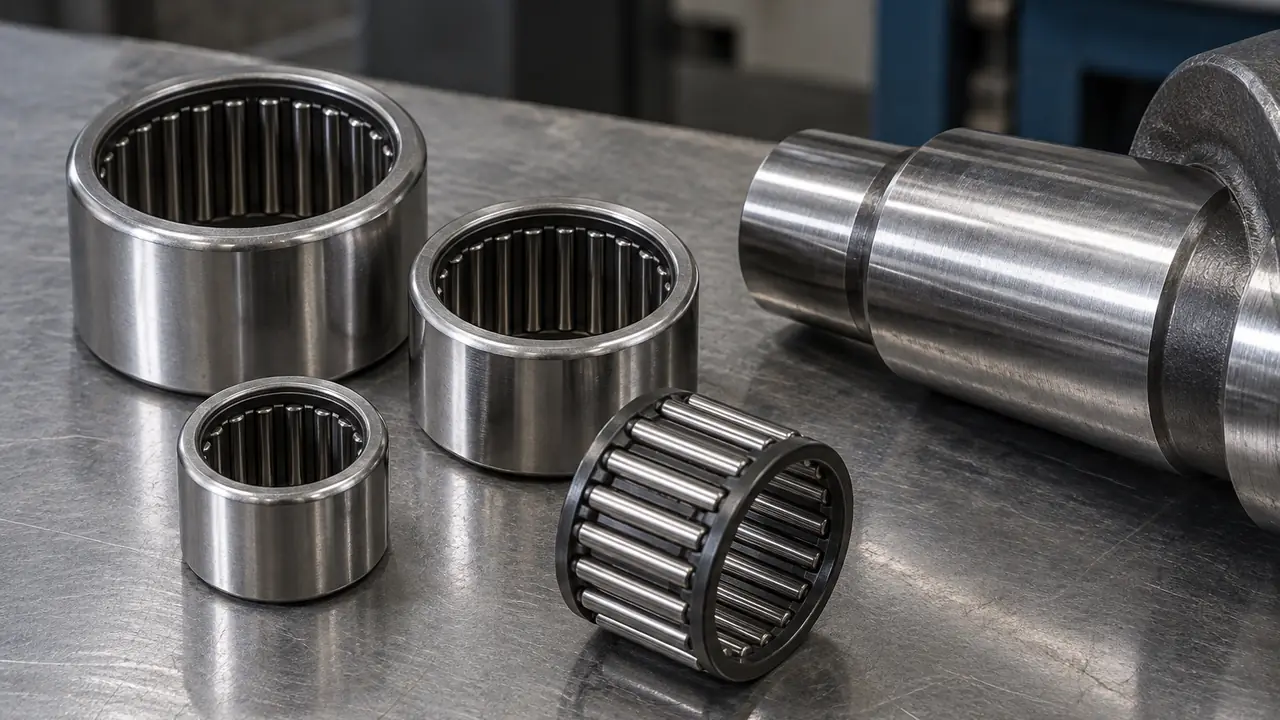
A needle roller bearing is a roller bearing whose rollers are long and thin, with a length several times the diameter. Because the rollers are so slim, the bearing has a very small radial section, often little more than the roller diameter plus a thin outer ring. For the same envelope it carries more radial load than a ball bearing and fits where a standard cylindrical roller bearing would need a larger housing. Typical applications are gearboxes, universal joints, pump drives, rocker arms, compressors, power tools and motorcycle transmissions.
The price of compactness is sensitivity. Needles need accurate, stiff housings and shafts, and tolerate little misalignment. Needle bearings are for radial load and oscillating movement; they carry no axial load themselves, so axial location comes from other parts such as thrust washers or a separate thrust bearing.
Types and designations
| Type | Designation | Inner ring | Typical use |
|---|---|---|---|
| Drawn cup, open ends | HK | No | Housing bores with a light press fit; gearboxes, tools |
| Drawn cup, closed end | BK | No | Shaft end applications; dust or oil retention |
| Solid ring, no inner ring | NK | No | Where the shaft is the inner raceway and the housing is heavy |
| Solid ring with inner ring | NA (e.g. NA49) | Yes | When the shaft cannot be hardened or ground |
| Cage assembly | K, needle cages | No | Maximum compactness; housing and shaft act as raceways |
Nominal examples: HK2012 has a 20 mm shaft diameter (Fw), 26 mm outside diameter and 12 mm width; NA4905 is 25 x 42 x 17 mm. These come from the standard dimension tables; confirm against the drawing. The HK number encodes the shaft size and width: the first two digits are the shaft diameter in mm and the last two the width in mm.
Shaft hardness and the raceway
When a needle bearing runs without an inner ring (HK, BK, NK, cage-only), the shaft itself is the inner raceway, so the shaft surface carries the rolling stress. It must be hardened and ground, typically to around 58 to 64 HRC, with a fine surface finish and tight roundness and diameter tolerance; the datasheet states the recommended values. A soft or rough shaft is the most common cause of premature failure in these bearings. Where the shaft cannot be treated, specify an inner ring (NA, or a separate inner ring series such as IR) and let the bearing carry its own raceway. See bearing steel for materials.
Housings matter as well: a drawn cup is thin and takes its shape from the housing bore, so the bore must be round and accurate, and the cup should be pressed in, not hammered. For cage-only designs both the shaft and the housing bore are raceways and both need the same hardness and finish.
Choosing between the forms
- Start from the space. If the housing bore is fixed and the radial height is tight, a drawn cup HK is the lowest-cost fit and presses straight in.
- Check the shaft. A hardened, ground shaft allows HK, BK, NK or cage-only; an untreated shaft points to NA or a separate inner ring.
- Check the housing. A thin or soft housing favours a solid ring (NK, NA) that holds its own shape; a drawn cup needs a rigid bore.
- Check the duty. Oscillating or intermittent load suits all forms; fast continuous rotation calls for a precise cage and oil lubrication.
If the load is high and space allows, compare with a cylindrical roller bearing, which tolerates misalignment and speed slightly better.
Lubrication and limits
Needle bearings are often pre-greased, with the grease held by the cup and cage. Oscillating duty and slow speed suit grease; higher speed needs oil. Because there is little free volume, relubrication access should be planned in the housing. Skewing of the needles, which happens with misalignment or high acceleration, is the failure to avoid, and a good cage that guides each needle is the main protection. Read the lubrication guide and needle vs cylindrical roller.
Sourcing and inspection
Drawn cup needle bearings are small, high-volume parts made in plants that stamp and heat-treat the cups; solid ring types need ground rings. The desk shortlists plants by type and quality system, not price alone, and checks needle size grouping, cup roundness and wall thickness, free rotation, cage condition, grease fill and rust protection for each lot. Standard designations commonly start from 100-500 pieces, with higher quantities for cage and drawn cup items made in volume; private label starts higher. Stock samples take 3-7 working days and production 25-45 days, as typical reference ranges confirmed in writing. Send your list via the quote form, and see bearing rollers for the components.